

India GDP growth seen at 6.8% in FY27; El Niño, West Asia risks weigh on outlook
India Ratings and Research expects India’s GDP growth to moderate from 7.6% in FY26, with higher food and energy inflation, currency depreciation and fiscal pressures likely to weigh on the economy.
Ind-RA cites higher than anticipated fuel and food inflation due to uncertainty in West Asia, weakening currency and impending threat of El Niño hurting agriculture for the slowdown. (AI Image)
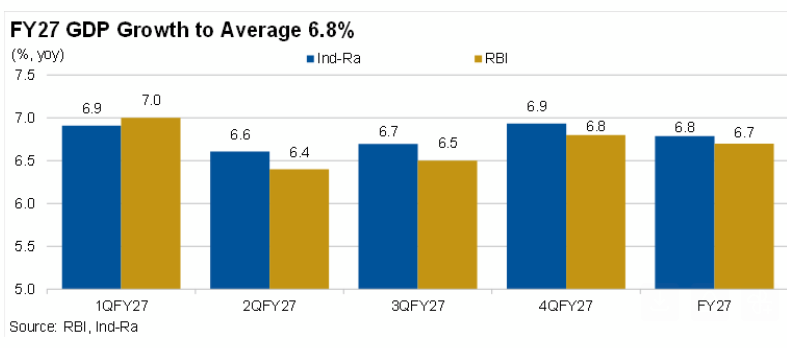
India Ratings and Research (ind-ra) expects India’s GDP growth at 6.8% yoy in FY27 (May cut: 6.7%) versus National Statistical Office’s (NSO) provisional estimate of 7.6% yoy growth in FY26. ind-ra cites higher than anticipated fuel and food inflation due to uncertainty in West Asia, weakening currency and impending threat of El Niño hurting agriculture for the slowdown.
“Crude oil price of the Indian basket averaged USD101.31/bbl in 1QFY27 and USD96.49/bbl for April-July 2026. Our crude oil price assumption for FY27 is USD85/bbl. Lower oil prices positively impact the Indian economy by reducing the trade/current account deficit (CAD). However, higher inflation due to El Niño may limit growth upside from lower oil prices. The FY27 fiscal deficit target of 4.3% remains challenging due to subsidies on liquefied petroleum gas and fertilisers. While direct tax collection and non-tax revenue may support achieving the fiscal deficit target, indirect tax collection may pose challenging,” says Dr. Devendra Pant, Chief Economist and Head – Public Finance, Ind-Ra.
Key assumptions and outcomes are:
1. Average oil price at USD85/bbl in FY27 compared to USD95/bbl in May 2026,
2. Pump prices of petrol and diesel are likely to remain same,
3. Rainfall is assumed to be 94% of long-period average during August and September 2026, translating in seasonal rainfall at 90.6% of normal rainfall,
4. India rupee-dollar exchange rate to average INR93.98 (May 2026: INR94.28), a depreciation of 6.4% yoy, in FY27, and
5. Capital flows amounting to USD70 billion under foreign currency non-resident (bank) (FCNR (B)) and external commercial borrowings (ECBs).
Ind-Ra estimates FY27 nominal GDP growth at 10.4% (FY26: 8.9%) due to higher inflation. While the real GDP growth is likely to slow down in FY27, higher inflation will translate in higher GDP deflator growth at 3.4% yoy (FY26: 1.1%).
Ind-Ra estimates quarterly GDP growth at 6.9%, 6.6%, 6.7%, and 6.9% for 1QFY27, 2QFY27, 3QFY27, and 4QFY27 as against the RBI’s forecast of 7.0%, 6.4%, 6.5%, and 6.8%, respectively.
Risks to Economic Outlook: Downside risks to GDP growth in FY27 include geopolitical developments, particularly the unresolved West Asia conflict; high headline inflation; a depreciated currency; weaker-than-expected capex, especially by the government to minimise fiscal risks; weak global trade growth; strong GDP growth in FY26 – the base effect; and notably, the likely El Niño weather pattern and the recent US government announcement of levying 100% tariff on India for buying Russian crude. Our GDP forecast of 6.8% assumes oil price settling around USD85/barrel (bbl) in FY27. A lower oil price, weaker El-Niño than the present assessment, and an improvement in capital flows could result in higher GDP growth than the present estimate.
Assuming normal rainfall and even spread over space and time in 2027, Ind-Ra expects FY28 real GDP growth to improve by 20-50bp compared to 6.9% forecasted for FY27. Other key assumptions are crude oil price stability, stable capital flows, easy liquidity conditions, domestic demand, and continued government capex.
El Niño Still a Risk to Inflation and GDP Growth: El Niño has cast its shadow over the 2026 monsoon rainfall. The cumulative rainfall till end-June 2026 was 39.8% below normal rainfall; favourable rains in July and the first week of August have reduced the shortfall. However, it is still 11.3% below normal (till 7 August 2026). The monsoon spread has been uneven. The weak monsoon is already affecting food prices and consumer food price inflation. An adverse base effect would continue to push up food inflation at least until October 2026.
Capex Mainly Led by Government: GFCF is the second-largest component of GDP from the demand side (32.3% in FY26). Government investment demand is likely to be a major GFCF growth driver in FY27 due to physical infrastructure development entailing capital investments. This will support growth of the manufacturing, cement, and steel sectors. However, given the fiscal consolidation roadmap, Ind-Ra expects GFCF growth to decline marginally to 8.0% yoy in FY27 (May 2026 forecast: 7.2%, FY26: 8.2%, FY25: 6.4%). If fiscal risks increase due to government interventions to mitigate the impact of West Asia crisis, the government may limit its capex growth.
Inflation to be within RBI’s Tolerance Zone: Ind-Ra forecasts the average Consumer Price Index (CPI) at 4.9% and Wholesale Price Index (WPI) at 8.5% for FY27 (May forecast: 5.0% for both, FY26: 2.1% and 0.7%, FY25: 4.6% and 2.3%). Key reasons for the high indices in FY27 include elevated food and energy prices due to the El Niño effect on crop production, and India’s dependence on energy imports amid the ongoing geopolitical uncertainty, respectively.
10-yr G-sec to Remain around 7%: The risk-free interest rate (10-yr G-sec) breached the 7.0% mark in end-April 2026. However, after joint efforts by the government and RBI to attract higher dollar inflows in the economy through FCNR(B) and ECBs, the yields have fallen to below 7% and traded in 6.76% – 6.83% range in the first week of August 2026. Ind-Ra expects around USD70 billion inflows through this channel, which will address the short-term issue.
Achieving Fiscal Deficit Target of 4.3% Would be Challenging: Ind-Ra expects the union government would continue to focus on fiscal consolidation. The government projects a fiscal deficit of 4.3% in FY27 (FY26: 4.4%). Achieving this may be challenging due to the expectations of higher fuel and fertiliser subsidies due to the West Asia crisis, reduced excise duty on petrol and diesel to mitigate the impact of increased energy prices to consumers, and likely monetary support to counter the El Niño’s impact. Ind-Ra expects government intervention in response to the West Asia crisis to involve credit measures, such as credit guarantees, rather than direct spending, thereby easing pressure on the current fiscal position. However, direct cash support to counter the adverse impact of El Niño cannot be fully ruled out.
Current Account to Widen: Ind-Ra expects CAD to be 1.5% of GDP in FY27 (FY26: 0.6%, FY25: 0.6%), due to expensive energy imports on account of higher energy prices and currency depreciation. Increased commodity prices are likely to elevate CAD, exerting downward pressure on the Indian rupee. Ind-Ra expects the external balance (current account + net FDI) to more than double to negative 1.2% of GDP in FY27 (FY26: negative 0.5%, FY25: negative 0.6%).





3 thoughts on “India GDP growth seen at 6.8% in FY27; El Niño, West Asia risks weigh on outlook”