

India, Southeast Asia remain growth-focused office markets: Colliers Survey
Office-centric models remain dominant across Asia-Pacific, while AI, access to skilled talent and demand for better-quality workspaces shape corporate real estate strategies.

Cost efficiency, talent availability and density remain the defining factors in workplace and location decisions across Asia Pacific. (Image: Freepik)
Office-based work remains the preferred model for companies across Asia-Pacific, with little appetite for a change in the near term. According to Colliers’ 2027 Asia Pacific Workplace Insights report, 82% of the organisations surveyed follow an office-centric model. Another 80% do not expect to make any significant changes to their workplace policies over the next year.
For companies, the office is still about getting work done and improving business performance. But there is another consideration gaining ground: giving employees more opportunities to work together, share ideas and learn from one another.
AI is adding to this shift. As the technology changes the way people work, companies are also rethinking what they want from their offices. Simply providing desks is no longer enough. Workplaces are increasingly expected to support collaboration, encourage new ideas and help employees build skills.
These are among the key findings of the report, which draws on inputs from more than 300 office occupiers across 11 Asia-Pacific markets. It looks at how companies are responding to changing business needs, the growing use of AI, cost pressures and the challenge of attracting and retaining talent.
India and Southeast Asia look to expand
India and Southeast Asia are emerging as important markets for companies looking to grow their operations. Despite geopolitical uncertainties, 34% of occupiers in the two markets are pursuing expansion, the report finds.
The choice of office location continues to come down to two practical considerations: the cost of running operations and the availability of skilled workers. Companies need to keep expenses in check, but they also want to be in places where they can find the people they need.
India is attracting particular interest from large corporations. Rather than focusing only on cutting costs, companies are showing a greater willingness to move into better-quality offices or change the way their existing spaces are used.
The shift suggests that businesses are looking at offices differently. The focus is not just on how much space they occupy or what it costs, but also on whether that space helps employees perform better and makes the company a more attractive place to work.
“India remains a high-growth office market in the APAC region, underpinned by a resilient economy and sustained occupier expansion. Beyond strong demand prospects, occupiers increasingly view the office as a strategic enabler of business performance, talent attraction and collaboration. This shift is reflected in the APAC survey, where 21% of occupiers in India and Southeast Asia prioritise upgrading to higher-quality office spaces with the same proportion focused on reconfiguring their offices. These trends underscore a growing emphasis on value creation, with businesses investing in workplaces that support evolving workstyles and long-term growth. This flight to quality is expected to play an increasingly important role in occupier decisions across the region,” said Arpit Mehrotra, Managing Director, Office Services, Colliers India.
AI to reshape workplace needs, with demand shifting towards new space formats
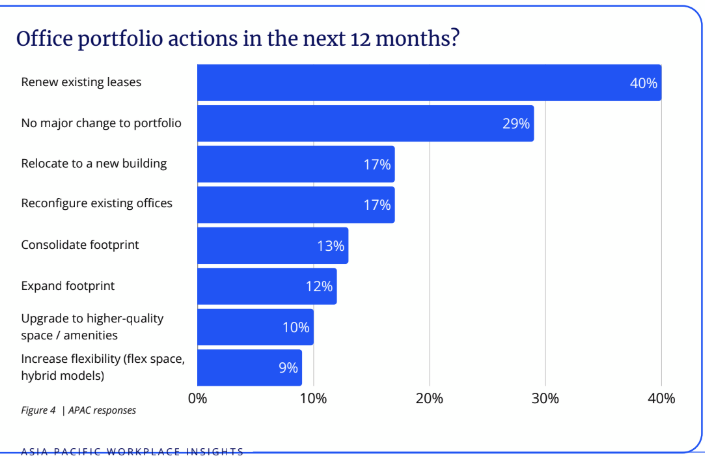
Artificial intelligence is emerging as a major force behind workplace decisions. Every respondent surveyed expects AI to create new specialized roles requiring different skills, capabilities and collaboration models. Occupiers also expect AI to have its greatest impact on productivity & output, followed by skills & job roles and workforce structures.
Importantly, the research challenges the assumption that AI will lead to widespread office contraction. Nearly half of respondents (47%) expect AI to drive demand for different workplace formats & space types, with more collaborative, tech-enabled environments.
Portfolio strategy: Workplace optimization takes priority over office consolidation
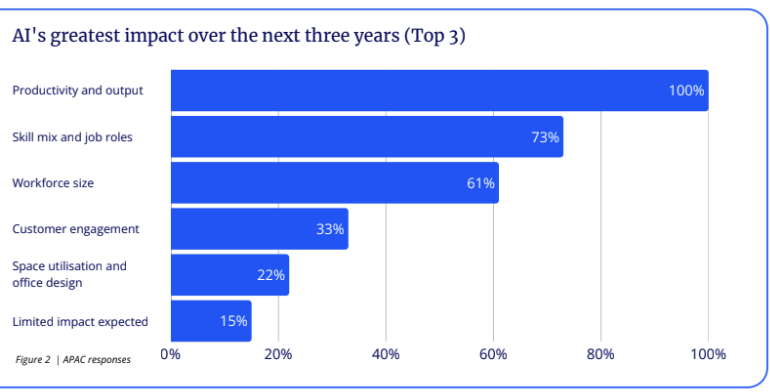
The report also reveals that occupiers across the APAC region are prioritizing value creation over footprint reduction despite ongoing cost pressures. Three-quarters of respondents (75%) cited occupancy costs as a major factor influencing workplace decisions. However, rather than reducing space, 40% plan to renew existing leases while 29% intend to maintain their current footprint.
The findings suggest occupiers are increasingly focused on extracting greater value from existing workplaces and directing investment towards initiatives that support talent, productivity and business growth.
“The workplace conversation has evolved significantly over the past few years. For most organizations, the question is no longer whether employees should be in the office, but how the workplace contributes to productivity, collaboration, innovation and business performance. Our survey shows that occupiers are becoming increasingly focused on outcomes. The organizations creating the most value are those aligning workplace, technology and talent strategies around measurable business objectives.”, said Mike Davis, Managing Director, Occupier Services, Asia Pacific at Colliers.
Growth & location: Talent gravity, cost efficiency to drive location decisions
Cost efficiency, talent availability and density remain the defining factors in workplace and location decisions across Asia Pacific. The survey shows organizations continue to prioritize operational cost efficiency and access to talent, outweighing geopolitical considerations. While geopolitical factors remain part of the operating environment, the region’s long-term growth fundamentals continue to drive occupier decision-making.