
Inflation broadens as food, energy prices rise; September CPI seen at 5%: Ind-Ra
Rising food and crude oil prices, along with broad-based manufacturing and services inflation, could push retail inflation above the RBI’s 4.7% forecast for 2QFY27, says India Ratings and Research.
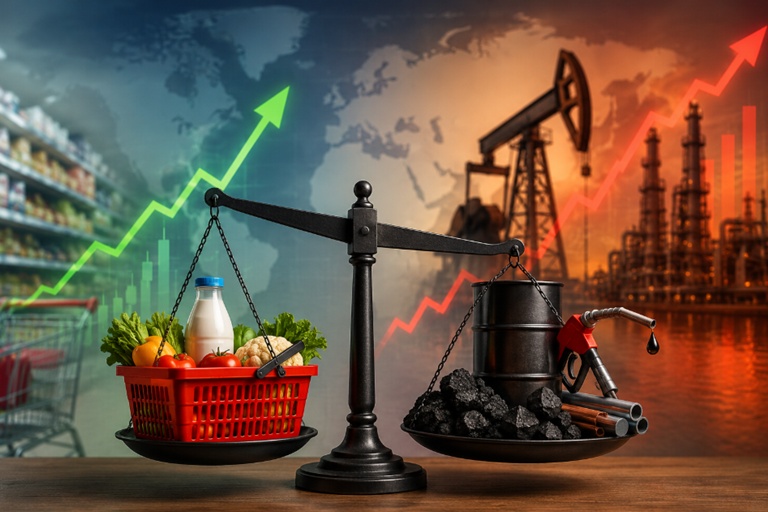
The average inflation in 2QFY27 is likely to be marginally higher than the RBI’s assessment of 4.7% for 2QFY27. (AI Image)
India Ratings and Research (Ind-Ra) opines that deceleration in inflation has been temporary, and concerns remain, as reflected in August 2026 print.
“The wholesale price index (WPI) recorded the second-highest print in August 2026 in the new series, as the prolonged West Asia crisis reversed two months’ declining trend of fuel and power inflation, and it is likely to remain elevated until the crisis is resolved. Separately, seven manufacturing sectors – tobacco products, textiles product, chemical products, rubber & plastic products, base metals, electrical equipment – and other manufacturing recorded double-digit inflation and pushed manufactured products inflation to an all-time high (in the new series). On the other hand, the consumer price index (CPI) recorded a broad-based increase. In September 2026, the WPI is likely to breach 10%, while CPI inflation is expected to jump to a 21-month high of 5.0% due to high energy and food prices,” says Dr Devendra Kumar Pant, Chief Economist and Head, Public Finance, Ind-Ra.
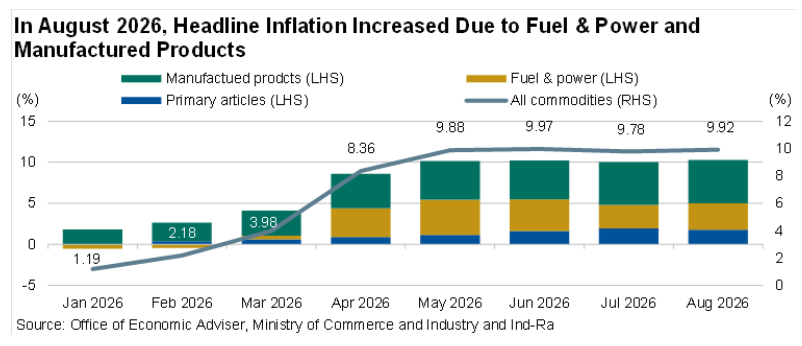
Wholesale Inflation: The headline WPI inflation, after easing marginally in July 2026, grew 9.92% in August 2026 (Ind-Ra forecast: 9.5%; July: 9.78%, June 2026: 9.97%) due to an increase in fuel and power (August 2026: 22.93%, July 2026: 20.05%) and manufactured products (August 2026: 8.37%, July 2026: 8.29%).
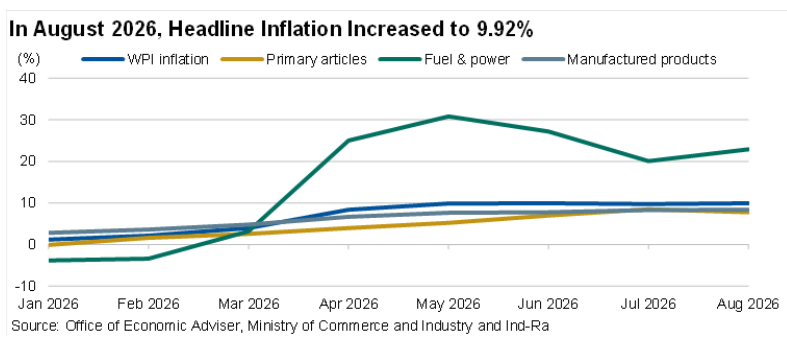
Primary articles inflation cooled marginally to 7.76% in August 2026 (July 2026: 8.52%). Despite deflation in electricity prices, a renewed spurt in crude petroleum prices in August, due to the West Asia crisis, has pushed up fuel and power inflation. Crude petroleum prices, and hence, fuel and power inflation are likely to remain elevated until a permanent solution to West Asia crisis is achieved.
Manufactured products inflation in August 2026 increased for 10 out of 22 sub-groups (July 2026: 13 out of 22). Inflation of seven sub-groups in manufacturing – tobacco products, textiles products, chemical products, rubber & plastic products, base metals, electrical equipment and other manufacturing – accounting for 26.30% weight in WPI (total manufacturing sector weight: 63.13%) remained in double-digits in August 2026. This suggests WPI inflation is turning structural.
Food inflation, comprising primary and manufactured food items, increased to 7.02% (July 2026: 6.65%, June 2026: 6.20%; May 2026: 4.58%). The elevated prices of petroleum products and other commodities have impacted core inflation; while it declined to 8.14% in August 2026 (July 2026: 8.18%), it has remained in excess of 7% since April 2026. At present, the impact of El-Nino has been visible only on fruit and vegetable inflation, and it has not had any significant impact on cereals, pulses and edible oil. However, edible oil inflation has been high since April 2026, earlier than the onset of monsoon.
While supply chain disruption had minimal impact on India’s 1QFY27 GDP growth, it has significantly impacted inflation. With the West Asia crisis remaining unresolved (similar to Russia-Ukraine), global uncertainty is likely to remain elevated in the near term. This, along with deficient rain and weaker currency, would continue to push inflation higher in the near term. Ind-Ra expects wholesale inflation to increase to 10.2% in September 2026 and it is likely to remain elevated in the rest of 2026, unless a permanent solution to the West Asia crisis is achieved.
The WPI inflation was 0.4% in FY26 and it was negative 0.2% during April-August 2025. The adverse base effect along with higher petroleum product prices pushed up wholesale inflation during April-August 2026 to 9.56%.
Output Produce Price Index (OPPI) Inflation: OPPI inflation increased 9.81% yoy in August 2026 (July 2026: 9.57%; June 2026: 9.67%). The upward trajectory was due to inflation in mining and quarrying and manufactured products.
Retail Inflation: As expected by Ind-Ra, consumer price index (CPI) inflation or retail inflation grew 4.82% yoy in August 2026 (Ind-Ra forecast: 4.6%; July 2026: 4.45%; June 2026: 4.38%; May 2026: 3.93%), thereby maintaining its upward trajectory and remaining above the Reserve Bank of India’s (RBI) benchmark inflation rate of 4%.
The key takeaways from August 2026 retail inflation are as follows: i) food inflation has risen since January 2026, mainly due to base effect, and El-Nino has aggravated the situation further; ii) the incomplete pass-through of high crude oil and product prices insulated consumers from the impact of high crude prices; iii) higher inflation for food (5.95%), pan & tobacco (7.34%), operation of personal transport equipment (7.40%), food and beverage serving services (8.41%), transport services for goods (14.64%) and other personal effects (44.56%) translated into higher headline CPI inflation in August 2026; and iv) barring pan, tobacco and intoxicants and health, yoy inflation for other commodity groups in August 2026 was higher than that in July 2026, suggesting generalisation of inflation, although at a slower pace than envisaged earlier. Inflation for discretionary spendings such as restaurants and accommodation services and personal care (August 2026: 8.4%, July 2026: 7.7%) and social protection and miscellaneous (15.2%, 14.8%) has continued to rise. The rising inflation for discretionary spending points towards strong demand for these services, and is reflected in an increase in core inflation to a nine-month high of 4.3% in August 2026.
Fuel impact was evident on user groups – transport prices increased 4.6% (July: 4.44%; June 2026: 4.31%; May 2026: 1.75%), while restaurant & accommodation services grew 8.38% (July: 7.72%; June 2026: 6.91%; May 2026: 5.75%) underlining the impact of the ongoing West Asia conflict on commercial liquified petroleum gas.
Food inflation grew to a 19-month high of 5.95% (July 2026: 5.52%; June 2026: 5.32%; May 2026: 4.78%) despite improved rainfall. Items of mass consumption such as ginger, garlic and onions recorded high double-digit growth.
The average inflation in 2QFY27 is likely to be marginally higher than the RBI’s assessment of 4.7% for 2QFY27 (as per August 2026 monetary policy); the trend of a sequential increase in quarterly inflation will continue until 3QFY27. Crude oil prices, which had been hovering between USD80-85/bbl before the August 2026 monetary policy, have breached the USD100/bbl mark since 9 September 2026 and pose the main risk to inflation. The inflows under FCNR(B) have surpassed expectations and the RBI has been applying all instruments available to it, including variable rate reverse repo and open market operations, to reduce liquidity in the system. At present, the RBI is in a strange situation of liquidity surplus and increasing inflation (broadly in line with their assessment as per August 2026 monetary policy).
Ind-Ra expects the RBI to hold rates in its October 2026 policy. The liquidity condition in the banking system will be a leading indicator of the RBI’s forthcoming monetary policy action.