

Bank profitability may moderate in FY27 despite strong credit growth: Ind-Ra
Ind-Ra expects bank credit growth to rise to 15% in FY27, while higher funding costs, muted margins and rising credit costs could weigh on profitability.

With banks grappling with margin pressure, led by compressed spreads, higher reliance on certificates of deposits and bulk deposits, the overall loan growth is likely to normalise in 2HFY27. (AI Image)
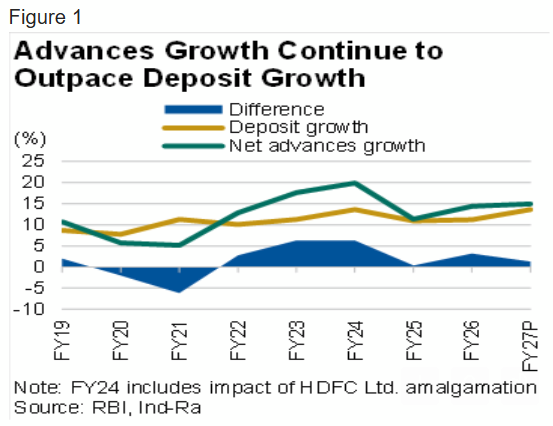
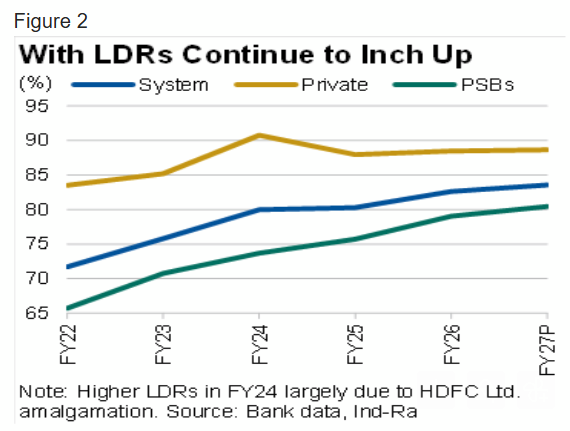
India Ratings and Research (Ind-Ra) has maintained a neutral outlook on the overall banking sector for the rest of FY27. Deposit growth has consistently lagged credit growth by an average of about 380bp since FY22, pushing loan deposit ratio (LDR) to 84.8% in 1QFY27 from 71.7% in FY22. While the elevated LDR has remained a structural concern over the past two years, the Reserve Bank of India’s (RBI) measures on foreign currency non-resident – bank (FCNR(B)) deposits are expected to attract additional deposits, which will result in LDRs moderating, but on a temporary basis. Factoring in FCNR(B) deposits, Ind-Ra now expects deposit growth of nearly 13.6% yoy in FY27 versus 11.4% previously (FY26: 11.2% yoy).
“We have revised our yoy FY27 credit and deposit growth to 15% and 13.6%, respectively, for the rest of FY27 to account for the traction in advances growth to corporates and non-banking finance companies, as well as FCNR(B) inflows on the deposit side. High LDR in the banking system, at about 85%, along with moderated profitability, resulting muted net interest margins, and an expected yoy increase in credit costs, are near-term concerns”, says Karan Gupta, Head and Director Financial Institutions, Ind-Ra.
Credit growth continues to be buoyant, with fortnightly data as of 31 July 2026 showing credit growth of 19.3% yoy versus deposit growth of 15.4% yoy. Ind-Ra now expects advances growth of 15% yoy for FY27, up from 13% previously (FY26: 14.4% yoy). This growth is largely driven by the cash reserve ratio reduction benefit being passed on for lending to large corporates for working capital needs and tighter bond yields in the market, making bank borrowings attractive for non-banking finance companies. However, the growth mix is increasingly return on assets (ROA) dilutive, driven by a sharp increase in lower-yielding large corporate loans. Growth in higher-margin unsecured retail credit growth slowed significantly to 12.3% in June 2026 from 25% in January 2024, due to overleveraging concerns and rising delinquencies.
With banks grappling with margin pressure, led by compressed spreads, higher reliance on certificates of deposits and bulk deposits, the overall loan growth is likely to normalise in 2HFY27. Margins could gradually recover from 2HFY27, supported by an improved asset mix and lower funding costs driven by healthy FCNR(B) inflows. Ind-Ra now expects an increase in credit cost to 74bp for the system in FY27 from 65bp in FY26 (Pvt Banks: FY27: 95bp; FY26: 88bp; PSBs: 60bps; 49bp).
This will largely be driven by transitioning to Expected Credit Loss norms, which is likely to weigh on the banking sector through a one-time balance sheet transition and higher steady-state credit costs driven by increased Stage 1 and Stage 2 provisioning requirements. Consequently, the system-wide ROA is projected to decline 6bp yoy to 1.31% in FY27, with PSBs likely facing a greater impact than Pvt Banks due to lower provisioning buffers. However, some of the pressure may be offset by capital release from the revised risk weight asset requirements.





2 thoughts on “Bank profitability may moderate in FY27 despite strong credit growth: Ind-Ra”