

UPI MDR: What the new 0.4% charge means for merchants, tax deductions and TDS
UPI MDR will be deducted from merchants’ settlements, while experts say the charge should generally be deductible as a business expense; clarity on TDS treatment is still awaited.

UPI payments up to ₹2,000 to merchants will remain free, as will person-to-person transfers. (Image: Freepik)
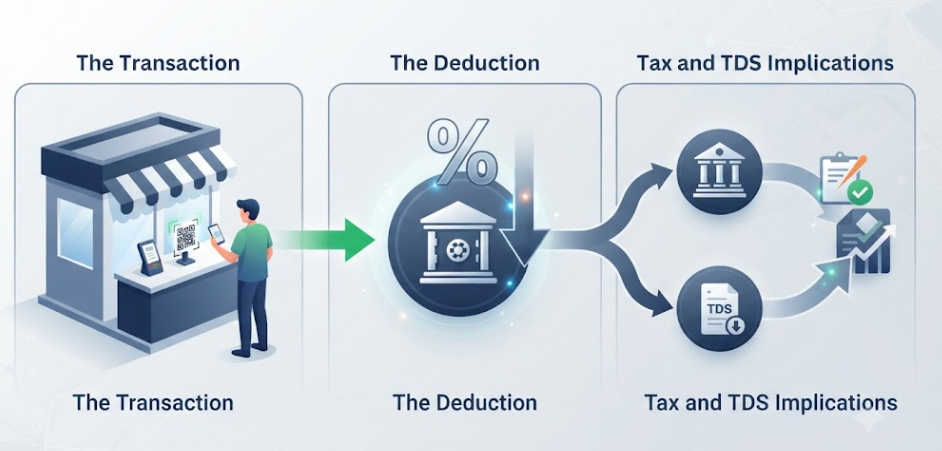
From October 15, merchants accepting higher-value UPI payments will have to factor in a new cost, with a 0.4% Merchant Discount Rate (MDR) applicable on eligible person-to-merchant (P2M) transactions above ₹2,000. The charge will be capped at ₹300 for transactions of ₹75,000 or more. Consumers will not be charged directly for making these UPI payments.
For businesses, however, the change raises a less visible question: how should the new MDR be treated for income-tax purposes, and will merchants have to deduct TDS on the amount?
According to Deepesh Chheda, Partner, Dhruva Advisors, the MDR should generally be treated as a business expense rather than a tax or duty.
“MDR is simply a fee that a merchant pays for the service of accepting digital payments. It works much like the fees businesses already pay for accepting card payments or using online payment gateways,” Chheda said.
Since the charge is paid to the bank or other payment service provider for processing the transaction, rather than to the government as a tax, it should ordinarily qualify as a deductible business expense, he said.
The distinction is important because merchants will effectively receive a lower amount in their bank account after the MDR is deducted. For instance, on an eligible ₹10,000 transaction, the 0.4% MDR would amount to ₹40, before any applicable GST on the service fee.
What about TDS?
The more complicated issue is whether merchants need to deduct tax at source on the MDR.
Chheda said there has been a similar debate in the past over card-processing and payment-gateway charges. Tax authorities had, in some cases, taken the view that such payments could fall under commission or brokerage provisions and therefore attract TDS.
However, courts have rejected this interpretation in the context of card transactions, pointing out that the relationship between a merchant and a bank processing a card transaction is not the same as that between a principal and an agent.
The tax department subsequently issued clarifications in 2012 and 2016 stating that TDS would not apply to card transaction charges paid by merchants to acquiring banks, Chheda said.
A specific clarification on UPI MDR is still awaited. Therefore, while the same principle would reasonably be expected to apply to UPI transactions, some uncertainty remains until the tax authorities provide a clear position.
“Going by that track record, UPI MDR should also be treated as a deductible business expense for merchants,” Chheda said.
There is also a GST angle. Tax experts have said the MDR service fee will attract 18% GST, although eligible GST-registered merchants can claim input tax credit, subject to the applicable conditions.
UPI remains free for consumers
The new MDR does not mean that consumers will start paying a fee every time they scan a UPI QR code.
UPI payments up to ₹2,000 to merchants will remain free, as will person-to-person transfers. Small merchants covered under the P2PM category will also remain outside the MDR framework.
For eligible P2M transactions above ₹2,000, the 0.4% MDR will be deducted from the merchant-side settlement rather than separately collected from the customer.
The new framework also provides different rates for some categories. For example, certain utility, fuel, insurance and telecom payments above ₹2,000 will attract a flat ₹5 MDR, while capital-market transactions will have a separate 0.02% rate, subject to the prescribed cap.
Industry sees MDR as a way to fund UPI’s next phase
Payment companies have broadly welcomed the introduction of MDR, arguing that the UPI ecosystem has costs that need to be funded as transaction volumes continue to grow.
Reeju Datta, co-founder, Cashfree, said the 0.4% rate for eligible transactions above ₹2,000, capped at ₹300, remains below typical card charges and leaves more than 95% of P2M transaction volume unaffected.
He said the return of MDR would give the ecosystem a way to fund the costs of operating UPI and invest in areas such as fraud prevention and payment infrastructure, particularly in smaller towns. He also expects the new model to encourage newer players to enter the market and develop additional use cases.
Anirban Mukherjee, CEO, PayU, said the next phase of UPI’s growth would require a more financially sustainable ecosystem capable of continuing to invest in reliability, security, technology and innovation.
“The return of MDR is an important step in creating that sustainable foundation and enabling UPI to scale further,” he said.
The change comes as UPI continues to handle very large transaction volumes. In August 2026 alone, UPI processed 24.51 billion transactions worth ₹29.82 trillion.
For merchants, therefore, the immediate takeaway is fairly straightforward: the new MDR is a payment-processing cost, not a tax collected by the government. It should ordinarily be treated as a business expense, but the TDS position on UPI MDR would benefit from an explicit tax clarification.