

IBC recoveries yet to show meaningful improvement despite expectations of faster resolutions: Ind-Ra
Ind-Ra expects claim-level recoveries to remain broadly stable in the near term. (AI Image)
Expectations that the Insolvency and Bankruptcy Code (IBC) would lead to faster resolutions and better recoveries for creditors are yet to show up clearly in the data, according to India Ratings and Research (Ind-Ra).
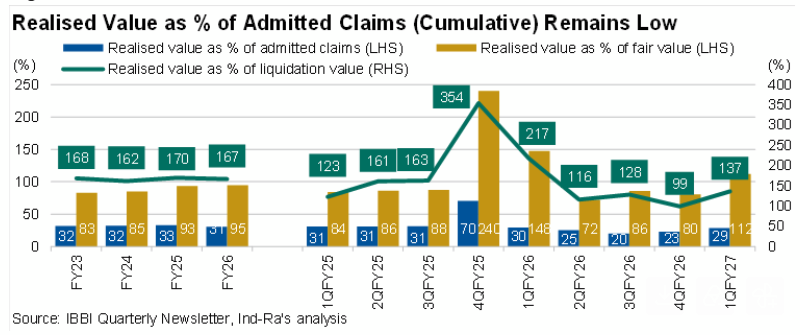
While resolution activity under the IBC remains steady, recoveries are broadly in line with historical levels and cases continue to take a long time to close. Companies that received resolution plans in the first quarter of FY27 took an average of 931 days to reach approval, excluding periods excluded by the adjudicating authority. Creditors recovered 28.6% of their admitted claims in these cases.
Ind-Ra said the time taken to recover money remains a key concern, particularly for stressed-asset portfolios. A delayed resolution can push back cash flows and, in some cases, reduce the value of the underlying assets. This makes the timing of recovery especially important for security receipts (SRs) backed by non-performing assets where insolvency is the primary recovery route.
Recoveries likely to remain range-bound
Ind-Ra expects claim-level recoveries to remain broadly stable in the near term.
During 1QFY27, 69 corporate insolvency resolution processes (CIRPs) resulted in resolution plans. These cases involved admitted claims of ₹12,443 crore, of which creditors realised ₹3,557 crore. This translated into a recovery of 28.6% of admitted claims. The amount recovered was equivalent to 136.7% of liquidation value and 112% of fair value.
Since the IBC came into effect, creditors have realised ₹4.35 trillion through 1,484 approved resolution plans, recovering 30.5% of admitted claims.
Although these numbers underline the advantage of resolution over liquidation in preserving value, the overall recovery rate has remained broadly consistent with the experience seen since the introduction of the IBC. Ind-Ra said this provides limited evidence so far of a structural improvement in creditor recoveries.
Creditors increasingly favour resolution over liquidation
There are, however, signs that creditors are becoming more willing to pursue resolution rather than liquidation.
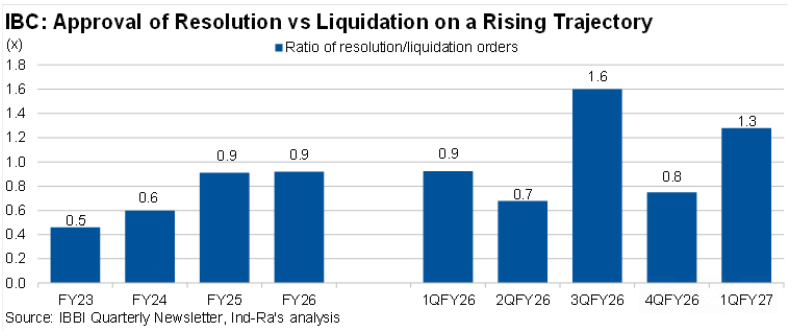
The ratio of resolutions to liquidations rose to 1.3 times in 1QFY27, compared with 0.9 times in FY26. The sharp increase could partly be a one-off, but the broader trend has been moving upwards.
According to Ind-Ra, if this ratio remains above one for a sustained period, it could indicate that creditors are becoming more confident in restructuring and resolution as a way of preserving value.
Delays remain the biggest concern
The bigger worry, however, is the amount of time cases continue to spend in the insolvency process.
Resolution plans approved in 1QFY27 took an average of 931 days, significantly higher than the 619-day average for cases approved during FY26. Companies that entered liquidation during the quarter had spent an average of 897 days in the process.
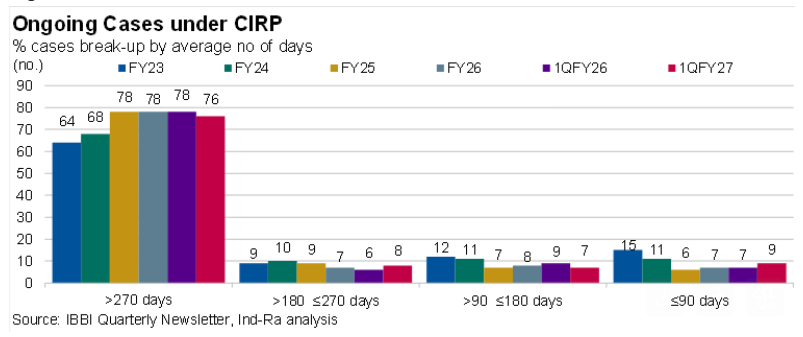
The ageing of cases is also a concern. Around 76% of ongoing CIRPs had already crossed the 270-day threshold as of June 2026.
Ind-Ra said the build-up of ageing cases points to execution bottlenecks across the insolvency ecosystem. For creditors, a prolonged resolution process can affect not just how much money is eventually recovered but also when that money comes back. This is particularly important where the value of a business depends on its continuing operations or the preservation of its assets.
Approval of a resolution plan is not the end of the recovery process
Another issue is that approval of a resolution plan does not necessarily mean that creditors immediately receive the money due to them.
Ind-Ra said its experience across several SR transactions shows that plan approval can be only an important milestone in the recovery process. Actual cash recovery can take longer because of implementation requirements, pending applications, litigation and other procedural issues.
As a result, the date on which a resolution plan is approved and the date on which creditors actually realise their money can be quite different. For investors in insolvency-linked SRs, execution risk therefore remains an important factor to monitor.
Legacy cases continue to weigh on recoveries
The large stock of older distressed assets is another reason why overall recovery numbers remain under pressure.
Around 42% of the CIRPs that resulted in resolution plans had previously been with the Board for Financial and Industrial Reconstruction (BIFR) and/or were defunct before entering the CIRP process.
Recovery from these cases was significantly lower. Creditors realised just 17.52% of admitted claims, compared with 33.30% for companies that were operational when insolvency proceedings began.
The gap highlights how strongly the quality and viability of the underlying business influence recovery outcomes. Going-concern businesses continue to deliver better recoveries than defunct or asset-light companies. As a result, the resolution of legacy distressed assets could continue to keep aggregate recovery rates under pressure.
Faster recoveries still need to show up in the data
Recent legislative and regulatory changes have strengthened the insolvency framework and could help preserve value over the medium term. But, according to Ind-Ra, the available data does not yet show a meaningful improvement either in recovery timelines or in the amount recovered by creditors.
In other words, expectations of faster recoveries are currently running ahead of what the data is showing.
The key test will be whether newer insolvency cases can be resolved faster and whether approved resolution plans translate into actual cash recoveries more quickly.
For investors in security receipts, Ind-Ra believes this improvement in the timing of recovery could ultimately matter more for returns than a marginal increase in the headline recovery percentage.