

Indian securitisation market set to stay resilient as asset mix widens
A wider asset mix, rising gold loan securitisation and stronger transaction safeguards are expected to support the Indian market, even as unsecured business loan delinquencies remain a concern.
Ind-Ra expects the securitisation market to remain on a stable footing in 2HFY27. (AI Image)
India’s securitisation market is likely to maintain its growth momentum in the second half of FY27, supported by a wider mix of underlying assets, continued investor interest and stronger structural safeguards, according to India Ratings and Research (Ind-Ra).
The market, which has traditionally been dominated by vehicle loan securitisations, is becoming more diversified. Gold loans, personal loans and other retail assets are increasingly contributing to issuance volumes, reducing the sector’s dependence on vehicle loans.
Transaction structures are also evolving. Features such as prepayment protection, quarterly payouts, replenishment structures, tighter trigger mechanisms and short-tenor rated pass-through certificates (PTCs) are being used more widely. These measures are aimed at providing greater protection to investors while making securitised instruments more attractive as an institutional investment option.
The Reserve Bank of India’s proposal to introduce a minimum investment threshold of Rs 1 crore for securitisation investments and secondary transfers could further strengthen the market. The move is expected to bring greater institutional participation and improve investor protection.
Gold loans emerge as a key growth driver
Gold loans have become an important growth segment for securitisation. The combination of strong portfolio growth, high gold prices, relatively resilient asset quality and the growing preference among non-banking finance companies (NBFCs) for secured lending has helped drive issuance.
Gold loan-backed transactions have accounted for a meaningful share of recently rated PTC issuances, and Ind-Ra expects the segment to remain an important contributor to market growth.
Another area that could gain momentum is the Trade Receivables Discounting System (TReDS). As regulatory measures improve access to receivables financing for micro, small and medium enterprises (MSMEs), invoice financing volumes are increasing. This could eventually create more opportunities for receivables-backed securitisation and broaden the asset base available to investors.
Most asset classes remain stable
Performance across most securitised asset classes remained stable between April and June 2026.
Vehicle loan securitisations, in particular, continued to hold up well. Healthy freight activity, stable borrower cash flows, government spending on infrastructure, steady e-way bill generation and a relatively stable interest rate environment have supported the segment.
Adequate credit enhancement and stronger transaction structures have also helped protect investors. However, fuel price volatility and any slowdown in freight movement remain key risks for vehicle loan pools.
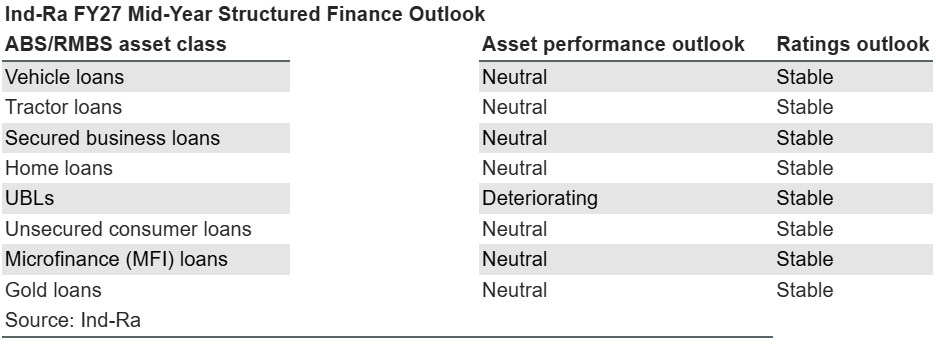
The picture is less comfortable for unsecured business loans (UBLs). Ind-Ra has retained a deteriorating asset performance outlook for the segment. While delinquencies have fallen from their peak in December 2025, they remain high compared with other asset classes.
In contrast, microfinance and unsecured consumer loan pools have shown signs of improvement. Tighter underwriting, better collection efficiency and more disciplined portfolio growth have helped improve performance in these segments.
Digital lending brings both opportunity and risk
Ind-Ra expects digital origination and cash-flow-based underwriting to play a bigger role in the UBL market. The growing availability of alternative data could allow lenders to assess borrowers more closely and improve risk selection.
Embedded finance is also gaining ground, particularly products that link repayments to daily cash flows. These models could support further growth in unsecured and digital lending.
At the same time, risks remain. High borrower leverage, multiple lending relationships and vulnerabilities around digital onboarding and KYC could affect portfolio performance and will need to be closely monitored.
“India’s structured finance market continues to demonstrate resilience, supported by stable asset performance, prudent underwriting practices, and strong structural safeguards. We are seeing encouraging trends across most asset classes, alongside increasing market diversification and investor participation. While UBLs and rural sector developments remain key areas to monitor, the overall sector outlook remains stable, backed by healthy fundamentals and sustained growth opportunities,” said Jatin Nanaware, Senior Director, Structured Finance Ratings, Ind-Ra.
UBL delinquencies remain a concern
Ind-Ra has retained a Stable rating outlook for its rated structured finance transactions for 2HFY27, supported by stable pool performance, adequate credit enhancement and stronger transaction safeguards. The financial strength and servicing capabilities of originators and servicers will remain important factors for ratings.
Average delinquencies across most asset classes were broadly stable during April-June 2026. UBL pools continued to record the highest levels, although microfinance transactions showed a noticeable improvement. Vehicle loans, home loans and other secured asset classes also continued to perform relatively well.
Collection efficiency remained broadly consistent across asset classes, pointing to stable repayment behaviour and supporting transaction cash flows.
For seasoned UBL-backed transactions, delinquencies rose to around 6% in December 2025 before easing to about 5% in recent months. Despite the improvement, the levels remain elevated.
Borrower leverage, the ability of MSMEs to withstand cash-flow pressures, fuel prices and rural demand will therefore remain key monitorables for the segment.
Overall, Ind-Ra expects the securitisation market to remain on a stable footing in 2HFY27, with diversification into new asset classes and stronger transaction structures helping the market navigate pockets of stress and broader global uncertainty.





4 thoughts on “Indian securitisation market set to stay resilient as asset mix widens”