
Bank gold loans set for further growth, backed by conservative lending
Gold loans are growing much faster than overall bank credit, with rising gold prices, conservative LTVs and strong collateral buffers supporting the segment despite risks in income-generating loans.

During FY26, gold loans across banks grew nearly 45% year-on-year, around 2.7 times the banking system’s overall credit growth of 16.7%.
gold loans are emerging as one of the fastest-growing segments of bank credit, and India Ratings and Research (Ind-Ra) expects this trend to continue in the medium term. High gold prices, greater borrowing capacity among households and banks’ growing preference for secured lending are likely to keep gold loans ahead of overall bank credit growth.
During FY26, gold loans across banks grew nearly 45% year-on-year, around 2.7 times the banking system’s overall credit growth of 16.7%. Gold loans now account for 6.9% of total bank credit.
However, the sharp increase in loan value does not necessarily mean that banks are taking on proportionately higher risks. A significant part of the growth has been driven by the sharp rise in gold prices, with gold recording a two-year compound annual growth rate of around 50%.
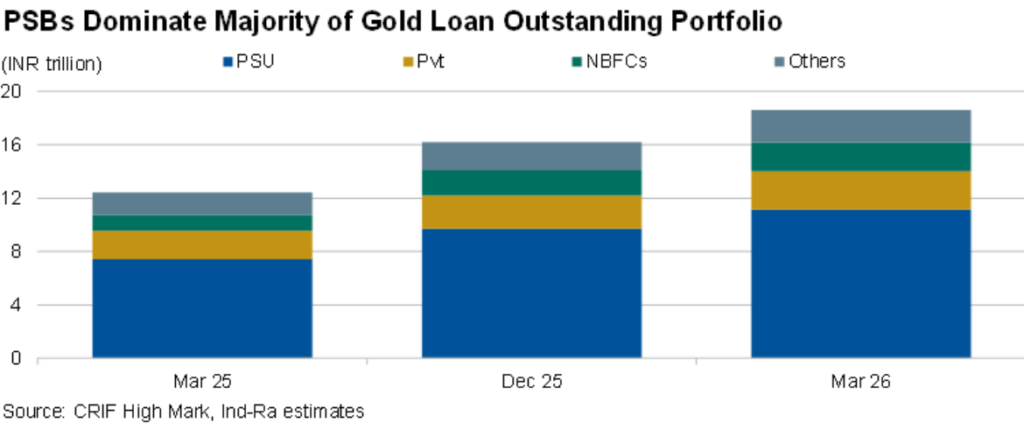
As of March 2026, India’s gold loan market was estimated at ₹18.6 trillion. Banks accounted for around 75% of the market, well ahead of NBFCs at about 12%. NBFCs have nevertheless increased their market share by around 210 basis points in recent years, largely by gaining customers from informal moneylenders.
“Banks continue to expand their gold loan portfolios, albeit with conservative underwriting and a strong focus on containing LTVs. During FY26, gold loans across banks grew nearly 45% yoy, about 2.7x the overall FY26 banking system credit growth rate of 16.7%, now accounting for 6.9% of the total banking credit. However, one should be watchful of income generating loans (IGLs) where LTVs could be treading in a cautionary zone,” says Karan Gupta, Head – Financial Institutions, Ind-Ra.
Agriculture Loans Still Drive the Market
Agriculture will continue to be the mainstay of banks’ gold loan portfolios, although retail borrowing is steadily gaining ground.
Agricultural gold loans accounted for roughly two-thirds of banks’ gold loan portfolios in FY26, down from about 85% in FY24. These loans are typically used as scale-based financing and often come with bullet repayment structures. For farmers, pledging gold can provide relatively quick access to credit based on estimated cultivation costs, without depending entirely on land as collateral.
Retail gold loans, meanwhile, have expanded rapidly and now account for roughly one-third of banks’ gold loan exposure, compared with around 15% in FY24.
The rise in gold prices has played an important role in this shift. Borrowers can now raise significantly more money against the same quantity of gold. Faster processing and relatively lower documentation requirements compared with personal loans are also making gold loans more attractive to customers.
Conservative Lending Gives Banks an Edge
One of the key differences between banks and NBFCs is the approach to underwriting and collateral management.
For consumption-oriented gold loans, regulatory LTV caps range from 75% to 85%, depending on the size of the loan. Agricultural gold loans and income-generating loans, on the other hand, are assessed based on the underlying economic activity rather than a single regulatory LTV threshold.
Large public sector banks, however, have generally maintained a more cautious approach, with many internally capping LTVs at around 80% even for these categories.
This becomes particularly important in the case of income-generating loans, where the quality of underwriting and monitoring can make a significant difference. Banks typically verify land ownership, establish the borrower’s farmer status and monitor the end use of funds.
Some NBFCs have adopted more aggressive strategies in this segment, including higher LTVs and less stringent end-use monitoring. This could leave such portfolios more exposed to credit and collateral risks if gold prices become volatile.
Banks’ caution is also visible in their average LTV ratios. Despite strong growth in gold lending, the average LTV fell to 55.4% in FY26 from 62.4% in FY25. Ind-Ra attributes the decline largely to greater gold price volatility and the more conservative lending practices followed by public sector banks.
Co-Lending Could Give the Market Another Push
The recent alignment of regulatory norms for gold loans could also encourage greater co-lending between banks and NBFCs.
With differences in LTV regulations between lender categories narrowing, the earlier scope for regulatory arbitrage has reduced. Ind-Ra expects co-lending arrangements to gain traction, particularly in the income-generating loan segment.
The model allows banks and NBFCs to combine their respective strengths. Banks can bring lower-cost funding and stronger credit controls, while NBFCs can contribute sourcing, distribution and local customer reach.
For banks, this could provide another route to expand their gold loan books without compromising credit quality, provided their underwriting and monitoring standards are maintained.
However, rapid expansion also brings its own challenges. Banks are opening dedicated gold-loan branches and adding gold lending capabilities to existing branches, creating a growing need for trained employees who can properly assess borrowers and manage pledged gold.
Under co-lending arrangements, NBFC partners are generally expected to follow the bank’s credit policies, underwriting standards and portfolio monitoring systems. This can help contain risks. Standalone NBFC portfolios, particularly those built through aggressive sourcing, may remain more vulnerable.
Asset Quality Remains Comfortable
Despite the rapid expansion of gold loans, Ind-Ra does not see an immediate deterioration in credit quality. Portfolio-at-risk levels across banks remain comfortable, indicating that borrowers have so far been able to service these loans relatively well.
Gold loans also have an important advantage over unsecured personal loans: the presence of collateral. In the event of a default, the lender can sell the pledged gold, which generally results in lower loss severity and better recovery prospects.
That does not mean the segment is risk-free. A sharp correction in gold prices, aggressive lending or weak borrower assessment could put pressure on portfolios, particularly where LTVs are high.
For now, however, banks’ relatively conservative approach provides a meaningful cushion. Lower LTVs, strong collateral coverage, tighter borrower assessment and comfortable asset-quality indicators should help banks manage the risks associated with rapid gold loan growth.
Ind-Ra’s outlook, therefore, remains favourable for bank gold loans in the medium term, with growth likely to remain strong as long as lenders maintain the credit discipline that has supported the segment so far.