
Surety Bonds gain ground in EPC sector, but new credit risks emerge

Ind-Ra does not view ISBs as a standalone credit risk or a negative rating factor. (AI Image)
India Ratings and Research (ind-ra) believes the growing adoption of insurance surety bonds (ISBs) represents a positive structural development for the engineering, procurement, and construction (EPC) sector by improving financial flexibility and reducing dependence on traditional bank guarantee (BG) limits. However, from a credit perspective, the key consideration is not the instrument itself, but the additional contractual capacity it can create. As ISB penetration increases, contractual obligations, order books, and execution commitments may grow faster than liquidity, operating cash flows and financial resources. Therefore, the credit impact of surety bonds will depend on whether incremental capacity is matched by adequate execution capability, working capital support, and financial discipline.
“As surety bonds become more widely accepted, EPC companies are likely to increasingly use them as a growth strategy, alongside traditional bank limits and internal liquidity. Over time, this could make order book quality, bidding & execution discipline, and cash-flow generation increasingly important determinants of credit profile,” said Vijay Babu Konda, Associate Director, Corporate Ratings, ind-ra.
Since their introduction in FY23, ISBs have gained meaningful traction and now constitute a notable share of the construction sector’s overall non-fund exposure. The instrument has helped reduce reliance on BG, lower cash collateral requirements, and release liquidity otherwise tied up in margin deposits.
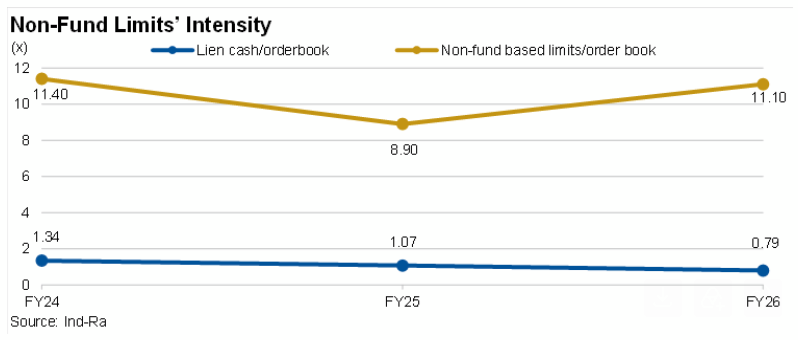
“Consistent with this trend, Ind-Ra’s analysis indicates a gradual decline in both lien-marked cash intensity and non-fund-based limit intensity relative to order books across rated EPC entities over FY24-FY26. While this improvement cannot be attributed solely to surety bond adoption, it suggests that contractors are increasingly able to support larger business volumes with lower levels of encumbered liquidity,” said Konda.
Notwithstanding these benefits, ISBs do not alter the underlying execution, performance or completion obligations of contractors. Consequently, reduced BG utilisation should not be interpreted as lowered contingent risk. The primary credit concern is whether the increased contractual capacity afforded by ISBs is commensurate with the borrower’s ability to execute, working capital position, liquidity profile and risk absorption. Specifically, continuing growth in the order book without a corresponding increase in execution capability and ability to generate cash could lead to greater execution risk and liquidity constraints in the future.
An additional consideration is information asymmetry. Reporting with respect to surety bonds is still in its infancy, with many issuers offering little transparency past total contingent liabilities. Therefore, analysis traditionally centered on funded debt and BGs alone may not paint a complete picture of a contractor’s total committed exposure. Recognising this evolving landscape, Ind-Ra has started separately capturing outstanding ISB exposures as part of its credit assessment framework to ensure a more comprehensive evaluation of contingent obligations.
Ind-Ra does not view ISBs as a standalone credit risk or a negative rating factor. Rather, the focus will remain on how prudently companies utilise the additional capacity that surety bonds provide. Companies demonstrating disciplined order book growth, strong execution capabilities, healthy operating cash flows, adequate liquidity, and transparent disclosures are likely to derive meaningful benefits from the instrument.
On the other hand, aggressive growth, deterioration in cash conversion, increasing working capital intensity or lack of transparency around contingent liabilities may all require closer credit analysis. Overall contractual exposure, not just traditional bank-driven exposures, will be something to watch as EPC contractors become more commonplace.