

Retail inflation rises above 4% in June as food costs gather pace
Retail inflation rose to 4.4% in June 2026, driven by higher food and transport costs, while Bank of Baroda warned that El Niño, deficient monsoon rains and sticky core inflation could keep price pressures elevated through FY27.
The major upward momentum in CPI was visible in food inflation and transport component. (AI Image)
CPI inflation reading came in at 4.4% in June 2026 compared to 3.9% in May’26, on YoY basis, and a tad above the estimated 4.3%. The major upward momentum in CPI was visible in food inflation and transport component. Consumer food price index rose by 5.3% in Jun’26, around 50 bps higher compared to May’26. The fine print of food shows that Tomato inflation is significantly elevated at 31.9% in Jun’26. In this context it is to be noted that the arrival statistics of TOP (Tomato, Onion and Potato) have risen by 7.1% sequentially, higher pace compared to last month’s sequential increase of 5.6%. Thus, supply dynamics have been favourable even in adverse weather conditions, according to a Bank of Baroda report.
“Other components of food inflation, which is sticky, are edible oil, cereals, milk, other dairy products & eggs, fruits and nuts and ready-made food. However, going forward, we see food inflation risks are tilted to the upside primarily from weather related shocks. As per WMO 3 Jul 2026 update “El Niño conditions have developed in the tropical Pacific and are forecast to strengthen rapidly over the coming months, increasing the likelihood of heatwaves, droughts, heavy rainfall and other extreme weather events in many parts of the world,” says Dipanwita Mazumdar, Economist, Bank of Baroda.
This was against the earlier update of WMO of an 80% likelihood of El Niño event during June–August 2026 and a 90% probability till Nov’26.
Globally food prices remained comfortable. The FAO food price index edged down. However, cereal prices and edible oils remained sticky. Within cereals, rice index has risen due to buoyant demand.
Edible oil especially palm oil is subject to pressure amidst expectations of tighter export availability from Indonesia as highlighted in FAO report. Hence in the wake of a sticky international price, domestic edible oil prices is also posed to upside risks. Further, 40% of the States is already in deficient rainfall. To add to this, Gujarat, AP and Karnataka are still in deficit which are major TOP (Tomato, Onion and Potato) producing States of India. Hence a close monitoring of spatial distribution of monsoon is required going forward to assess the impact on inflation. On a cumulative basis, rainfall is in deficit of -18% below LPA.
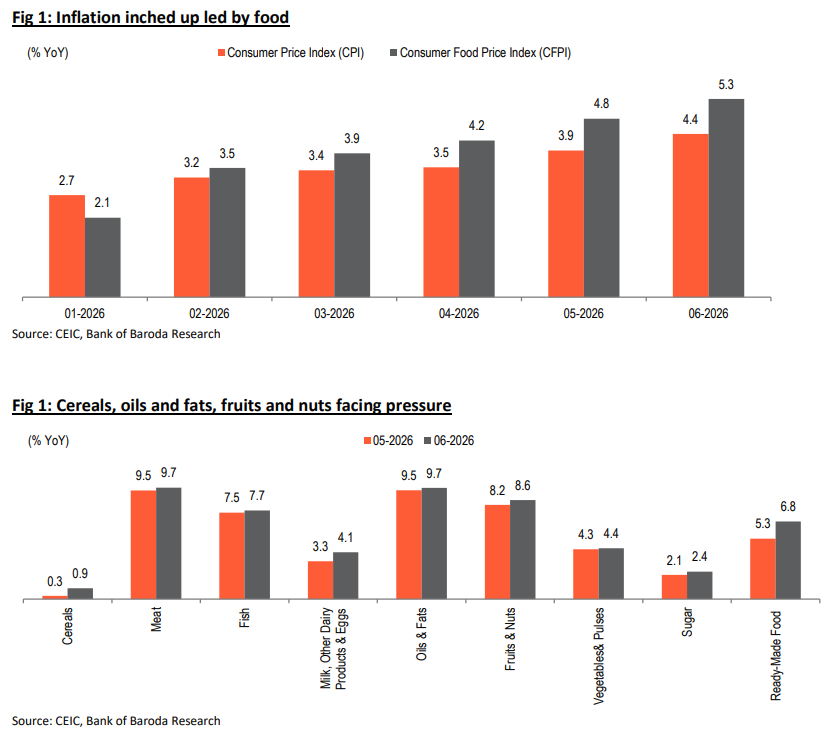
Core inflation was at 3.9%:
Core excluding pan, tobacco, gold, silver and precious metals inched up a tad at 2.2% in Jun’26.
Within core, the main driver has been the transportation component. It has increased by 4.3% in Jun’26 compared to 1.8% in May’26. Other than this, Restaurant and accommodation services are continuing to firm up this month as well (4th consecutive month of increase) showing the gradual pass through of hike in price of commercial cylinder. This component rose by 6.9% in Jun’26 compared to 5.7% in May’26. Personal care and effects were also elevated at 16.7%, albeit showing softening compared to previous month’s reading of 18.5%. This is on account of moderation in gold (-7.8%, MoM, in Jun’26: Source: World Bank) and silver prices (-14.5%). Demand driven component of core such as household equipment & routine maintenance also picked up to 2.2% from 1.9% in May’26.
Thus, underlying demand conditions are picking up. Other component of core such as education also increased to 3.3% in Jun’26 from 3% in May’26. Only health and recreation showed some moderation.
“The outlook on core remains sticky as companies are likely to pass on higher input costs if demand conditions remain satisfactory. The trajectory of international oil prices remains crucial as again tensions flared up between US and Iran. We expect core to trade in the 4.7-4.9% range in FY27,” says Mazumdar.
Housing, Water, Electricity, Gas & Other Fuels rose to 2% in Jun’26 from 1.7% in May’26, driven by sequential increase of Domestic LPG (Non-Subsidised RSP) in Jun’26.
Way Forward: Headline CPI has crossed the 4% mark. Hence RBI will be watchful whether future print will be within the 4+/-2% mark. The upside risk is broadly coming from food inflation. This year particularly remains crucial as EL Niño conditions have already formed. Cumulative rainfall is -18% below LPA and 40% of the States (% area) is still in deficient rainfall. Overall Kharif acreage, as of 10th Jul 2026 has been lower by 16% compared with last year. With this, the total sown area has covered 48.1% of the normal area compared to 57% of same period previous year. What is comforting is that till now the arrivals of major vegetables (Tomato, Onion and Potato) have been satisfactory. But the question is how long? Hence the food inflation trajectory this year is crucial.
FAO report has specified that risks for global food inflation is also skewed to the upside as “climate extremes increasingly colliding with conflict and economic stress”. For India, the report has specifically pointed out that “El Niño can weaken the summer monsoon across much of India, putting rainfed crops such as rice and maize under stress during the critical growing season”.
Core is also facing upside risk especially from transportation component. Hence the trajectory of international oil price remains crucial. Further since demand conditions are broadly stable, we can expect further upside risk on core as firms might pass on higher input costs to consumers under such conditions.
“Our estimate for CPI is to settle between 5.0-5.2% in FY27 with core in the range of 4.7%-4.9%,” says Mazumdar.