
Homebuyer affordability holds steady in 6 of 8 cities in H1 2026 despite rising property prices: Knight Frank India
Lower home loan rates and stable financing conditions helped keep homebuyer affordability supportive across six of India’s eight major residential markets in H1 2026, with Ahmedabad emerging as the most affordable city.

Affordability declined slightly in Bengaluru (35%) and NCR (65%) year-on-year but remained broadly stable in rest of the cities. (AI Image)
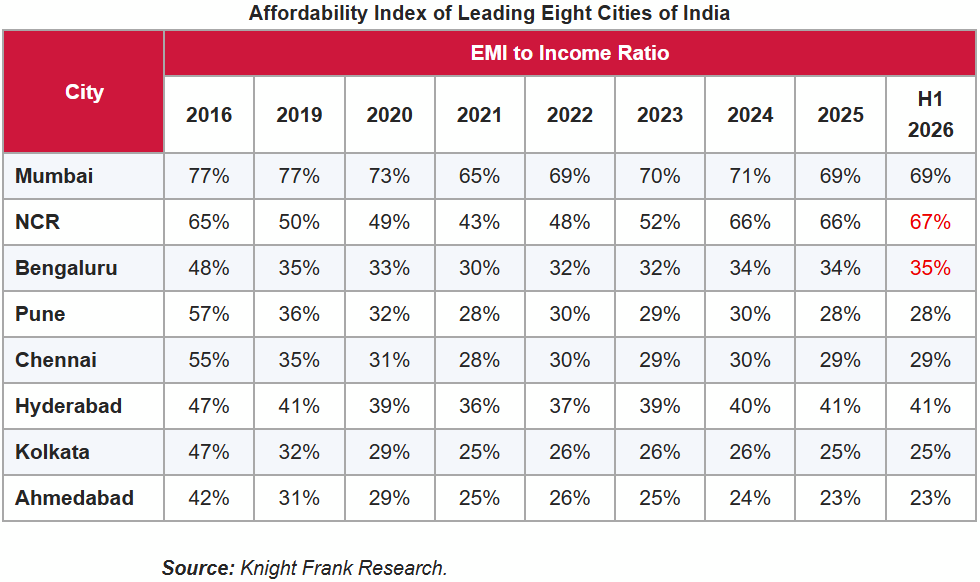
Homebuyer affordability remained broadly supportive across India’s residential markets during H1 2026, aided by the cumulative impact of 125 basis points of monetary easing, according to knight frank india’s proprietary report, affordability Index. The report said six of the eight tracked cities remained within the affordability threshold, while Mumbai Metropolitan Region (MMR) and the National Capital Region (NCR) continue to remain above the threshold of 50%. Ahmedabad once again emerged as the most affordable housing market among the top eight cities, with a ratio of 23%, followed by Kolkata at 25% and Pune at 28%.
Affordability declined slightly in Bengaluru (35%) and NCR (65%) year-on-year but remained broadly stable in rest of the cities. Six cities out of eight monitored continue to remain under the 50% affordability mark – direct cumulative impact of lower borrowing cost that will continue to drive housing demand in H2 2026.
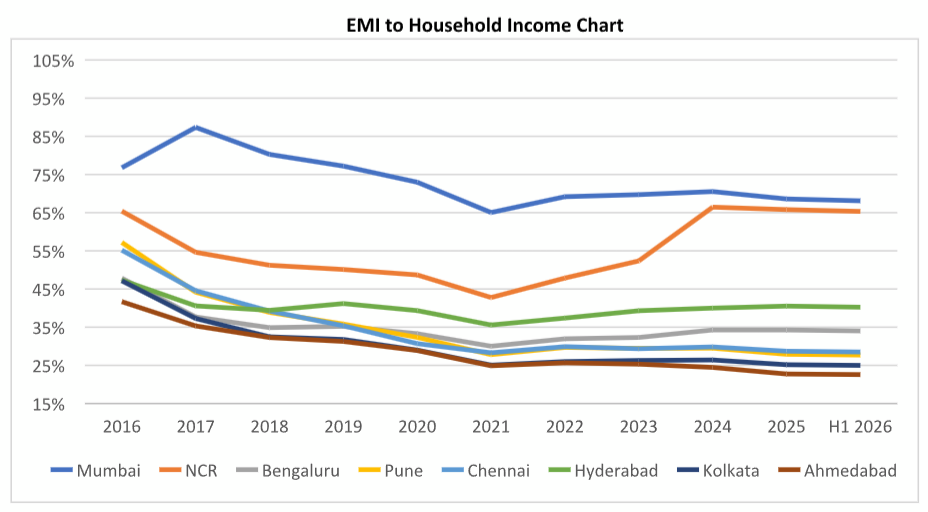
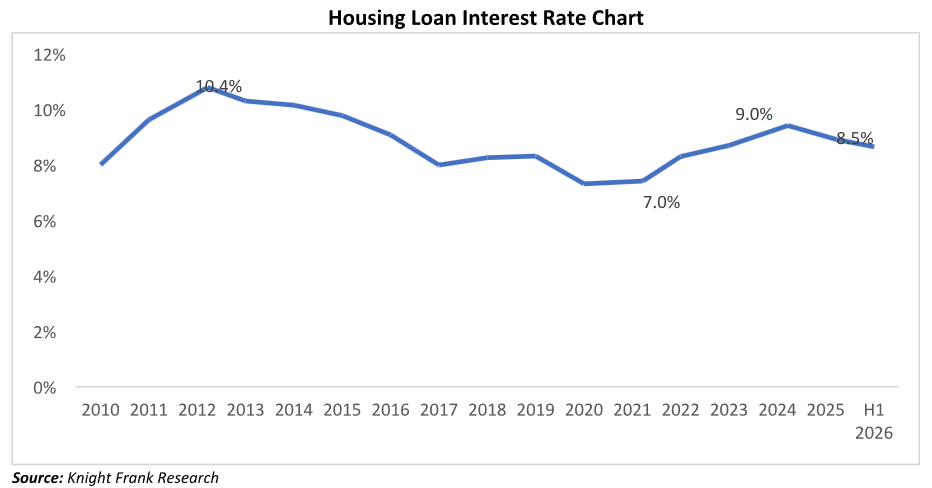
The knight frank india Affordability Index maps out the portion of income that goes into EMIs. The Index revealed that affordability improved consistently across the eight cities between 2016 and 2021. It improved further during COVID-19 as RBI reduced the policy repo rate to historic lows. Owing to high inflation, RBI raised the repo rate by 250 basis points over nine months starting May ’22, making affordability decline in 2022.
Rate stability from early 2023 onward also supported affordability levels from falling further, but rising prices kept them at elevated levels through most of the year, especially in the NCR. Going forward, affordability could receive a further boost from the RBI if they decide to cut rates again later this year. In the meantime, the RBI has delivered 125 basis points of cumulative easing since the start of the easing cycle ahead of the current pause, supporting home loan affordability and allowing residential sales to remain close to post pandemic highs seen in 2024. RBI MPC held the policy repo rate at 5.25% at its June as well as February 2026 meetings, both times citing concerns around conflict related energy prices and uncertainty around monsoon this year. With FY 2027 GDP growth revised to 6.6% and the CPI forecast raised to 5.1%, near-term rate stability appears the most likely scenario. The accumulated benefit of easing nevertheless continues to provide meaningful affordability support to homebuyers across most tracked markets.
Shishir Baijal, International Partner, Chairman and Managing Director, knight frank india, said, “housing affordability remains a key driver of residential demand. The cumulative benefit of lower interest rates continues to support homebuyers across most markets, helping sales remain close to post-pandemic highs. Over the year, affordability gains have moderated mostly due to the rise in property prices. However, healthy employment, stable incomes and supportive financing conditions continue to underpin demand. Going forward, sustained income growth and balanced market fundamentals will be critical to maintaining housing affordability and supporting long-term market growth.”
Assumptions:
EMI, housing unit size and price/sq ft represent city-level averages.
EMI:
Loan Tenure – 20 years
Loan to Value – 80%
Home loan interest rate – Average home loan rates
Area of housing unit: House size is fixed for each city across the years but varies within different cities taking into account the average size preference for each city.
Housing Price: Weighted average price based on unsold inventory for that city.
India’s residential market continues to benefit from stable employment, urbanisation and supportive financing conditions. These structural drivers remain intact despite heightened global uncertainty.
Geopolitical events and inflation may impact sentiment in the short-term but the boost from monetary easing and strong fundamentals will likely keep housing demand buoyant in most major cities.





3 thoughts on “Homebuyer affordability holds steady in 6 of 8 cities in H1 2026 despite rising property prices: Knight Frank India”