

India’s housing market turns premium as affordable segment loses ground: CareEdge
Developers are increasingly favouring premium and luxury homes as rising costs, affordability pressures and stronger affluent demand reshape India’s housing market.
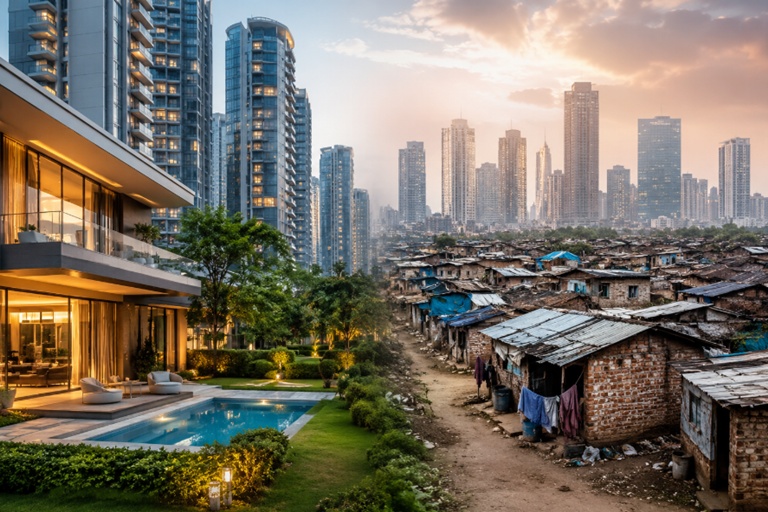
India’s new housing supply has shifted sharply towards premium homes in recent years. (AI Image)
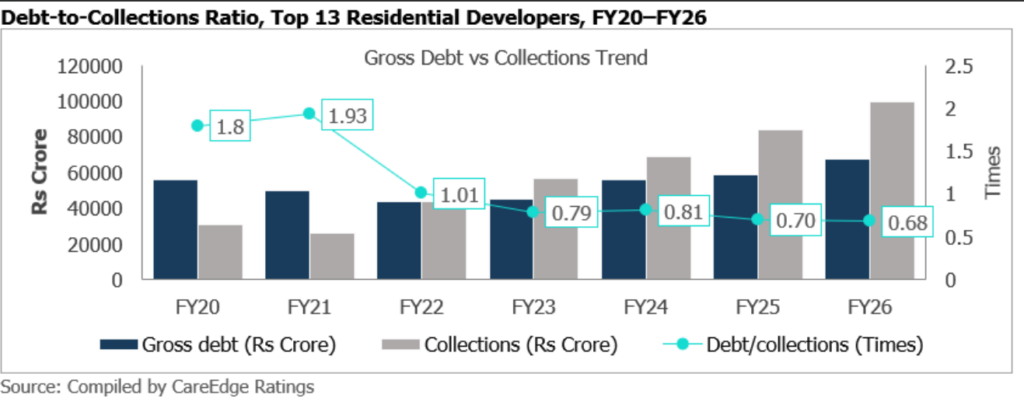
According to careedge ratings, Indian residential developers are better positioned to navigate ongoing geopolitical uncertainty, as healthy collections, fundraising-led deleveraging, and greater financial discipline have strengthened their balance sheets. The debt-to-collections ratio has declined sharply from 1.80 times in FY20 to 0.68 times in FY26, reflecting sustained deleveraging across leading market players. While debt levels remained broadly range-bound during this period, healthy collections from sizeable launches rose to over Rs 90,000 crore, with bookings exceeding Rs 1.5 lakh crore in FY26.
This balance-sheet resilience provides developers with a meaningful cushion against potential crisis-led pressures, including higher construction and energy costs, interest-rate volatility, tighter liquidity and near-term demand uncertainty. As a result, financially stronger developers are better placed to maintain project execution and navigate a prolonged period of external volatility. However, small and medium-sized developers are likely to face greater pressure due to weaker balance sheets, smaller project portfolios and limited financial flexibility to manage potential disruptions in demand, material supplies, energy-price volatility and rising input costs.
Shift to Premiumisation
careedge ratings notes that India’s new housing supply has shifted sharply towards premium homes in recent years. In Q1 2022, homes priced below Rs 1.5 crore accounted for 85% of new launches across the top 7 cities; by Q1 2025 this had fallen to 57%, and by Q1 2026 it stood at just 47%. Over the same period, the Rs 1.5–4 crore segment grew from a 14% share to 34% and then 44%, while homes priced above Rs 4 crore rose from just 1% to 9% of new launches.
Rajashree Murkute, Senior Director, careedge ratings, said, “This shift reflects developers’ increasing focus on mid-premium and luxury housing, driven by customer preferences and rising land acquisition, construction and compliance costs that have impacted the viability of affordable housing projects. At the same time, sustained demand from affluent domestic buyers and NRIs, coupled with a preference for larger homes with premium amenities, has encouraged developers to allocate a greater share of new supply toward the luxury/ultra-luxury segments.”
India’s residential segment has seen a structural shift in demand towards the premium and luxury end of the market, with a growing disconnect with affordable housing. Total residential housing sales across top seven cities dropped by a low-single-digit in Q1 2026 versus Q1 2025. However, trends varied across segments. Premium and luxury categories continued to see steady demand from the high-net-worth population, which is less impacted by inflation. Affordable and mid-income segments saw demand come under pressure due to inflation, high property prices and affordability concerns.
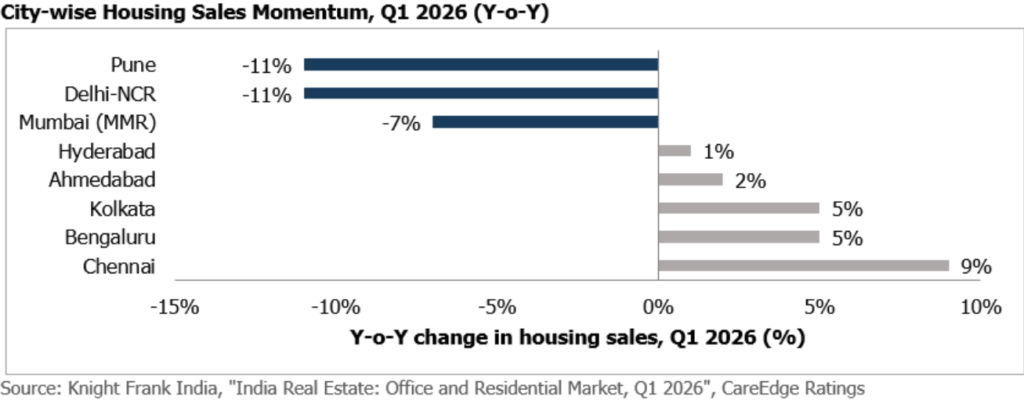
“In Q1 2026, housing sales trends across the top 8 cities were divergent. While sales fell by 11% and 7% respectively in Pune and Delhi-NCR, and by 7% in MMR, they increased by 9% in Chennai, 5% in Bengaluru and 1% in Hyderabad,” says careedge ratings.
The decline in the former is attributed to affordability challenges after several years of price appreciation, as well as a normalisation following a strong multi-year upcycle and cautious buyer sentiment due to geopolitical and financial-market volatility. Meanwhile, southern markets continue to remain resilient on account of steady end-user demand, housing needs due to employment-linked migration and new project launches. Kolkata and Ahmedabad too saw sales increase by a modest 5% and 2%, supported by affordable prices and stable demand in the cities.
This points to a widening gap between cities, with expensive markets in the west and north cooling off and growth persisting in more affordable, end-user driven markets in the south.





9 thoughts on “India’s housing market turns premium as affordable segment loses ground: CareEdge”