

RBI’s dovish pause leaves the door open for a December rate hike: Bank of Baroda
RBI retains repo rate at 5.25% and keeps its neutral stance, while raising FY27 GDP growth forecast to 6.7% and lowering inflation projection to 5%.
RBI has revised GDP growth forecast for FY27 to 6.7% from 6.6% projected earlier in the Jun’26 policy. (AI Image)
The RBI MPC in its August meeting on Wednesday unanimously decided to keep its policy rates on hold. Stance of the monetary policy was also retained at neutral, as it will allow the central bank to act as per evolving global situation. Noting strong domestic fundamentals and resilience in growth (as visible in high frequency indicators) despite global external shocks, RBI has revised FY27 growth projection upward by 10 bps to 6.7%. Further, given that Q1FY27 inflation was 30 bps lower than anticipated, and that inflationary pressures are still not broad-based, the central bank has also revised its inflation projection 10 bps lower to 5% for FY27.
Revisions to both growth and inflation have been primarily in H1FY27. inflation is still expected to peak at 5.9% in Q3FY27, before easing in Q4 and Q1FY28. “However, in these three quarters, if policy rate remains unchanged at 5.25%, then we are looking at negative real interest rates. We also believe that upside risks to inflation persist as monsoon remains in deficit so far and kharif sowing is currently lower than last year. Uncertainty around global oil and other commodity prices is also prevailing. Given these factors, we continue to expect at least 1 rate hike by the central bank in FY27, most likely in Dec’26, when there is more clarity available on growth, impact of El-Nino, and geopolitical tensions in West Asia,” said Sonal Badhan, Economist, Bank of Baroda, in their RBI Monetary Policy announcement report.
MPC decision:
RBI’s monetary policy committee (MPC) voted unanimously to keep the policy repo rate on hold at 5.25%. The MPC also continued with the neutral stance, to “respond appropriately to macroeconomic developments”. Growth numbers for H1FY27 have been revised upward and inflation is now projected to be lower this year, thus signalling a more dovish than expected policy. On the liquidity front, Governor in the press conference clarified that it would peak in Q2FY27, and will then get absorbed due to needs of the economy (currency in circulation, maturity of RBI’s forwards book), and will remain balanced throughout the year.
Assessment of growth outlook:
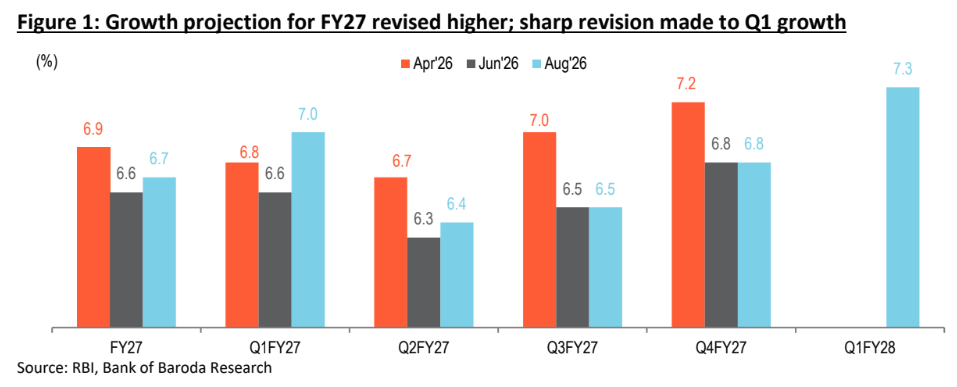
• RBI has revised GDP growth forecast for FY27 to 6.7% from 6.6% projected earlier in the Jun’26 policy. The 10bps upward revision is mainly on account of revisions to Q1 and Q2 numbers. Numbers for H2FY27 have been left unchanged so far.
• MPC members agree that “Indian economy has remained resilient amidst persisting global headwinds”. High frequency indicators for private consumption, and investment, along with robust corporate results indicate support for growth in Q1.
• Furthermore, the central bank expects momentum in services sector to be maintained with GST rates rationalised, employment will get support from urban demand, and investment activity will get a boost from government’s capital spending, strong capacity utilization, and robust credit growth.
• As a result, Q1 and Q2 GDP projections were increased to 7% (+40bps from Jun’26 policy estimates) and 6.4% (+10bps) respectively, implying a cumulative 50 bps upward revision.
• For Q3 and Q4, numbers have been left unrevised for now, indicating that the central bank awaits more clarity on West Asia crisis and full impact of El Nino.
• For the full year, growth is expected at 6.7%, 10bps higher than what was projected in Jun’26. And a sharp revival is projected in Q1FY28.
• This forecast also assumes that “turbulent global economic environment is likely to have some bearing on domestic economic activity. Energy prices and supply chain pressures remain elevated and uncertain.”.
• The statement also highlights that “even though the situation is still evolving, deficient and uneven south-west monsoon amidst El Niño conditions poses some risks to agriculture sector’s outlook and rural demand.”.
• We also expect growth range around 6.6-6.8% in FY27
Assessment of inflation outlook:
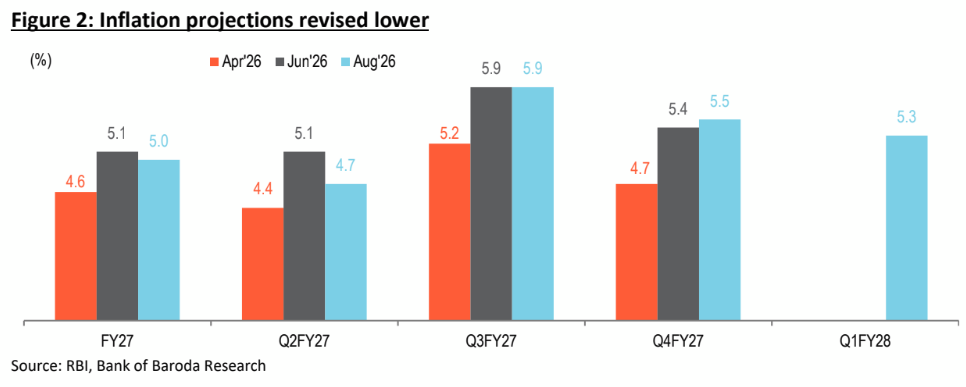
• RBI expects inflation to average lower at 5% in FY27, down by 10bps from RBI’s Jun’26 estimate and core inflation is projected at 4.3% (down by 40 bps).
• This is primarily due to lower-than-expected inflation in Q1 (3.9% versus 4.2% estimated by RBI) and possibility of Q2 inflation also coming in lower by 40 bps at 4.7%.
• Projection for Q3 has been left unchanged at 5.9% and Q4 is expected at slightly higher level of 5.5%. In Q1 next year, inflation is likely to ease to 5.3%.
• In Q1FY27, the central bank observed that “the higher inflation is mostly on account of fuel and food with little signs of generalisation of price pressures so far”.
• In Q2FY27 as well, the pressure is likely to come from food and fuel inflation. Core inflation is estimated to remain contained, implying “limited pass-through of cost pressures”.
• Inflation is expected to peak in Q3 again mainly due to food and fuel components and RBI does not expect pressures to get broad-based.
• However, it is important to note here that as per RBI’s projections, from Q3FY27 onwards, if policy rate remains at 5.25%, then real rates will become negative till Q1FY28.
• On an average, for the three quarters starting Q3FY27, inflation is expected to average 5.6%.
• This signals the need to hike rate by RBI in the near-term.
Regulatory measures:
• The Reserve Bank proposes to rationalise the regulatory framework on interest rates for all Regulated Entities (REs) on a principle-based basis. The proposed rationalisation aims to: (i) harmonise the guidelines across REs while maintaining proportionality; (ii) address certain operational aspects of the current framework on MCLR and EBLR; and (iii) standardise certain divergent market practices concerning interest charging, including day count convention and benchmark reset dates.
• It has been decided to resume licensing of UCBs on ‘on tap’ basis. The draft guidelines will be issued shortly for stakeholder consultation.
• For RCBs, Prudential norms on Concentration Risk Management are still being government by Credit Monitoring Arrangement (CMA) instructions issued in 2008. Therefore, RBI has decided to review these instructions, keeping in view the objectives of developing a vibrant co-operative sector while addressing the prudential concerns arising from concentrated lending. Draft Amendment Directions in this regard are being issued for wider stakeholder consultations.
Way forward: August 5, 2026’s statement by the RBI Governor was slightly more dovish than expected. The statement broadly justified central bank’s neutral stance with FY27 growth projection revised upward and CPI inflation estimate revised downward. The statement currently signals a pause in Oct’26 as well, unless there is any major shock to the global economy. We continue to expect at least 1 rate hike by the central bank in this financial year. We believe there are 2 reasons why the hiking cycle must begin this year: one, upside risks to inflation remain. Currently monsoon is still 12% below LPA (as of 4 Aug 2026). Area sown for Kharif crops is 2.9% lower than last year (as of 31 July 2026). Water reservoir levels (storage as % of live capacity at FRL) is currently at 44.4% versus 67.9% last year. This will have a bearing on Rabi crop sowing. Second, factoring in the inflation projections of RBI for Q3FY27, Q4FY27 and Q1FY28, if the policy rates remain at 5.25%, then this would imply negative real rates for almost 9 months, and INR will have to face to brunt of it. Noting these factors, we expect at least 1 rate hike in FY27, most likely in Dec’26, when the central bank has complete information about growth in H1FY27 and impact of monsoon.





2 thoughts on “RBI’s dovish pause leaves the door open for a December rate hike: Bank of Baroda”