

Earnings, valuations and global cues to drive Indian markets: Bajaj AMC
Bajaj AMC expects domestic demand, improving earnings and a gradual recovery in private investment to support equities, while favouring short-duration debt as global yields, inflation and the rupee remain key risks.

Near-term market volatility could remain elevated amid developments in global interest rates, inflation and geopolitical conditions. (Image: Freepik)
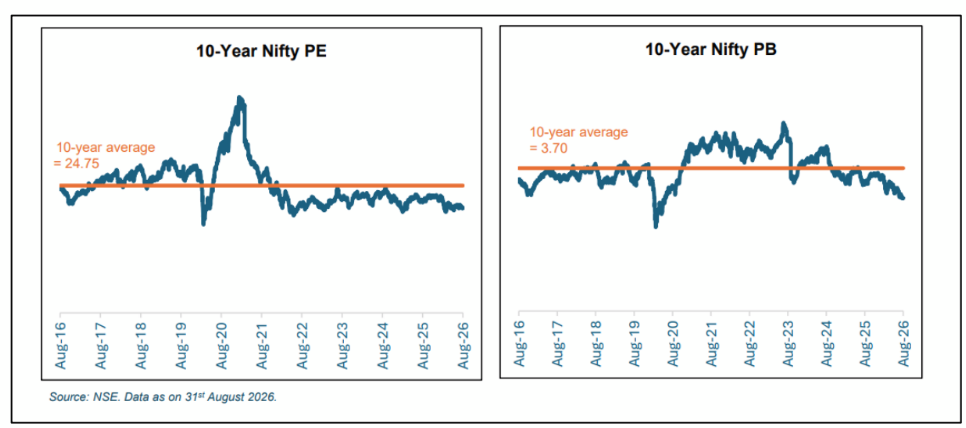
Bajaj Asset Management’s September 2026 market outlook is positive on Indian equities over the medium term. The fund house expects domestic demand to stay firm, corporate earnings to improve and private investment to pick up gradually. At the same time, it sees some parts of the market as expensive and expects global developments to remain a source of uncertainty. This, it says, makes it important to be selective while investing in equities.
In fixed income, Bajaj AMC sees opportunities in shorter-duration investments. Inflation, liquidity conditions and changes in global interest rates, however, will remain important factors to watch.
Equity Outlook
Bajaj AMC says the banking sector continues to have healthy fundamentals. Credit growth remains supportive, while asset quality has also been improving. Meanwhile, improving consumption indicators in the automobile sector and continued government infrastructure spending add to the broader growth outlook. A gradual revival in private investment could further strengthen the medium-term economic cycle.
“The outlook remains constructive, although investors may need to remain selective. Auto ancillaries, healthcare and select private banks also offer risk-reward opportunities. At the same time, the IT services sector warrants caution given the potential impact of artificial intelligence-led disruption, pricing pressures, hiring trends and slower discretionary technology spending,” says Sorbh Gupta, Head -Equity, Bajaj AMC.
Near-term market volatility could remain elevated amid developments in global interest rates, inflation and geopolitical conditions. However, domestic liquidity, improving earnings and the resilience of the Indian economy provide support to the medium-term outlook. “Investors may consider using market corrections to build equity exposure gradually while maintaining strategic asset allocation aligned with their investment horizon and risk appetite,” Gupta adds.
Debt Outlook
The bond market is moving from a phase dominated by liquidity and monetary policy expectations to one where structural factors are becoming more important. Inflation uncertainty, currency stability and the level of global interest rates are likely to play a larger role in determining bond yields. Domestic growth remains healthy, but risks from commodities, administered prices and disruptions to global supply chains have not gone away. This makes the case for aggressive duration less compelling.
The rise in global term premium is an important change for bond markets. Concerns around fiscal sustainability in the US and Japan are putting pressure on longer-term yields and steepening yield curves. India cannot remain completely insulated from this adjustment. Even if domestic inflation remains relatively contained, higher global yields can influence the required return on Indian bonds, particularly at the longer end of the curve.
The currency is another important consideration. The INR remains under pressure from external financing requirements, changing capital flows and a higher global cost of capital. In this environment, a significant decline in domestic interest rates could work against currency stability. This may reduce the room for monetary accommodation and require real yields to remain higher than domestic inflation conditions alone would otherwise suggest.
We therefore remain constructive on accrual opportunities but cautious on outright duration. Long-duration bonds have a more challenging risk-reward than they did during the earlier period of declining inflation and surplus liquidity. Portfolio strategy should focus on earning carry, maintaining flexibility and preserving the ability to respond to changes in inflation, the currency and global yields.
The next major move in Indian fixed income is likely to be shaped by the interaction between US inflation, global term premium and INR stability, along with domestic monetary policy.
“Within fixed income, the current carry environment continues to favour short-duration strategies. While we see potential opportunities in longer-duration securities, we would prefer to wait for yields to adjust and better align with changing
market fundamentals. “Liquid, money market, and ultra-short to short-term strategies may be well suited for investors seeking liquidity and capital preservation, while Banking & PSU Debt strategies may be appropriate for investors with a longer investment horizon,” concludes Siddharth Chaudhary, Head- Fixed Income, Bajaj Asset Management Limited.