
Real estate sentiment stabilises; office market stays resilient in Q2 2026
While the current real estate sentiment score slipped marginally to 48 amid global geopolitical and inflationary pressures, the future sentiment score remained neutral at 50.

The residential market is moving through a phase of cyclical consolidation after an extended growth cycle, while the office segment continues to demonstrate resilience through strong leasing demand and firm rental growth. (AI Image)
Tracking the pulse of India’s real estate sector, the Knight Frank–NAREDCO real estate sentiment Index for Q2 2026 shows that the market is beginning to stabilise even as it operates under a cloud of global uncertainty. Although the Current sentiment Score (CSS) decreased slightly to 48 in Q2 from 49 in the previous quarter and remains in negative territory, the Future sentiment Score (FSS) remained at 50, suggesting that the sharp decline we witnessed in the previous quarter has stabilised.
Externally, developments such as geopolitical conflict, high energy prices and inflation continue to weigh on growth forecasts for the global economy. However, India’s domestic economic fundamentals remain robust, and occupier demand in the office sector continues to remain resilient. Looking ahead, we observe a marginal softening in concerns across all the underlying indicators that make up the index, indicating that real estate stakeholder sentiment is stabilising.
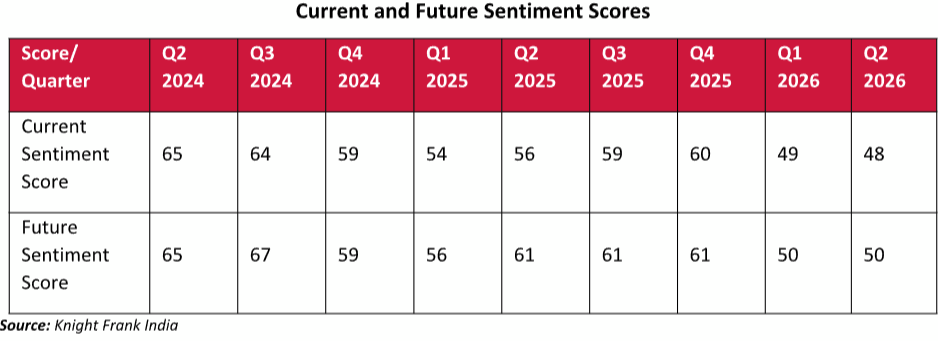
The Current Sentiment Score slipped by one point quarter-on-quarter to 48, reflecting continued caution among stakeholders amid a challenging global environment. However, the pace of decline has slowed significantly compared to the sharp correction witnessed in the previous quarter.
The Future Sentiment Score remained unchanged at 50, indicating that stakeholders expect prevailing challenges to persist over the next six months
Shishir Baijal, International Partner, Chairman and Managing Director, Knight Frank India, said “The real estate sector continues to navigate a complex global environment characterised by geopolitical tensions, inflationary pressures and volatile energy markets. While these factors have weighed on current sentiment, the more significant takeaway from this quarter’s findings is the sharp decline witnessed in the previous quarter has levelled off, with future sentiment holding steady at the neutral threshold. The residential market is transitioning into a phase of normalisation after a prolonged growth cycle, while the office segment continues to demonstrate resilience supported by robust leasing activity and sustained occupier demand. India’s strong domestic fundamentals, coupled with its position as the fastest-growing major economy, continue to provide confidence in the sector’s long-term growth prospects.”
Sentiments of Developers and Non-Developers
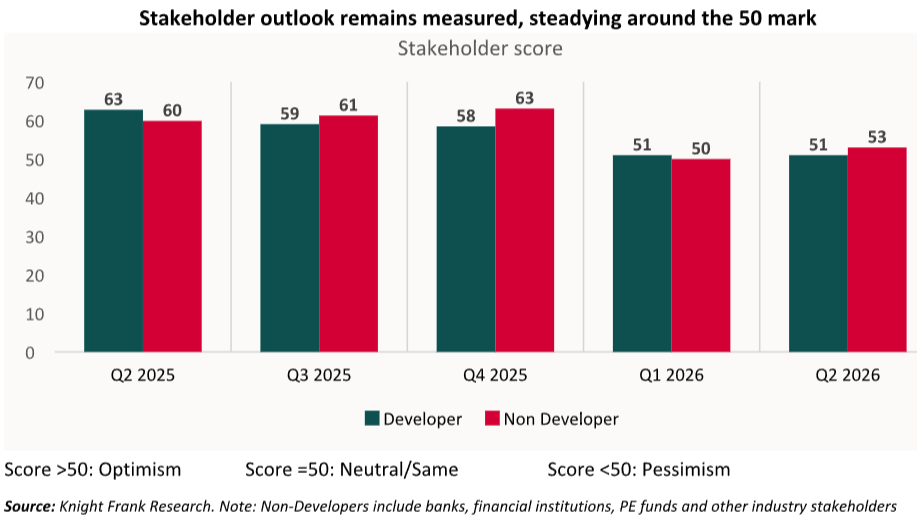
Stakeholder sentiment remains measured as it continues to hover around the neutral threshold, reflecting cautious optimism amid global uncertainties.
Developer sentiment remained flat at 51, unchanged from the previous quarter, indicating that while the sharp decline seen earlier has arrested, sentiment continues to hold marginally above neutral threshold, with the earlier post-pandemic optimism yet to return. Meanwhile, non-developer stakeholders, including financial institutions, banks and private equity investors, recorded an improvement in sentiment, with the score rising to 53 in Q2 2026 from 50 in the previous quarter.
The measured recovery among non-developer stakeholders suggests that capital providers and investors have become more comfortable with prevailing market conditions after reacting sharply to global uncertainties in Q1 2026.
Regionally, sentiment remained near the neutral mark across all zones. The North Zone has recovered modestly to 52 in Q2 2026, supported by robust office market activity, while the West Zone remained at the neutral threshold of 50. The South and East Zones continued to remain cautious as stakeholders monitored evolving economic and geopolitical developments.
Residential Market Outlook
The residential market continues to undergo a phase of moderation following multiple years of sustained growth. Housing sales across the top markets rose marginally by 1% year-on-year in H1 2026, indicating a transition towards a more mature and stable growth cycle.
While sentiment remains cautious, the degree of pessimism has moderated. The proportion of stakeholders expecting residential demand to weaken over the next six months declined to 45%, compared with 52% in the previous quarter. At the same time, the share of respondents expecting market conditions to remain unchanged increased significantly, suggesting expectations of stabilisation rather than further decline.
A similar trend is visible on the supply side. The proportion of stakeholders anticipating weaker launch momentum fell to 38% from 45% in Q1 2026, indicating a cautious developers’ sentiment amid concerns around construction costs, labour availability and financing conditions.
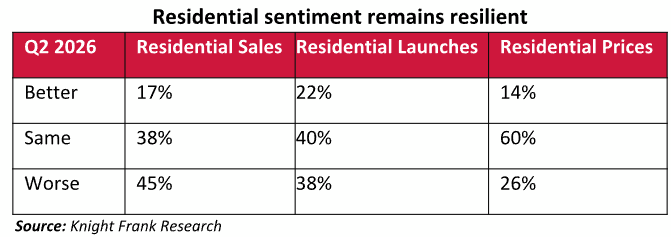
Property prices continue to remain resilient. A significant 74% of respondents expect residential prices to either remain stable or rise over the coming six months. Persistent inflationary pressures across construction materials, transportation and labour costs continue to support pricing strength across major residential markets.
Parveen Jain, National President, NAREDCO, said “The current score has slipped a point to 48, reflecting a global environment that remains fast-evolving and difficult to read. The future score, however, holds firm at the neutral threshold of 50 — a signal that stakeholders see the challenges persisting rather than deepening, and that the sharp decline of the previous quarter has levelled off. Residential is settling into a more mature phase, a normalisation rather than a weakening, while office continues to anchor the market with resilient leasing and firm rents. The pressures at play are external in origin, and India’s real estate fundamentals remain robust enough to absorb them.”
Office Market Outlook
The office market continues to be the strongest-performing segment within the real estate sector and remains a key anchor for overall sentiment.
Office transactions reached 48 mn sq ft in H1 2026, registering only a marginal decline of 2% YoY despite an exceptionally high base in the previous year. Occupier demand continues to remain robust, supported by expansion activity from Global Capability Centres (GCCs), technology firms and diversified corporate occupiers.
Stakeholder confidence in leasing activity remains constructive, with 74% of respondents expecting leasing volumes to either remain stable or improve over the next six months.
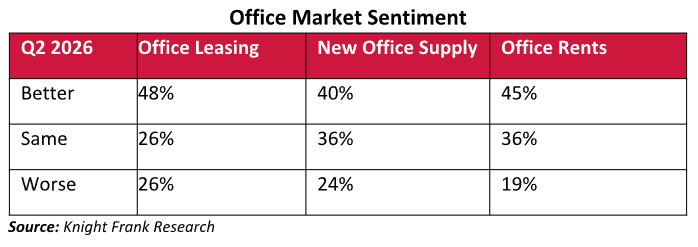
The supply outlook also remains healthy. 76% of respondents expect office completions to remain stable or improve, reflecting confidence in long-term occupier demand and the continued attractiveness of Grade A office assets.
Rental expectations remain particularly strong. Limited availability of high-quality office space across key micro-markets and sustained occupier demand continue to support rental growth. As a result, 81% of stakeholders expect office rents to remain stable or increase over the coming six months.
Economic scenario and funding outlook
Stakeholder sentiment regarding the broader economy remains cautious but has improved compared with the previous quarter.
The proportion of respondents expecting economic conditions to worsen declined significantly to 36%, compared with 50% in Q1 2026. Meanwhile, 31% expect economic momentum to improve, indicating that concerns surrounding global growth and geopolitical risks have moderated to some extent.
India’s status as the fastest-growing major economy continues to provide a strong foundation for stakeholder confidence despite global headwinds.
Funding sentiment remains broadly stable. Half of all respondents expect funding conditions to remain unchanged over the next six months, while 19% expect improved availability of capital.
Although private equity investments in Indian real estate moderated during H1 2026 amid tighter global financial conditions, investors continue to demonstrate interest in high-quality assets and projects backed by strong execution capabilities. The prevailing investment environment remains focused on risk-adjusted returns, liquidity and asset quality.
Outlook
The Q2 2026 Sentiment Index highlights a sector that is adapting to a more challenging global environment while retaining confidence in its long-term fundamentals. Although current sentiment remains subdued, the stabilisation in future sentiment suggests that stakeholders do not expect conditions to worsen materially from current levels.
The residential market is moving through a phase of cyclical consolidation after an extended growth cycle, while the office segment continues to demonstrate resilience through strong leasing demand and firm rental growth. As geopolitical uncertainties and inflationary pressures gradually ease, India’s real estate sector remains well positioned to benefit from the country’s robust economic fundamentals, urbanisation trends and long-term demand drivers.





3 thoughts on “Real estate sentiment stabilises; office market stays resilient in Q2 2026”