
Real estate sentiment slips below neutral on global uncertainty: Knight Frank–NAREDCO Index
The Q1 2026 Sentiment Index highlights a transition phase for the Indian real estate sector. While global challenges are making stakeholders cautious, the core market strength remains intact.

The residential market is witnessing a natural moderation after a strong growth cycle in Q1 2026. (AI Image)
The Knight Frank–NAREDCO real estate sentiment Index Quarter 1 2026 has shown a change in stakeholder sentiment compared to the high optimism witnessed over the last few quarters. Global uncertainties have clouded the sector outlook leading to a steep decline in the Current sentiment Score to 49 (points) from 60 pts in Q4’25, falling into negative territory. Similarly, Future sentiment Score dropped to a neutral 50pts, from 61pts in the preceding quarter.
Global macroeconomic instability was the key dampener this quarter. High crude prices continue to fuel inflation further squeezing margins in construction and logistics costs making certain projects unviable. Tighter financial conditions too have made stakeholders risk averse. While India’s macroeconomic story stays robust, geo-political developments have started impacting real estate demand and supply dynamics.
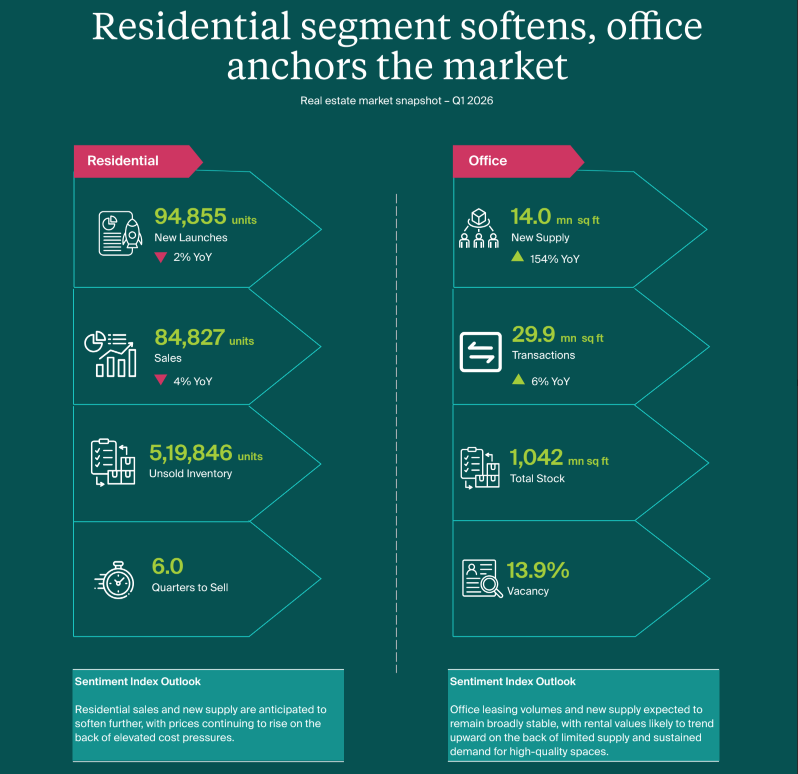
On account of cooling sales after the multi-year growth cycle, residential witnessed moderation across sales and new launches during Q1’26. The slowdown is partly due to cyclical adjustments but weak buyer sentiment is also coming to the fore. Overall demand is expected to soften further in the near term even as prices stay firm/higher. The dichotomy between slowing demand and stable/rising prices reflects underlying structural-cost issues.
Office remains the segment of choice with investors and occupiers continuing to show strong interest. Office leasing activity hit a new peak during the quarter. Rentals too are rising across markets with supply remaining constrained. Stakeholders also expect leasing activity to remain stable/improve during the near term.
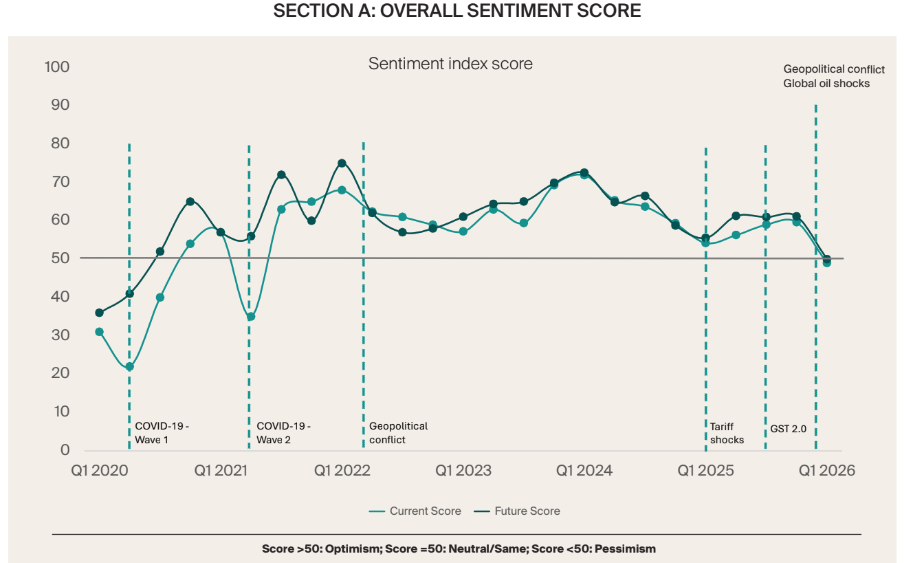
Quarterly Knight Frank-NAREDCO India real estate Sentiment Index measures the current and future sentiments of stakeholders towards real estate sector performance, economic environment and funding availability. The respondents include supply side stakeholders and financial institutions investing in real estate. An index score of 50 indicates a status quo; above 50 shows positive sentiment and below 50 indicates negative sentiment.
Developers Vs Non-Developers
The change in sentiment witnessed this quarter was on account of the non-developers turning cautious when compared to developers. Non-developers, which includes banks/investors showed a notable decline in confidence with future sentiment score dropping to a neutral 50, down from previously high optimistic levels of 63 in Q4’25. The future sentiment score of developers too declined easing to 51 from 58 in Q4’25. The change in stance highlights increasing risk averseness among capital providers while developers remain cautiously optimistic.
On a regional level, all regions posted a decline in sentiments when compared to the previous quarter. North and South turned negative while West stayed above the base level of 50, even as some level of demand softening was witnessed across regions.
Commenting on the findings, Shishir Baijal, International Partner, Chairman and Managing Director, Knight Frank India, said, “The moderation in sentiment reflects the growing influence of global uncertainties, particularly energy market disruptions and geopolitical tensions. While India’s economic fundamentals remain robust, the real estate sector is entering a phase of cautious recalibration. The residential segment is witnessing a natural moderation after a strong growth cycle, while the office market continues to exhibit resilience driven by strong occupier demand. In the near term, stakeholders are likely to remain in a wait-and-watch mode as they assess the evolving macroeconomic environment.”
Residential market outlook
The residential market is witnessing a natural moderation after a strong growth cycle in Q1 2026. Demand expectations have weakened notably, with 52% of respondents expecting housing sales to drop. With the sentiment being more negative than before, the market is adjusting after a growth phase.
A similar moderation is visible on the supply side, as new project launches slowdown. With nearly half of the stakeholders expecting fewer new launches, a significant proportion anticipates stability and developers are being more cautious. This marks a distinct shift from the stronger launch activity observed earlier in 2025.
In contrast, residential prices still hold strong even though demand is weakening. A substantial 73% of respondents expect prices to either increase or remain stable, while only 27% foresee a decline. Rising costs are keeping prices up, with materials, labour and loans getting more expensive. These costs are likely to increase property costs for buyers. The divergence between weakening demand sentiment and firm pricing expectations highlights that rising structural costs are driving the residential market.
Praveen Jain, National President-NAREDCO, said, “Real estate sentiment has moderated amid global macroeconomic headwinds and inflationary pressures; however, this reflects short-term caution among stakeholders rather than any weakening in the residential market’s underlying strength. The recent softening in residential sentiment can be seen as a natural recalibration following a sustained growth phase, with end-user demand and steady price appreciation continuing to support resilience.”
“At the same time, the commercial segment remains a key area of strength, with stable to improving leasing activity and firm rental trends reflecting sustained occupier confidence. As global uncertainties ease, the residential segment is expected to regain momentum and sustain its growth trajectory.”
Office market outlook
The office market outlook is still strong, though growth has slowed slightly, compared to the previous quarters. Office leasing demand remains steady, with 41% of respondents expecting improvement and 36% expecting stability. However, a smaller group of 23% foresee a decline, as caution increases due to macroeconomic uncertainties. However, the core occupier demand remains robust.
A similar trend is observed in the office supply outlook with nearly half of the stakeholders expecting more completions, and others expecting stable or lower supply. This suggests that while developers remain committed to delivering projects, they are also mindful of evolving demand conditions and capital considerations. The supply outlook continues to be supported by sustained demand for high-quality Grade A spaces, even as overall sentiment moderates.
Rental outlook looks strong despite market caution, with majority expecting rents to rise or stay stable. While 81% see rents holding or increasing, very few expects rent drops. While low supply of premium offices is supporting rents, high demand from Global Capability Centres is driving the market, which continues to push rents upwards.
Economic Scenario
The economic outlook has softened in Q1 2026, with stakeholder sentiment turning noticeably cautious amid rising global uncertainties. The share of respondents expecting economic improvement has declined to 29%, while a majority 50% believe conditions will worsen over the next six months. Around 21% anticipate stability, indicating that the overall outlook is now cautious compared to balanced earlier. This moderation reflects concerns around a global growth slowdown, with inflation and high energy prices being key worries as geopolitical tensions add to the risk.
The funding outlook is steady but cautious. About 33% of respondents expect an easier access to funds while 43% anticipate no change, suggesting that liquidity conditions are likely to hold steady in the near term. However, a smaller group of 24% foresee tighter funding, reflecting increased risk aversion among investors and financial institutions. This indicates a shift toward more selective investments, with greater emphasis on quality assets and careful pricing, marking lesser aggressive growth and a more disciplined strategy.
Overall, the Q1 2026 Sentiment Index highlights a transition phase for the Indian real estate sector. While global challenges are making stakeholders cautious, the core market strength remains intact. While the residential market is adjusting to a more sustainable trajectory, the office segment continues to anchor growth. The future sentiment depends on global factors, with energy markets and geopolitics being the key influencers. These factors will highly impact investment decisions and recovery speed across the sector.





5 thoughts on “Real estate sentiment slips below neutral on global uncertainty: Knight Frank–NAREDCO Index”