
India’s flex office stock to nearly double to 180 million sq ft by 2030: Colliers-CII Report
Flex space stock across India’s top seven office markets is projected to rise to 170–180 million sq ft by 2030, driven by growing enterprise demand, rising GCC adoption and the expansion of managed workspaces into Tier II and III cities.
By 2030, leasing by flex space could account for nearly one-third of the overall Grade A leasing across top 7 markets in the country, up from around 20-25% share currently.
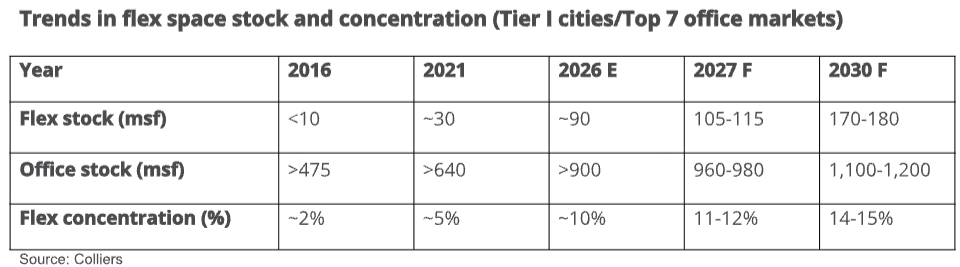
India’s flex space market is poised for an accelerated phase of growth & expansion in the next 3-4 years, supported by rising enterprise demand, growing Global Capability Center (GCC) participation and increasing integration of flex spaces in occupiers’ real estate portfolio. According to the latest report by Colliers in collaboration with Confederation of Indian Industry (CII) titled, “Flex First: Transforming the future of work & real estate”, released at the 22nd CII Realty event, flex stock across India’s top 7 office markets is likely to increase from around 90 million sq ft in 2026 to around 170-180 million sq ft by 2030. Flex stock concentration, represented as a share of flex stock in overall Grade A office stock, is also expected to increase from ~10% currently to about 15% in the next 3-4 years.
Having evolved from a start-up-centric workplace solution to an enterprise-grade service offering, flex space market is now being shaped by large occupiers seeking agility, scalability, employee wellness and faster speed-to-market. In fact, strong flex space uptake in recent years and higher enterprise adoption reiterate sustained demand for managed & flexible workspaces.
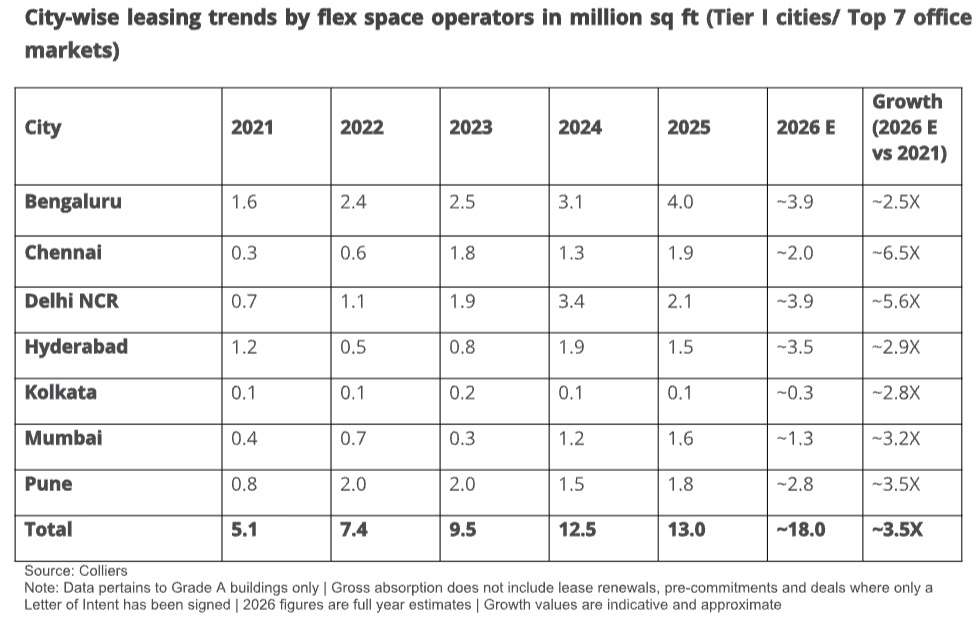
All the top 7 office markets have seen multi-fold rise in leasing by flex operators over the last 5-6 years, reflecting the growing adoption of flex spaces as a mainstream real estate solution. Flex operators are likely to lease about 18 million sq ft of Grade A office space in 2026, with Bengaluru, Delhi NCR & Hyderabad alone driving 3-4 million sq ft each. Interestingly, Secondary Business Districts (SBDs) across the top 7 cities have driven over 55% of overall flex space leasing in last 5-6 years, led by improved accessibility, rental arbitrage and sustained occupier demand.
By 2030, leasing by flex space could account for nearly one-third of the overall Grade A leasing across top 7 markets in the country, up from around 20-25% share currently.
“India’s flexible workspace sector is undergoing a structural shift, from an alternative office format to an integral part of enterprise real estate strategy. With flex stock projected to reach 180 million sq ft by 2030, the real significance lies not just in its scale, but in how businesses are rethinking capital efficiency, agility and access to talent. The growing participation of GCCs and expansion into emerging cities can also support more geographically balanced economic growth. The CII–Colliers report captures an important transition in India’s commercial real estate landscape,” said Ashwinder R. Singh Chairman, CII Committee on Real Estate (NR) and Vice Chairman, BCD Group
“Scale, institutional maturity, enterprise adoption, access to public equity and workplace innovation will define the next growth phase of India’s flex market. Flex stock across India’s top 7 office markets could potentially double up and reach 180 million sq ft by 2030. Enterprise clients, including GCCs, are likely to remain the primary demand drivers amidst growing preference for larger managed spaces & experience-led workplace formats. Moreover, with surging enterprise adoption, flex spaces are projected to occupy 20-25% of occupiers’ real estate portfolio in the next 3-4 years, up from current estimates of 15-20%, reinforcing their growing role as a core component of modern workplace strategy,” said Arpit Mehrotra, Managing Director, Office Services, India, Colliers.
Bengaluru continues to be the most prominent flex market; Pune stands out with the highest concentration levels amongst top 7 markets
India’s flex space market continues to be anchored by the top 7 office markets supported by strong availability of high-quality supply, sustained demand momentum across sectors and deep talent pool. Over the last five years, all the top 7 major office markets have witnessed significant increase in both flex stock and concentration levels, reflecting the growing adoption of flex spaces as a mainstream real estate solution.
Bengaluru continues to be the largest flex space market in India, with about 27 million sq ft of Grade A flex stock, representing about 30% of the total flex inventory across the top seven cities. Delhi NCR & Hyderabad follow and are likely to have 17 & 13 million sq ft of flex stock respectively by the end of 2026. Interestingly, among India’s major office markets, Pune has the highest flex concentration at around 14%, well above the average of around 10% across the top seven markets.
Enterprise demand on the upswing; annual seat uptake could rise further by 40-50% and reach 3-3.5 lakh seats by 2030
Enterprise clients have emerged as the primary drivers of India’s flex space market, accounting for 75-85% of the total flex space demand. Annual enterprise seat uptake has increased at a CAGR of 33% in the last 5-6 years, from around 55,000 seats in 2021 to an estimated 230,000 seats in 2026. Interestingly, in recent years, GCCs have driven 45-50% of the enterprise demand. Increasing preference for fully managed offices, growing adoption of hybrid work models, ongoing portfolio decentralization and agile requirements are encouraging GCCs to integrate flex spaces into their long-term real estate strategies.
Over the next 3-4 years, annual enterprise seat uptake is likely to be in the range of 300,000- 350,000 seats, 40-50% higher than the current levels. Established sectors such as technology, BFSI, engineering & manufacturing, consulting and healthcare will remain key demand anchors, while AI-led businesses, life sciences and digital-first brands are likely to emerge as new drivers of enterprise demand.
Flex stock in emerging Tier II/III cities to double up in next 3-4 years
In addition to the traction in established markets, the role of Tier II/III cities within India’s flex space market is evolving rapidly. Several of these emerging markets are already transitioning from tertiary locations to strategic growth destinations for leading operators. Supported by strengthening commercial real estate, ongoing infrastructure development, expanding talent pool, rising office space demand and growing GCC interest, leading operators are gradually widening their footprint into these emerging flex space hubs.
Emerging Tier II/III cities are set to account for 8-12 million sq ft of flex stock by the end of 2026 with select markets such as Ahmedabad, Jaipur, Coimbatore, Lucknow, Kochi, Indore & Bhubaneswar likely to witness notable traction over the next few years. Going ahead, flex stock across emerging Tier II/III cities is expected to further scale up and reach 20-25 million sq ft by 2030. As flex operators continue to deepen their networks and occupier demand becomes more geographically diversified, these emerging markets are likely to increasingly complement the established Tier I markets.