

“12% Assured?” Ventura warns high-yield bond investors to prioritise safety first
Higher yields in bonds are rarely free lunches, and the well-established correlation between ‘return and risk’ applies across investment products.
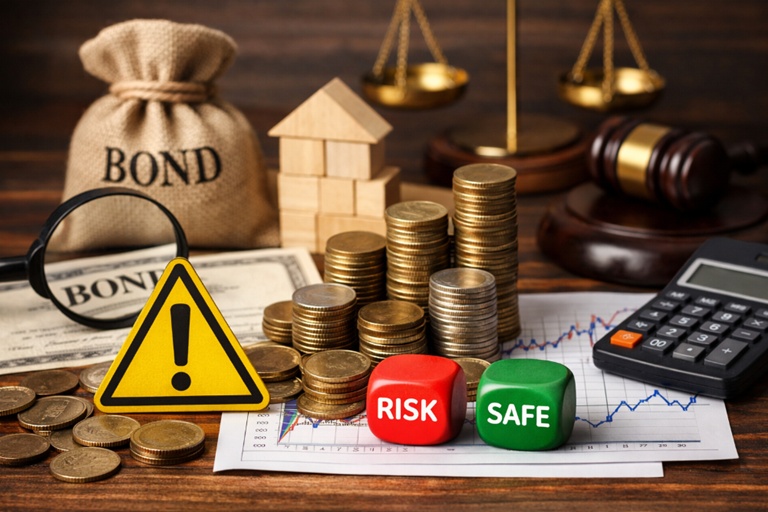
The focus should not be on chasing the highest yield you see on a platform, but to try to maximise post-inflation return, at best. (AI Image)
According to Ventura’s Monthly MF Pointer for January 2026, recent defaults and delayed repayments across high-yield bond platforms have once again exposed an uncomfortable truth: higher yields in bonds are rarely free lunches, and the well-established correlation between ‘return and risk’ applies across investment products.
The ideal approach is simple and clear: invest using the SLR principle – Safety, Liquidity, and then return. Alongside this, ensure tax efficiency so that the gap between pre-tax and post-tax returns remains minimal. Instead of chasing isolated high-yield bonds, consider basket-oriented multi-asset allocation funds to create a balanced approach – aligning stability, tax efficiency, and long-term objectives.
Ventura highlights the growing 12% illusion: “In recent times, a growing number of bond platforms have emerged. In addition, front-page advertisements are now promising investor’s returns in excess of 12%, often carrying the tag of assured.” However, in debt markets, higher yield comes with higher risk.
Debt is not designed to create extraordinary wealth; at best, it is predominantly meant to protect the portfolio from volatility and to provide a source of steady and regular flow of income to many investors, especially senior citizens. So, the focus should not be on chasing the highest yield you see on a platform, but to try to maximise post-inflation return, at best.
For instance, if SBI offers 7% and Bajaj Finance offers 8%, the additional 1% may be reasonable if backed by strong financial stability. But if a cooperative bank offers 10% while established institutions offer 7-7.5%, that excess return probably signals elevated risk, and safety may be compromised.
The real question is not whether 12% looks attractive, but whether the extra 3-4% truly compensates for the additional uncertainty. In debt investing, outcomes can be binary – either you get your money back in full, or you do not get it.
How “Stability,” “Secured,” and “Listed” get Sold
Online Bond Platform Providers (OBPPs) offering listed bonds across government and corporate securities often highlight terms such as “stable,” “secured,” and “listed” to attract investors.
However, listed does not necessarily mean liquid. Beyond top-rated or sovereign papers, secondary market volumes can be thin, exits before maturity may require discounts, and liquidity often disappears during stress.
Similarly, “secured” and “stable” – supported by over-collateralisation or diversified loan pools – do not guarantee immediate recovery. Enforcement depends on legal processes, resolution timelines (which can get extended), and cash realisation (which may be staggered). While Collateral may reduce loss severity, but it does not eliminate delay or risk. The IL&FS recovery is still going on.
SLR Framework: Safety, Liquidity, Return
Fixed income plays a structural role in portfolios stability, capital preservation, and predictability.
Unlike equity, it is not designed to maximise upside; it is designed to anchor risk. Therefore, fixed income allocation should follow a clear hierarchy:
Safety: Safety is paramount. Prefer highly reputed and financially strong brands like SBI, Tata, or Bajaj, where capital protection is more reliable.
Liquidity: Ensure access to funds when required, with clear exit options available.
return: Returns should be the last consideration – only after safety and liquidity are fully addressed
Many investors reverse this sequence and begin with return. That is where risk concentration begins when incremental yield starts driving allocation decisions instead of risk control.
Structural Alternative: Diversification instead of Concentration
If the objective is to enhance returns without falling into a yield trap, concentrating on a single 12% instrument may not be prudent especially when a 12% pre-tax return in a 30% tax bracket significantly reduces post-tax returns, narrowing the advantage over a safer 7-8% alternative.
Rather than allocating separately to one instrument offering 15% and another offering 8%, it may be more efficient to invest in a multi-asset product with a structured allocation (you can define your comfort zone). A basket approach like Multi-Asset Allocation Funds avoids a single concentrated bet – enhancing return potential while improving tax efficiency and overall risk balance.