

Akshaya Tritiya 2026: Gold shines, silver outpaces as retail investors eye bullion boom
Bullion markets continue to trend higher and could maintain this trajectory in the near-term despite trading at elevated levels and experiencing bouts of volatility as risk-sentiment shifts.

Younger investors are also showing preference for regulated products such as gold ETFs. (AI Image)
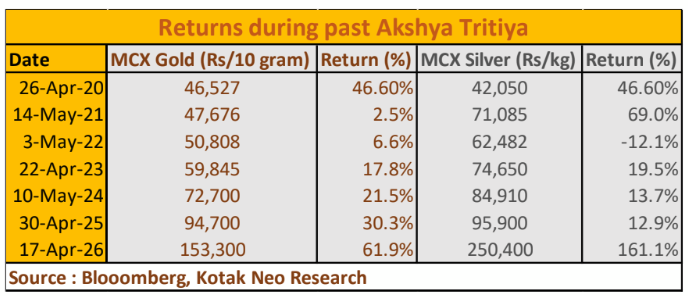
As India celebrates Akshaya Tritiya on 19th April 2026, retail investors are likely to turn their focus towards bullion once again for wealth creation purposes. Known as one of the most auspicious days in the Hindu calendar, Akshaya Tritiya celebrates prosperity and good luck. Tradition holds that buying gold during Akshaya Tritiya will bestow lasting riches upon the buyer. Sentiment surrounding gold as a wealth creation vehicle is further supported by price action in recent months. Gold has returned over 60% over the past year alone, one of its strongest annual showings in recent years. With geopolitical tensions continuing to weigh on investor sentiment, along with strong central bank buying and healthy investment demand, gold prices have surged, according to a report by Kotak Securities.
Adding to gold’s impressive performance during past Akshaya Tritiyas, gold makes a great fundamental long-term holding to provide stability within portfolios. Outperforming gold this year has been silver, returning approximately 160% year-over-year. “While safe-haven demand has played a significant role in silver’s rally, robust industrial demand for silver-backed renewables and technology ETFs has also been supportive. Due to its higher cyclical nature, silver offers higher return potential but with increased volatility when compared to gold. Both gold and silver should be considered for portfolio allocation by retail investors,” says Kaynat Chainwala, AVP Commodity Research, Kotak Securities.
Gold demand fundamentals
According to the World Gold Council (WGC), high prices continue to encourage consumers towards staggered purchases and exchange-led demand. WGC expects jewellery demand to remain soft, while investment demand through coins, bars and ETFs strengthened during the quarter. Consumers are increasingly transacting in lighter weights and value-based purchases. Younger investors are also showing preference for regulated products such as gold ETFs. Although Akshaya Tritiya served as a trigger to prompt seasonal buying interest, total volumes traded are likely to be muted even with consistent participation stemming from the festival. In March, investment demand, particularly in bars, coins and ETFs, remained strong and partially offset further weakness in jewellery demand witnessed last month.
High prices, which reached record highs above ₹1,80,000 per 10 grams in March largely disrupted discretionary purchases. Annual demand is now expected to ease to 600–700 tons from peak of over 810 tons in 2024 and 710 ton in 2025.
The WGC also notes that Indian consumers are increasingly shifting to lower caratage and lighter jewellery designs to cope with high prices. Gold recycling also jumped to account for an estimated 40–70% of all purchases in exchange form. On the supply side, local prices are trading at a premium to global benchmarks of around $130/oz on fears of import shortages due to geopolitical tensions. Additionally, market sources have told the WGC that while price gains earlier this year aided investment demand, recent price action has led consumers to hesitate on buying physical gold with many opting to wait on making fresh purchases.
Gold ETFs post modest gains
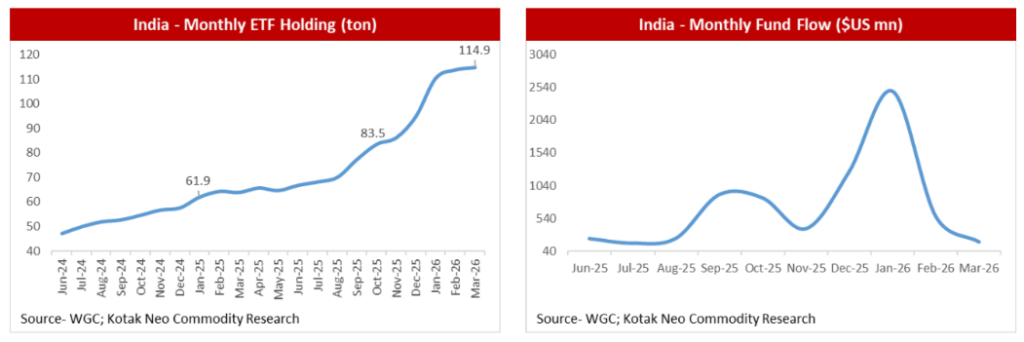
Gold ETFs in India witnessed fresh inflows in March 2026, extending its run of net positive additions for the eleventh month. Assets under management reached record levels while total inflows added 1.1 tonnes to reserves at US$176.6 million. This marks a sharp slowdown from the month prior driven by profit-taking from investors as prices reached lofty valuations. However, participation in gold ETFs continues to increase with the number of total folios rising to 12.1 million. Retail investors make up a key portion of this increase. For the first three months of 2026, gold ETF inflows remained positive overall aided by price strength and portfolio diversification needs. This saw total holdings rise to 114.9 tonnes while AUM climbed to an all-time high. Additionally, high prices and volatility saw investors both pile into gold ETFs and redeem on rises as investors have become more savvy in their approach to gold.
How will Akshaya Tritiya 2026 impact gold and silver prices?
Retail investors can maintain an allocation towards gold of 8–15% of their portfolios for long-term stability. “Given the current market environment, investors should also consider adding silver to their portfolios this year. Silver’s industrial demand coupled with its precious metal properties provide higher medium-term return potential. With gold and silver, an allocation split of 75–80% and 20–25% respectively could allow retail investors to hedge against uncertainty while capturing more opportunities as the precious metals landscape evolves,” says Chainwala.
Outlook
Overall, bullion markets continue to trend higher and could maintain this trajectory in the near-term despite trading at elevated levels and experiencing bouts of volatility as risk-sentiment shifts.
“We continue to expect gold prices to receive support from expectations for monetary easing, declining real yields, geopolitical risks, and ongoing central bank demand. Risks to our upside view includes potential de-escalation of geopolitical tensions, a stronger US dollar, and lower demand at higher prices. While gold is likely to maintain its role as a store of value against macro and geopolitical uncertainty, silver offers greater return potential with higher volatility due to its industrial ties,” says Chainwala.
On MCX, gold has consolidated about 30% from its March lows and currently trades back above ₹1,50,000. Find support near ₹1,40,000 and resistance at ₹1,60,000–₹1,75,000. If prices break above resistance, gold could extend gains towards ₹1,80,000 and ₹2,00,000. Prices could face downside risks towards ₹1,25,000 and ₹1,10,000 on weakness below supports