

Gold, silver rally as US-Iran peace hopes sink dollar, oil prices
Easing geopolitical tensions and falling oil prices boosted gold and silver sharply, while investors now await US payroll data and Fed commentary for further direction on interest rates and commodity markets.
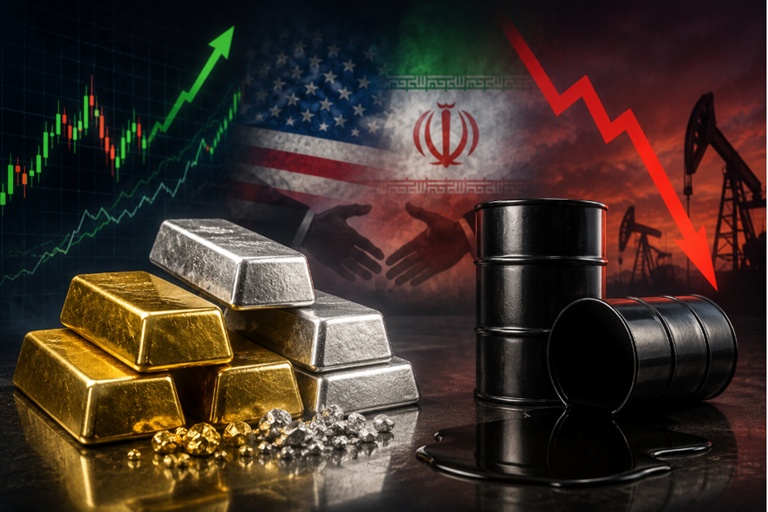
With oil-linked inflation risks easing, the macro environment tilts modestly bullish for precious metals. (AI Image)
COMEX gold surged more than 3% to a one-week high of $4,720/oz, while silver jumped nearly 6% to $77.87/oz, its highest level in two weeks, on Wednesday (May 6), extending a sharp recovery, as the prospect of a US-Iran peace agreement sent the dollar and oil prices sharply lower, removing the two key headwinds that had weighed on bullion since the war began.
“With oil-linked inflation risks easing, the macro environment tilts modestly bullish for precious metals. However, Wednesday’s ADP non-farm payrolls report and speeches from several Fed officials will be closely watched for rate outlook cues. A stronger-than-expected ADP print could limit near-term upside by reinforcing the higher-for-longer narrative, while a softer reading would add fuel to the rally ahead of Friday’s official jobs report,” said Kaynat Chainwala, AVP-Commodity Research, Kotak Securities.
That said, with geopolitical developments continuing to dominate price action, the impact of today’s data may prove secondary to any further headlines out of Washington or Tehran.
Brent crude tumbled 7% to around $102/bbl and WTI plunged 8% to below $94, extending a sharp two-day sell-off as a breakthrough in US-Iran negotiations appeared closer than at any point since the war began. The accelerated decline reflects a rapid unwinding of the geopolitical risk premium that had driven both benchmarks to multi-year highs last week.
The catalyst for Wednesday’s leg lower is a report from Axios, citing two US officials and two other sources briefed on the matter, that the White House believes it is close to agreeing a memorandum of understanding with Iran to end the war. The one-page memo is described as a framework for more detailed nuclear negotiations, with key provisions including a suspension of Iranian nuclear enrichment, lifting of sanctions, and restoration of free transit through the Strait of Hormuz, the two central sticking points that have blocked a deal since the ceasefire began in April.
The US expects an Iranian response within 48 hours, though nothing has been formally agreed yet. The news builds on the diplomatic momentum of recent days, with Trump signalling “great progress” in talks, pausing naval escort operations around the strait to create space for negotiations, and US officials reaffirming the ceasefire holds.
Iraq added to the bearish tone, offering steep discounts to term buyers willing to transit the strait, a sign that producers are actively trying to move stranded barrels despite ongoing operational risks. Nonetheless, physical market conditions remain tight. The Strait of Hormuz continues to operate well below normal capacity, with U.S. naval restrictions still limiting flows.
“If the MOU is formalised and leads to a durable agreement, a sharp further downside correction in oil prices is likely as bottled-up supply returns to global markets. Any collapse in talks, however, could reverse this week’s decline just as quickly. The next 48 hours may prove decisive,” Chainwala said.





4 thoughts on “Gold, silver rally as US-Iran peace hopes sink dollar, oil prices”