

Housing launches jump 13% in Q1 2026, sales grow 8%: JLL
Strong launch momentum and premium housing demand drive growth, even as buyers remain cautious in the short term.
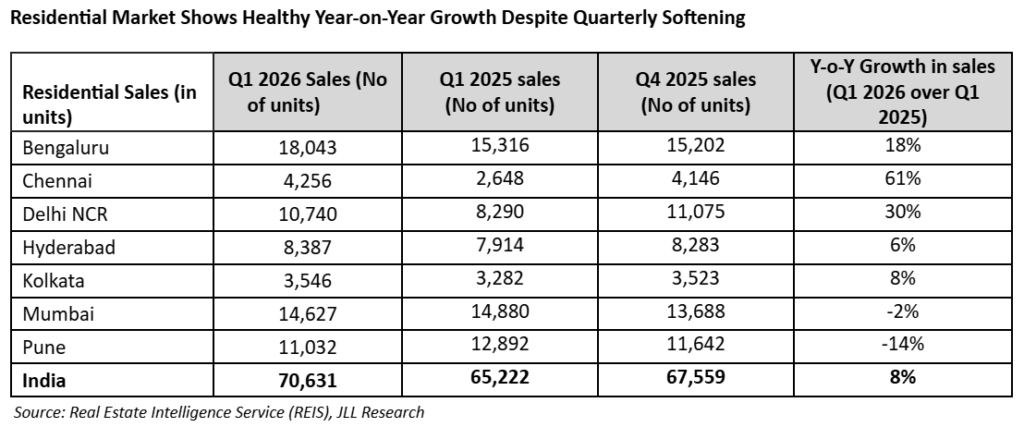
Bengaluru, Mumbai, Pune and Delhi NCR registered healthy sales volumes and collectively contributed nearly 77% of sales in Q1 2026.
India’s residential sales volume reached 70,631 units in Q1 2026 (January-March) compared to 65,512 units in Q1 2025, up 8% Y-o-Y. Robust new launches supported sales growth, with supply totalling 90,023 units in Q1 2026 compared to 79,772 units in Q1 2025, up 13% Y-o-Y and up 32% quarter-on-quarter, according to a JLL India report.
Supply additions have grown on account of developers launching projects which are backed with credibility ensuring timely completion and delivery. This has created a positive sentiment among buyers allowing them to choose from a wide range of options as well as fuelling their confidence in market resilience, thereby driving sales growth. Sales growth (8%) slightly lagged behind launch growth (13%) Y-o-Y suggesting some moderation in sales momentum as buyers adopt a wait and watch approach due to current market conditions.
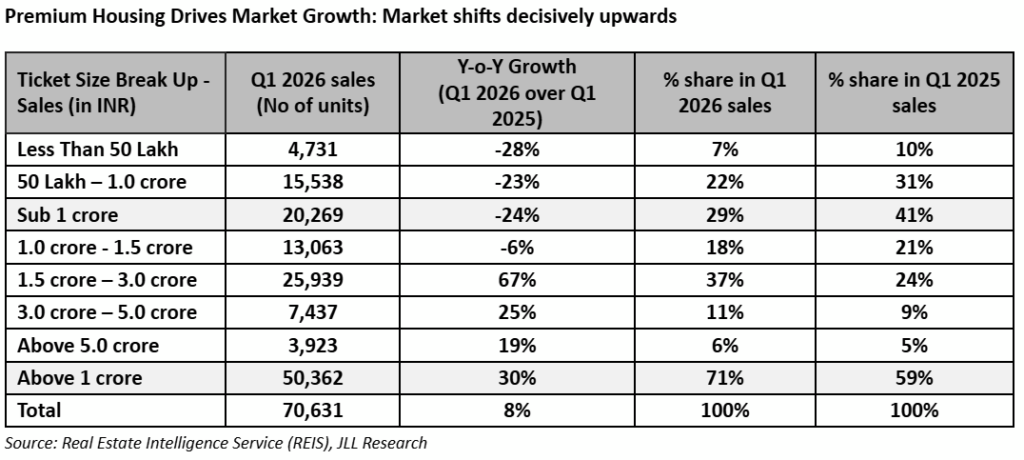
Healthy sales growth was driven primarily by strong sales in the premium segment with residences priced over INR 1 crore registering 30% Y-o-Y growth. Homes in the INR 1.5-3 crore price bracket recorded strong growth. Strong launch growth against tepid sales growth indicates short-term market recalibration. Developers are launching projects with confidence derived from short-term tailwinds such as premiumization and long-term growth story of Indian realty sector, while buyers are taking time to evaluate their options before making purchases.
Bengaluru, Mumbai, Pune and Delhi NCR – the four markets that together account for sales of over 10,000 units – registered healthy sales volumes and collectively contributed nearly 77% of sales in Q1 2026. These markets continue to attract employment from several large multinational companies and startups which offer employment to thousands of individuals every year. Large-scale infrastructure development has also made these cities extremely attractive.
Excellent performance in Chennai (61% YoY sales growth) driven by robust employment opportunities in the IT sector and improved connectivity was a key highlight. Delhi NCR (30% year-on-year growth) witnessed strong growth on the back of recent announcements of infrastructure projects and benefitting from pent-up demand. Bengaluru (18% growth) too clocked strong growth on the back of healthy supply in terms of quality of projects coming up and continued office expansion in the city. Pune was the only city to witness negative growth with sales declining 14% year-on-year which also coincides with slower launch activity in the quarter.
Launches contributed to nearly a quarter of the sales volume in Q1 2026. Quarter-on-quarter, launches account for ~26% of sales volume in Q1 2026 compared to ~23% of sales volume in Q4 2025. Projects launched in Q1 have consistently contributed to sales volume due to launches by developers with established credibility that ensure projects are delivered on time and see stable price appreciation.
“The current market scenario is witnessing robust residential supply being met with buyers exercising caution while deciding to buy. This led to launches recording a strong growth of 13% year-on-year while sales grew by 8%. Though there is a disparity between launch and sales growth, this is only a short-term phenomenon and is not reflective of a long-term trend. Markets are recalibrating themselves and this is healthy and good for the market. The residential segment priced INR 1 crore and above saw an excellent growth of 30% year-on-year, indicating that there is demand in the market and it is led by the premiumisation trend,” said Siva Krishnan, Senior Managing Director (Chennai & Coimbatore), Head – Residential Services, India, JLL.
“We continue to see healthy sales growth in the premium segment comprising homes priced over INR 1 crore. The luxury and super-luxury segment led the charge and accounted for 71% of total unit sales in Q1 2026, increasing from 59% in Q1 2025. Overall, sales in the above-INR 1-crore category grew 30% year-on-year. The steady migration towards this segment is also attributable to robust sales in the INR 1.5-3 crore range, which reported remarkable 67% year-on-year growth. On the contrary, the sub-INR 1 crore segment witnessed a contraction of 24% year-on-year, with its market share coming down further to 29% from 41%,” he added.
New launches in the country stood at 90,023 units in Q1 2026 compared to 79,772 units in Q1 2025 recording a 13% year-on-year growth. Bengaluru witnessed the highest number of launches at 27,055 units (up 32% Y-o-Y) followed by Delhi NCR which witnessed a staggering 64% year-on-year growth. The two markets together contributed to 45% of total launches in Q1 2026. The strong growth in launches despite a cautious buyer sentiment indicate that developers are bullish about the long-term growth story of Indian real estate market and are driving by the tailwinds of urbanisation and increasing affluence. Moreover, the demand-supply gap is largely expected to be met with replenished stocks over a medium to long-term time frame and hence current sales or launches trends will not impact this supply rise.
Overall residential property prices continued their upward trajectory across the top seven cities during Q1 2026. Property prices across cities have recorded double-digit growth on a year-on-year basis ranging from 8% to 20%. Rising input costs coupled with shift in the sales mix to premium segment will continue to keep property prices on an upward trajectory. However, the pace of growth may not be as high if sales growth remains subdued.
Home affordability will be supported by declining home loan interest rates during this period. Going forward, we expect sales to pick up as economic conditions stabilise.