

CPI inflation at 2.75% in January under new 2024 base
The core CPI in the new series is at 3.4% in January 2026, compared to ~4.15% going by the old series in January 2026.

The CPI 2024 has increased its coverage both geographically and in terms of number of items. (Image: Freepik)
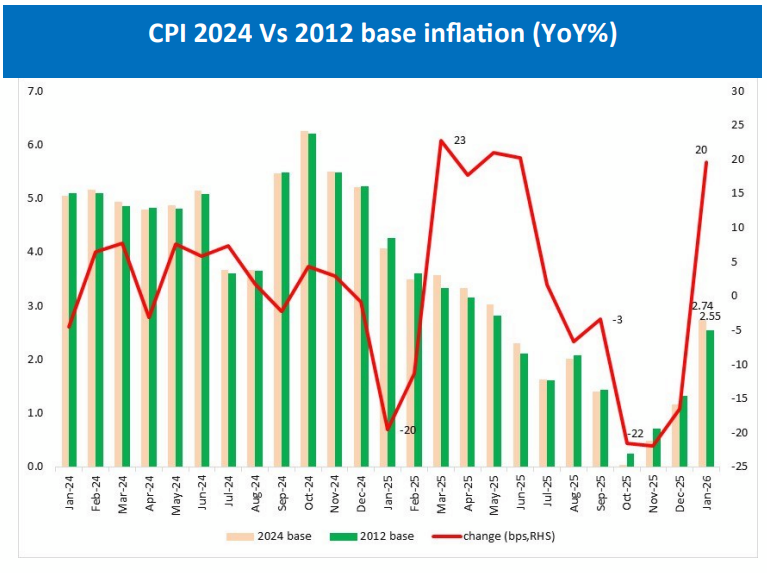
India’s Consumer Price Index (CPI) inflation rose to 2.75% in January 2026, compared to 2.55% in the old series by using the linking factor (0.5267). This reflects an increase in headline retail inflation, with rural inflation at 2.73% and urban at 2.77%. Food inflation was 2.13%. The core CPI in the new series is at 3.4% in Jan’26, compared to ~4.15% going by the old series in Jan’26. The decline in core is mainly due to the change in weightage in gold, which declined to 0.62% in 2024 series, compared to 1.08% in 2012 series, according to SBI Research.
By looking at the division-wise inflation (a new terminology defined by CSO in the new series), personal care inflation is at 19.02% in Jan’26, due to higher gold inflation of 46.77% and 159.67% in silver. Food inflation is at 2.13%, of which 64.8% is in tomato, 47.18% in coconut, 40.4% coconut oil. Inflation in Garlic, Onion and Potato is of –53.05%, -29.27% and –28.98%, respectively. Among the States, highest inflation is 4.92% in Telangana, 3.67% in Kerala, 3.36% in Tamil Nadu and 3.17% in Rajasthan and 2.99% in Karnataka in January 2026.
The revision in the index always involves changes in technical compilation of the index. The CPI 2024 base series have many methodological revisions besides new data sources.
Firstly, the main revision is the use of Jevons short index formula that complies index sequentially compared to long index formula which calculates the price change directly from the base period. This revision makes addition of new items easy.
Secondly, change of weight includes the combined impact of change in basket and change in standard. With reference to food items the change in weight on account of change in basket is 5.76% with reference to old classification and change in standard is 3.3% with reference to old classification resulting in new weight of 36.8% in new series.
Thirdly, another major revision in respect of housing price index and its coverage. The previous series included housing price for all India and urban, while the new series includes rural as well. Further, prices for employer provided accommodation are now excluded.
The CPI 2024 has increased its coverage both geographically and in terms of number of items. Overall, 565 more markets (both rural plus urban) have included in CPI-2024 as compared to CPI-2012. However, out of 565 new markets only two states (UP and Maharashtra) accounted for 43% share. This indicate that inclusion of new markets is skewed and tilted more towards certain states.
Further, 12 online markets are also added across 12 towns having more than 25 lakh population as per 2011 census (Mumbai, Delhi, Bengaluru, Hyderabad, Ahmedabad, Chennai, Kolkata, Surat, Pune, Jaipur, Lucknow and Kanpur) to capture price variations of the items on the e-commerce/online platforms on weekly basis. As 2011 census is chosen for selecting cities some of the vibrant and growing cities like Indore, Patna, Nagpur, Bhopal, Thane, etc. are missing from the list. These cities are on the cusp of becoming 25-lakh population cities. The new series also includes price in digital marketplaces, but the geographic coverage is limited to few cities.
Overall, the most illuminating part of the new data set is the comprehensive sub classification which will allow policymakers, regulators and researchers to use the data for policy decisions and trend analysis.





1 thought on “CPI inflation at 2.75% in January under new 2024 base”