

India emerges strategic winner in US Trade Pact with $90-Bn surplus potential
As per SBI’s preliminary estimates, Indian exporters may increase their exports of top 15 items to US by ~$97 billion in a year.
With 18% tariff rate, India has now one of the lowest tariffs among key Asian economies. (Image: AI Generated)
The trade deal with the united states, back on the heels of wide arc of trade deals with the EU & UK, catapults India to a unique strategic position wherein the country, as also its exporters, are poised to gain much, without ceding meaningful ground on matters of sensitivities: At least a $45-billion annual additional trade surplus with the US post deal / 1.1% of GDP and savings of $3 bn FX Reserve, according to SBI Research.
As per the India-US joint statement:
▪ India will eliminate or reduce tariffs on all US industrial goods and a wide range of US food and agricultural products, including dried distillers’ grains (DDGs), red sorghum for animal feed, tree nuts, fresh and processed fruit, soybean oil, wine and spirits, and additional products
▪ The united states will apply a reciprocal tariff rate of 18% on originating goods of India, including textile and apparel, leather and footwear, plastic and rubber, organic chemicals, home décor, artisanal products, and certain machinery
▪ The United States will also remove tariffs on certain aircraft and aircraft parts of India
▪ India will receive a preferential tariff rate quota for automotive parts
▪ India will receive negotiated outcomes with respect to generic pharmaceuticals and ingredients
▪ The United States and India will address non-tariff barriers that affect bilateral trade
▪ India intends to purchase $500 billion of US energy products, aircraft and aircraft parts, precious metals, technology products, and coking coal over the next 5 years
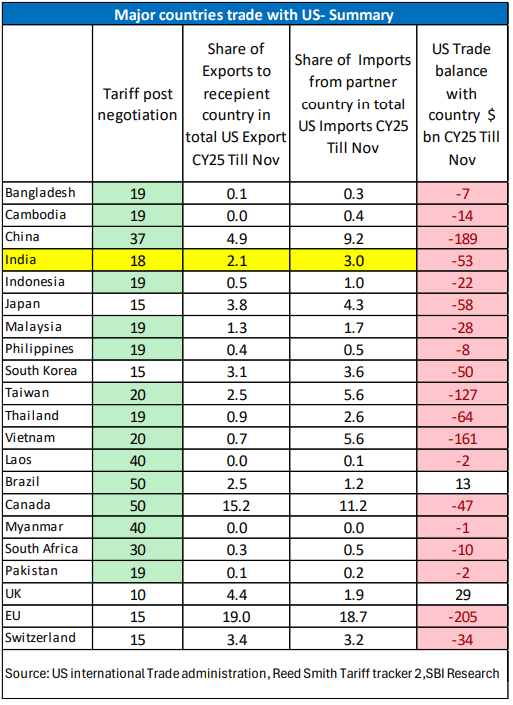
Now India has one of the lowest tariffs among Asian countries
* With 18% tariff rate, India has now one of the lowest tariffs among key Asian economies (even lower than the Vietnam which is US one of the major trading partners)
* Indian exports have regained competitiveness vis-à-vis other major Asian exporters
Broad macroeconomic impact of 18% US tariffs on India:
India stands to gain post tariff increase compared to its neighbours even after the 18% imposition
1. The major export sectors that will be positively impacted by this potential deal include the following
- Gems and jewellery
- Leather and leather products
- Textiles
- Chemicals
- Sea foods
- Engineering export
2. Inflation impact is minimal form the energy sourcing point of view
3. Importantly, traction in exports could only be an upside post the deal as Indian exports even with 50% tariff has almost matched a hypothetical no tariff scenario.
India’s Export to US
* While US share in India’s exports is ~20%, in certain commodities this share is more than 30%
* As per the 2 -digit classification, India’s top export to US is electric machinery, which is almost 50 % of out total exports for that commodity
* In pharma also, 35% of our total exports goes to the US
* In textile, 45 % of our total exports goes to the US.
India’s Export to US on Agri Commodities
* As per the Government notifications, India has a trade surplus of $1.3 bn on agricultural trade with US
* India’s export of $1.36 billion of agricultural commodities will receive zero additional US duty access
* Key Agri export items to US, which will be beneficial are in the adjacent table. Some of the major items, where India has a substantial share are: copra and coconut oil; vegetable wax, sesame and poppy seeds, and nuts such as areca nuts, Brazil nuts, cashew nuts and chestnuts.
India’s Export to US on Agri Commodities set to jump as 75% will now be at zero tariffs
* However, within agricultural products valued at $1.035 bn have assured zero reciprocal tariffs, which will significantly help Indian farmers and exporters to scale up
* Some of the items may be rice, spices, oilseeds and tea/coffee
* US import share of Indian rice is almost ~24%, so this will support Indian farmers
* Tea, coffee, & spices have share of ~3%, this deal will support plantation economy
* India’s fishery sector was badly affected by US tariff and US imports ~10% from India. So, the lower tariff of 18% will help the sector.
India’s Exports and Imports from US post New Deal Demand-Supply Gap & Potential
Demand-Supply Gap: Huge Potential for Indian Exporters out of $3 trillion pie..
* The US market has huge potential (demand) for Indian exporters
* Currently we are catering (supply) only a small part of it
* There is huge demand-supply gap of whopping $3000 billion
* With lower tariff rates, Indian goods are better positioned in US market and expected to jump as it currently has only 3% share.
Export Potential in US: Could cross $100 bn annually post tariff
* Decline in tariff is a golden opportunity for Indian exporters to increase their market share in US
* As per our preliminary estimate Indian exported may increase their exports of top 15 items to US by ~$97 billion in a year. Including the remaining items the potential may easily cross $100 billion mark.
India’s Imports from US
* While the share of US in India’s exports is ~20%, its share in India’s imports is only ~7.0%
* However, in some of the commodities, the US share is as much as 20-40% which will further going to increase as India decide to reduce the tariff.
India’s Trade surplus with US may cross $90 bn annually
* As per SBI’s preliminary estimates, Indian exporters may increase their exports of top 15 items to US by ~$97 billion in a year. Including the remaining items, the potential may easily cross the $100 billion mark
* Also, US has yearly potential of more than $50 bn imports in India (ex services)
* India’s trade surplus with US was $40.9 bn in FY25, $26 bn in FY 26(Apr-Dec), it could cross $90 bn annually
* The net impact on GDP would be ~1.1%
* An indirect impact in the form of savings in FX reserves due to zero/reduced import duty from US is around $3.0 billion (with import substitution the savings may be higher).