
Luxury housing drives market recovery; Rs 1.5–3 crore segment sales jump 54%: JLL
Housing sales across India’s top seven cities rise 6% to 2.14 lakh units in January-September 2026, but demand for homes priced below ₹1 crore drops 23% as buyers increasingly opt for premium properties.
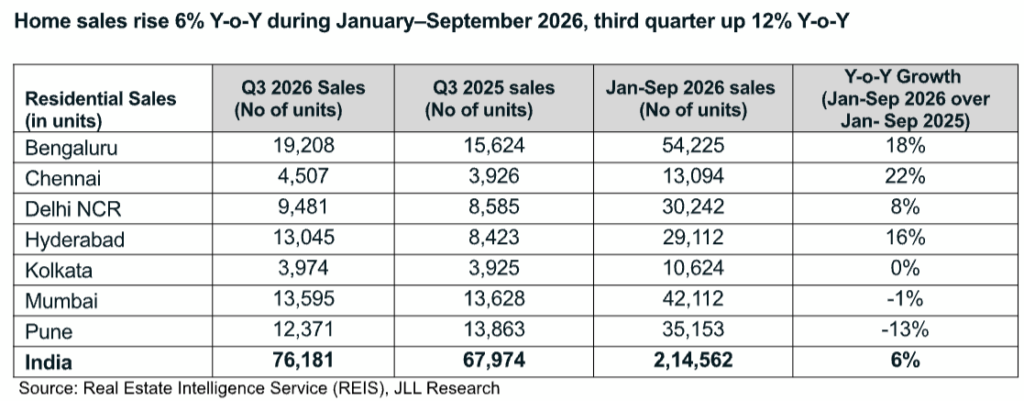
Among the major housing markets, Chennai recorded the highest annual growth in sales at 22% during the first nine months of 2026. Bengaluru followed with an 18% increase, while Hyderabad reported 16% growth.
India’s housing market is showing signs of a recovery, but the revival is being driven largely by buyers looking at more expensive homes. Sales across the country’s top seven residential markets rose 6% year-on-year (Y-o-Y) to 2,14,562 units between January and September 2026, reversing the 12% decline recorded during the same period last year, according to a JLL report.
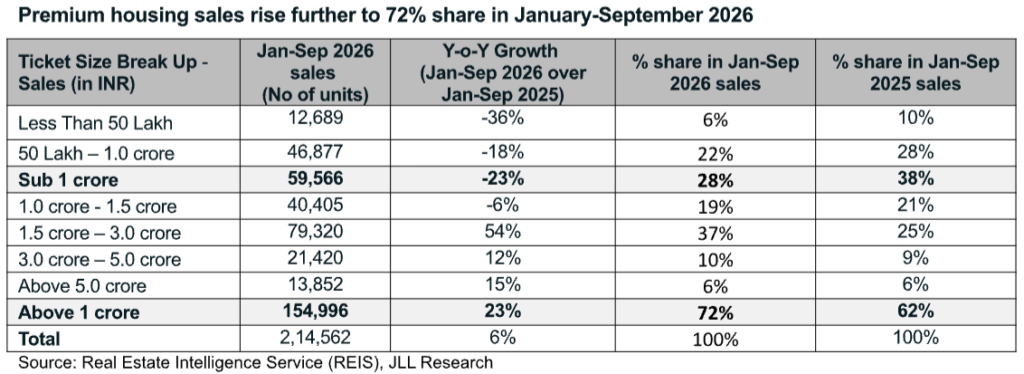
Homes priced at ₹1 crore and above accounted for much of this growth. Sales in this category increased 23% Y-o-Y, taking its share of the overall market to 72%, compared with 62% a year ago. The ₹1.5–3 crore segment was the strongest performer, recording a 54% rise in sales.
The picture was quite different at the lower end of the market. Sales of homes priced below ₹1 crore fell 23% during the nine-month period, suggesting that rising property prices and affordability concerns are continuing to weigh on budget-conscious buyers. The growing preference for larger homes with better specifications and amenities has also shifted demand towards higher price brackets.
Chennai, Bengaluru and Hyderabad lead sales growth
Among the major housing markets, Chennai recorded the highest annual growth in sales at 22% during the first nine months of 2026. Bengaluru followed with an 18% increase, while Hyderabad reported 16% growth.
Bengaluru, Mumbai and Pune together accounted for 60% of housing sales across the seven cities, retaining the same combined share as in the corresponding period last year. These markets continue to be the biggest contributors to residential demand.
The momentum was also visible in the July-September quarter. Housing sales across the seven cities rose 12% sequentially to 76,181 units. Hyderabad led the quarterly growth with a 70% increase, followed by Kolkata at 28% and Bengaluru at 13%. Sales, however, slipped 5% in Delhi-NCR and 2% in Mumbai compared with the previous quarter.
The shift towards premium homes is also changing what buyers look for in a property. Location, construction quality, amenities and the developer’s track record are increasingly influencing purchase decisions. Buyers appear more willing to pay a premium for projects by established developers, particularly where there is greater confidence in construction quality and timely delivery.
Siva Krishnan, Senior Managing Director (Chennai & Coimbatore) and Head – Residential Services, India, JLL, said the ₹1.5–3 crore category had emerged as the biggest growth driver, with sales rising 54% year-on-year. Developers have responded by increasing launches in this segment, with supply rising sharply during the period.
He added that the difference in demand between premium and mass housing was becoming more pronounced, while cities such as Bengaluru, Chennai and Kolkata were also seeing stronger property price appreciation.
Sales value rises faster than volumes
The shift towards higher-priced homes is also reflected in the value of residential transactions. The total value of homes sold across the seven cities increased 15% year-on-year during January-September 2026, outpacing the 6% rise in the number of units sold. Strong demand for premium properties was a major contributor to this increase.
Developers, meanwhile, have stepped up new supply to cater to buyers willing to spend more. Housing launches across the seven cities rose 15% year-on-year to 2,59,425 units during the first nine months of 2026.
Bengaluru recorded the sharpest increase in launches at 41%, followed by Hyderabad at 37% and Mumbai at 24%. Kolkata, Chennai and Pune, on the other hand, saw a decline in new supply.
The pace of launches picked up further in the September quarter. Developers introduced 90,918 units, a 28% increase over the 70,915 units launched in the corresponding quarter last year. Launches were also up 16% compared with the preceding quarter.
Property prices continue to climb
The growing demand for premium housing has kept property prices on an upward trajectory across most major markets.
Bengaluru recorded the highest annual increase in capital values at 15% in the September quarter. Chennai followed with a 12% rise, while Kolkata saw prices increase 11%. Delhi-NCR and Mumbai reported annual appreciation of 10% and 8%, respectively.
Pune recorded the lowest increase among the seven markets, at 6%, in line with its relatively softer sales performance in recent quarters.
Premium housing likely to remain the main growth driver
The premium housing segment is expected to remain the mainstay of residential demand over the coming months. Buyers with higher purchasing power are likely to continue looking for larger homes, better amenities and projects in well-connected locations. Developers are expected to keep a close eye on this demand while deciding the size, pricing and location of new launches.
Cities such as Bengaluru, Chennai and Kolkata could see further price increases, supported by demand for quality homes, limited availability of suitable projects and rising construction costs.
The outlook is less encouraging for affordable and mass housing. Higher property prices and borrowing costs could keep buyers in these categories cautious, particularly those who are already stretching their budgets to afford a home.
The market is therefore likely to see a difference in fortunes between the two ends of the housing spectrum. While premium home sales and overall transaction values may continue to grow, a broad-based recovery in sales volumes will depend on whether homes become more affordable for middle-income buyers.