

How Delhi-NCR’s peripheral belt could emerge as real estate’s next growth frontier
Backed by the NCR Regional Plan 2041, emerging corridors such as Jewar, Sonipat, Bhiwadi, Rewari and Meerut could witness significant real estate activity as transit infrastructure, smart townships and logistics hubs drive decentralized growth across the region.
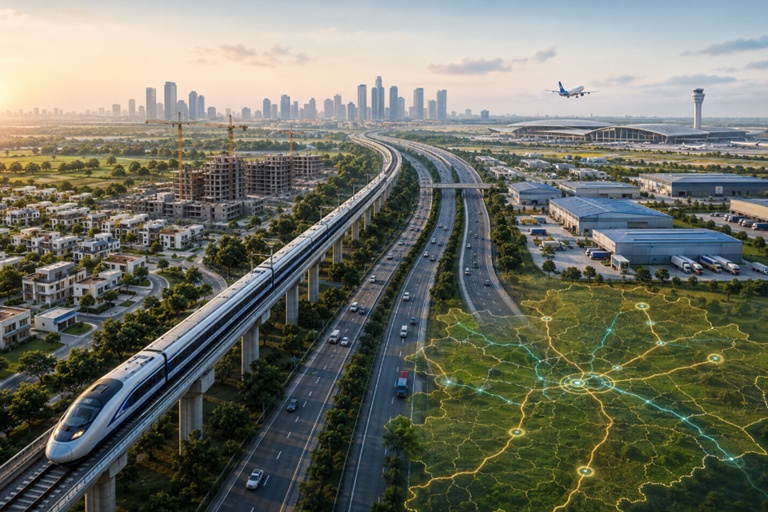
The Draft NCR Regional Plan 2041 is best read as a directional commitment with execution discount. (AI Image)
The Delhi NCR Regional Plan 2041 is a proposed draft development plan involving Delhi, Uttar Pradesh, Haryana and Rajasthan. It outlines an ambitious vision to reshape Delhi-NCR into a more connected, decentralized, and future-ready urban region. Central to the plan is the creation of 5-8 townships across Haryana, Uttar Pradesh, and Rajasthan, supported by high-speed rail and regional transit networks that aim to make travel between Delhi and major NCR cities possible within 30 minutes. Its core logic is sound:
* Decongest Delhi by building economic mass at the periphery
* Stitch the region together with high-speed transit
* Formalise the unregulated land economy that has grown between jurisdictions
The strategy seeks to reduce pressure on Delhi by fostering self-sustaining growth hubs, improving housing and infrastructure, and accommodating the region’s rapidly expanding population through an estimated investment of over INR 20 lakh crore over the next 15 years.
Ankita Sood- National Director- Research, Knight Frank India said, “NCR is projected to absorb an additional population larger than Spain’s between now and 2041- a scale of demographic pressure that demands a fundamentally different planning response. What sets this plan apart is the quantum of physical infrastructure already committed, the operational Delhi–Meerut RRTS, the KMP corridor running from Kundli to Palwal, and the Noida International Airport (Jewar) under development – which gives this plan more real-world anchors than its predecessors had. For the first time, Sonipat, Bhiwadi, Meerut, and Alwar are being planned as deliberate growth destinations and not peripheral towns connected to Delhi through transit rather than dependent on it. If even partially executed, that shift will change the investment geography of northern India.”
Critical caveat
Every previous NCR plan has said some version of this and the gap between notification and ground reality has been wide. Regional Plan 2021’s highway corridor zones took years to filter into state master plans. Delhi’s Land Pooling Policy is still largely stalled eight years after notification. The TOD framework in this plan is left entirely to individual states to operationalize, with no common Floor Area Ratio (FAR) benchmark across Delhi National Capital Territory (NCT), Haryana, UP, and Rajasthan.
The Draft NCR Regional Plan 2041 is best read as a directional commitment with execution discount. The direction is right and the ambition is appropriately scaled. But the plan’s value to investors, developers, and policymakers will be determined not by what was approved in today’s Planning Board meeting, but by which state moves first, which corridor gets notified earliest, and whether the Centre steps in to bridge the coordination gap that four-state planning has never managed to close on its own.
Infrastructure-led urban transformation
The plan’s infrastructure thesis is structurally coherent but operationally fragile. It bets that formalized land plus connected transit equals private capital mobilization a sequence that has worked in single-jurisdiction Indian urban markets before but has never been tested at this scale across a four-state geography with no unified delivery authority.
The Ring of Opportunity
The plan designates the KMP–Eastern Peripheral Expressway belt as Central NCR’s Ring of Opportunity, mandating formal notification of all non-notified land pockets within the CRE-I boundary. This ends decades of regulatory limbo for peripheral land sitting between Delhi, Haryana, and UP jurisdictions giving it a defined FAR and use-permission pathway for the first time.
The 30-Minute Connectivity Target
The plan’s headline ambition is 30-minute travel time between Delhi and all major NCR cities via high-speed mass transit rail. The Delhi–Meerut RRTS is the only operational proof point today. Every other proposed corridor remains unfunded and unsequenced. Until a corridor-by-corridor financing architecture is committed, we feel delivery will be negotiated project by project not driven by the plan’s 2041 horizon.
The INR 20 Lakh Crore
The plan estimates that accommodating over three crore additional residents and upgrading infrastructure for the existing population will require over INR 20 lakh crore in combined housing, transport, and civic infrastructure investment through 2041. This is not a government budget commitment, it is an aggregate capital mobilisation signal directed at public agencies, state governments, and private developers collectively.
Transit-Oriented Development (TOD) as a real estate catalyst
TOD is the plan’s most direct real estate underwriting tool. The shift from a fixed 500m Highway Corridor Zone to a 1km band around all RRTS, MRTS, DFC corridors, expressways and national highways with higher FAR and vertical-plus-horizontal mixed use is a meaningful density unlock. The immediate actionable corridor is Delhi–Meerut RRTS, with Gurugram–Manesar–Rewari and Sonipat–Panipat metro extensions following in the medium term.
Risk
The plan leaves TOD delineation and FAR benchmarking entirely to individual states with no NCR-wide standard. Haryana – given its track record on FAR liberalization in Gurugram and Manesar will almost certainly move faster than UP or Rajasthan. That asymmetry means the unified corridor economics that make TOD bankable at scale could fragment in practice.
Rise of new growth corridors and decentralization
The plan’s decentralization thesis is its most structurally forward-looking element. The proposed CRE-II and CRE-III orbital loops running through Panipat, Shamli, Meerut, Jewar, Bhiwadi, and Rewari are essentially a second and third ring road network wrapped around NCR’s existing radial structure, deliberately designed to route industrial, logistics, and residential demand away from the saturated Gurugram–Noida core.
The under-radar markets
The CRE-II loop deliberately bypasses Central NCR, passing through currently undervalued land markets Bhiwadi–Neemrana, Bawal–Dharuhera, and the Jewar catchment — where land values today sit at a fraction of equivalent Gurugram or Noida locations. The proposed 5–8 greenfield smart townships distributed across sub-regions, modelled on Dholera and AURIC, represent new city-scale development in geographies that have no current formal urban identity.
Logistics and industrial hubs strengthening NCR’s economic competitiveness
The regional development plan’s proposals of granting warehousing ‘industrial status’, permitting multi-storey warehouse conversion, mandating Integrated Freight Complexes at all 1-lakh plus population urban peripheries by 2026, and clustering logistics parks between the first and second Orbital Rail Corridors are key direct responses to multiple, long-standing issues such as fragmented land titles, inconsistent state-level industrial-versus-commercial classification for warehouses, and the absence of a unified approvals window.
The integrated logistics network concept placing logistics nodes around CRE-I/II/III and near IGI, Jewar and Hisar airports effectively pre-positions the next generation of Grade-A warehousing demand away from the currently saturated NH-8 and KMP corridors. If the policy is implemented uniformly, it could shift cap rates on logistics assets in second-tier NCR locations closer to those currently commanded only by Bhiwandi or Chakan in Maharashtra, for example.
Brownfield redevelopment, greenfield townships, affordable housing
The plan’s identification of specific brownfield redevelopment targets i.e. Okhla and Badli in Delhi, Faridabad and Bahadurgarh in Haryana, Ghaziabad-Modinagar-Meerut in UP combined with the FAR 400%+ recommendation for regeneration zones and the escrow-based fund-management mechanism for industrial land conversion, is more granular than what Regional Plan 2021 offered.
The 40% redevelopment-led housing demand estimate for Delhi is notable and if even partially realized, it is expected to change the residential absorption trends for Delhi’s resale and redevelopment-driven new-supply pipeline, which is often flagged as supply-constrained relative to NCR peripheral markets.
On greenfield townships and affordable housing, however, the plan largely restates existing frameworks (PMAY, National Urban housing and Habitat Policy 2007, Transferable Development Rights, land pooling) without addressing the core friction that affordable housing margins in NCR peripheral markets have compressed to the point where many listed developers have already pivoted toward premium and luxury segments, a trend visible in launch-mix data across Gurugram and Noida over the past few years.
The 5–8 proposed smart townships are viable in concept but carry the same delivery risk as every Indian greenfield city project since GIFT City which itself took over a decade from notification to functional occupancy. NCR’s greenfield townships will need the same sequencing infrastructure and anchor demand committed before land banking translates to real development.





1 thought on “How Delhi-NCR’s peripheral belt could emerge as real estate’s next growth frontier”