

India’s structural growth story intact despite global market cap ranking slip: Bajaj Finserv AMC
India’s decline in global market-cap rankings reflects AI-driven capital concentration in Taiwan and South Korea rather than any weakening of domestic fundamentals.
India remains a structural story for investors based on domestic growth as well as earnings diversification and lower dependence on global technology cycles. (AI Image)
Has India really lost its edge as an investment destination? Not quite, says Bajaj Finserv AMC. The fund house contends that India’s slip behind Taiwan and South Korea in global market-cap rankings reflects the current AI-fuelled concentration of global capital rather than any weakening in the country’s economic fundamentals. Beneath the rankings shuffle, India’s structural growth story remains largely unchanged.
Different Growth Engines, Different Outcomes
While Taiwan and South Korea are closely tied to global technology cycles like semiconductor and electronics supply chain, India continues to be a broadly diversified domestic-economy- led market with healthy weightages towards financials, consumption and information technology. “India remains well exposed to local demand themes,” Bajaj Finserv AMC added.
India Vs Taiwan & Korea: Diversified Vs Concentrated Markets
Bajaj Finserv AMC noted that India is far more diversified compared to its regional peers. India’s largest sector financials commands close to 29% weightage while South Korea’s IT and Taiwan’s Technology sector command weightages of around 61% and 88%, respectively. On a stock level, India’s biggest stock commands about 6.6% of the index weightage compared with Taiwan’s top stock which commands nearly 57%. India’s domestic focus also means earnings are much more diversified.
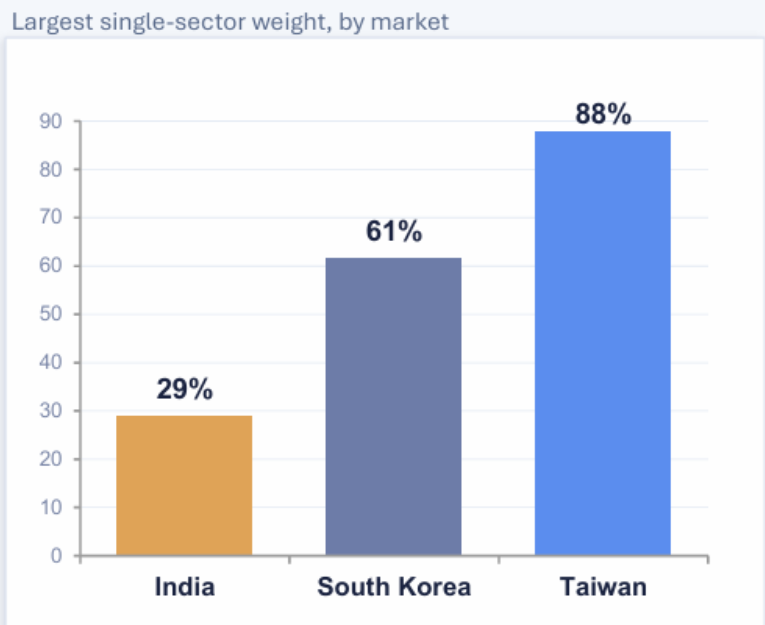
Investment theme for Taiwan and South Korea Vs India
While we believe tactical opportunities will continue to exist for Taiwan and Korea based on themes such as artificial intelligence and semiconductors or global manufacturing and trade cycles, India remains a structural story for investors based on domestic growth as well as earnings diversification and lower dependence on global technology cycles.
While stock markets can exhibit leadership changes based on global themes played out in capital markets, the structural growth drivers of the Indian economy look intact. Therefore, investors focussed on long-term returns can still find India to be one of the most attractive opportunities in emerging markets with its broad-based economy, wide market participation and strong consumption demand.”