
IBC recoveries under pressure as 76% cases breach statutory timeline
The insolvency system will continue to produce low realisation values because its fundamental structural problems remain unaddressed.
Unless structural bottlenecks are addressed, liquidation is expected to remain a preferred closure route. (AI Image)
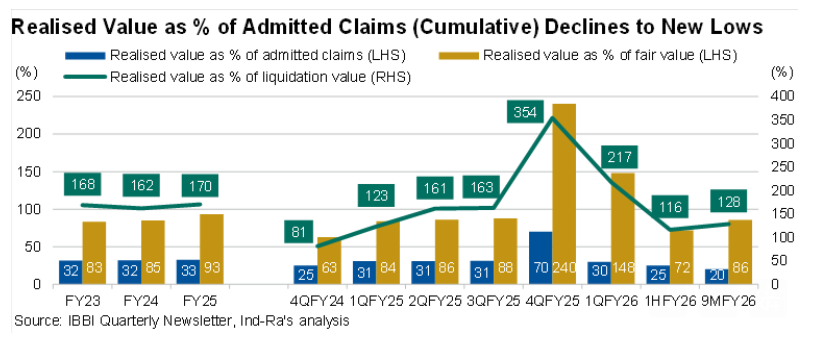
India Ratings and Research (Ind-Ra) opines that India’s insolvency resolution landscape is likely to focus more on recovery efficiency as resolution-to-liquidation ratios increase, despite declining realisations. The third quarter of FY26 showed a 20% realisation rate, which dropped from the previous quarter’s 25% rate during 2QFY26. The third quarter of FY26 showed a 1.6x increase in liquidation case resolutions compared to 2QFY26 when they stood at 0.7x, which suggests organizations might be changing their recovery methods. Ind-Ra, however, notes that recovery timelines remain lengthy, with 76% of ongoing CIRP (Corporate insolvency Resolution Process) cases exceeding statutory limits (30 September 2025: 77%) and addressing this may take time.
Realisations Likely to Stay Weak, despite Higher Resolution Counts: The insolvency system will continue to produce low realisation values because its fundamental structural problems remain unaddressed, according to Ind-Ra. The Standing Committee on Finance reports that the Insolvency and Bankruptcy Code (IBC) has made progress in insolvency results yet the system continues to suffer from delayed proceedings and insufficient asset valuation which lowers recovery funds. The framework needs better institutional strength and transparent operations together with simplified procedures which should serve small businesses and their micro and medium-sized enterprise counterparts. The current situation remains aligned with Ind-Ra’s assessment because Indian recoveries depend on how well organizations perform their duties instead of the strength of statutory measures like IBC. The third quarter of FY26 showed that resolution cases reached 1.6 times the number of liquidation cases which had been at 0.7 times during the previous quarter, thus showing a growing difference between resolution numbers and recovery values.
The third quarter of FY26 showed that operational creditors (OCs) achieved 25% recovery through the CIRP resolution plan which stayed the same as the previous year’s third quarter. The corporate debtor recovery rate stayed at 18% during 3QFY26 while financial creditors achieved a 32% recovery rate which represents a 1% increase from 3QFY25 but remains within the 31%-34% range which started during FY23.
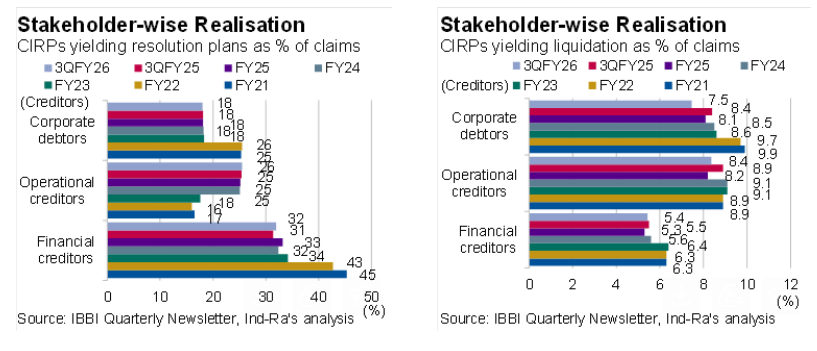
Resolution Preference to Deepen as Creditors Prioritise Value Preservation: Ind-Ra predicts creditors will choose resolutions instead of liquidations because they tend to resolve matters through restructuring which led to a 1.6x resolution-to-liquidation ratio in 3QFY26 (2QFY26: 0.7x). The credit ratio showed a sudden increase during this quarter but it could prove to be a temporary spike. The ratio has been moving upward and a ratio above 1x for an extended period would demonstrate that creditors have developed their strategies and they trust resolution methods more than before.
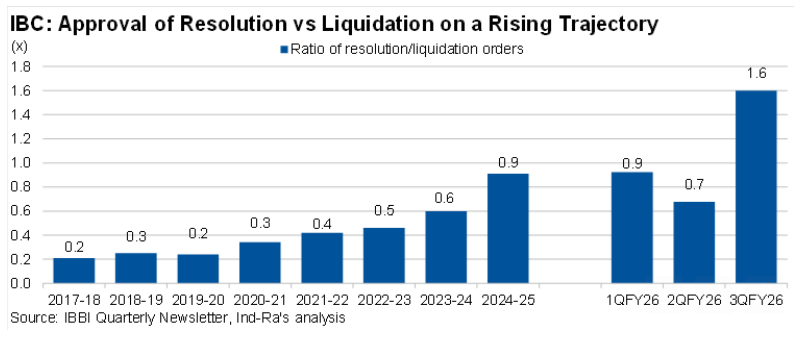
IBC serves as the main system recovery source because it functions as the primary channel which allows organizations to recover their large corporate stressed assets and security receipts (SRs) that derive from corporate non-performing assets (NPAs). The Reserve Bank of India (RBI) shows that the IBC realizable value reached 170.1% of liquidation value at the end of September 2025 (September 2024: 161.1%) which creates a positive trend for SR pools that use large corporate NPAs as security because their main approach involves IBC resolution instead of liquidation.
The Committee of Credits needs to establish better supervisory methods which will protect creditor funds while making the entire system more transparent. The new discussion paper from the Insolvency and Bankruptcy Board of India will create better creditor supervision through its rules which require the Committee of Creditors to document their discussions about recovery estimates and market discovery and applicant ability. The system requires all businesses to perform going concern assessments while it establishes specific guidelines for handling delayed claims and it prevents related operational creditors from participating to decrease conflicts and strengthen process organization.
IBC serves as the main recovery method for stressed assets but the current system will maintain its extended timeframes for both resolution and liquidation procedures because of ongoing obstacles which affect court decisions and asset evaluation and operational procedures. The process of resolving cases through CIRP has extended its duration which now stands at its maximum level since FY21 for FCs, OCs, and CDs. The timeline recorded in 3QFY26 was 745 days for FCs, 751 days for OCs, and 623 days for CDs. The average time taken for resolution through liquidation during 3QFY26 was 533, 539, and 452 days for FCs, OCs, and CDs, respectively.
Recovery for CIRPs yielding liquidation continues to decline for all stakeholders, now around the lowest levels since FY21. The share of ongoing cases under CIRP increased for the 270 days and above category to 76% in 3QFY26 compared to 74% in 3QFY25 (2QFY26: 77%).
Liquidations Will Continue Dominating Closures: Unless structural bottlenecks are addressed, liquidation is expected to remain a preferred closure route—dominating at 42% of the total cases closed (3QFY25: 44%). The closure through the various routes has shown minimal change compared to 3QFY25.
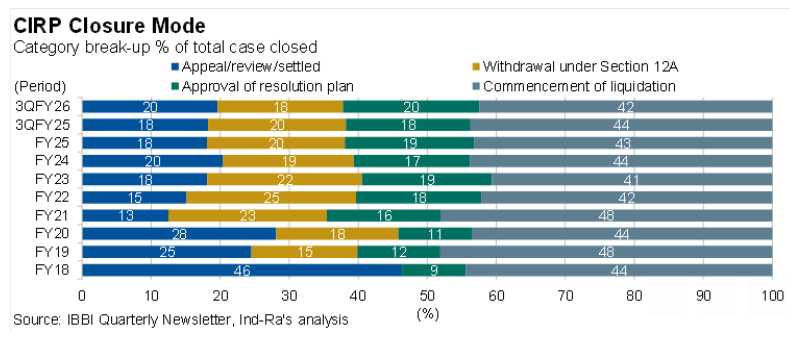
Note: Section 12A was introduced into the IBC by Insolvency and Bankruptcy Code (Second Amendment) Act, 2018 w.e.f. 6 June 2018. It gives power to Adjudicatory authority (AA) to allow withdrawal of case post admission under CIRP if the creditors and applicant have agreed to a settlement. In case the committee of creditor (CoC) is formed post admission, it requires COC with 90% voting share to agree to the applicant’s settlement scheme for AA approval of withdrawal.