
Retail inflation may breach 6% in October; RBI could raise rates by 50-75 bps: Ind-Ra
Rising food and energy prices, a weak rupee and adverse base effects could push retail inflation higher, with Ind-Ra warning that persistent price pressures may prompt the RBI to raise policy rates by 50-75 basis points.
Wholesale Price Index (WPI) inflation averaged 10.4% in the second quarter of FY27, compared with a contraction of 0.3% in the corresponding quarter last year. (AI Image)
India Ratings and Research (Ind-Ra) expects inflation to rise further in the coming months, driven by an unfavourable base effect, weather-related pressures and higher energy prices. The impact is already visible in both wholesale and retail inflation, with a weaker rupee adding to the pressure.
“Wholesale inflation reacts quickly to changes in energy prices, particularly petroleum products. The impact on retail inflation, however, depends on government decisions on taxes and duties, as well as changes in fuel prices at the pump. These prices have not kept pace with movements in global crude oil and petroleum product prices,” says Dr Devendra Kumar Pant, Chief Economist and Head, Public Finance, Ind-Ra.
The agency expects the adverse base effect to keep wholesale inflation under pressure until at least February 2027, with the rate remaining in double digits. Wholesale inflation could cross 12% and retail inflation may breach 6% in October 2026. However, inflationary pressures could ease if the West Asia crisis is resolved. Ind-Ra also sees the possibility of the Reserve Bank of India (RBI) raising policy rates by 50-75 basis points in the current tightening cycle.
Wholesale Inflation: The WPI headline inflation grew 11.39% yoy in September 2026, exceeding Ind-Ra’s expectation of 10.2% and rising from 9.92% in August 2026, due to a broad-based increase across groups and base effect. This was the highest inflation in the new series.
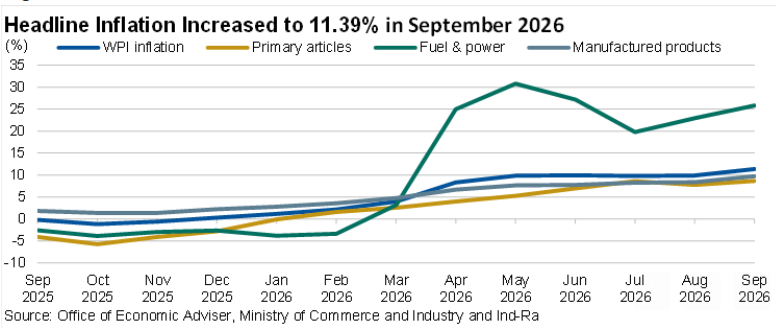
Fuel and power continued to record the highest inflation at 25.85% (August 2026: 22.93%), followed by manufactured products at 9.76% (8.37%) and primary articles at 8.67% (7.76%). Despite continued deflation in electricity prices, elevated crude petroleum prices due to the West Asia crisis pushed fuel and power inflation. This might continue until a permanent solution to the West Asia crisis is achieved.
Manufactured inflation in September 2026 increased for 13 out of 22 sub-groups. Inflation of seven sub-groups in manufacturing – tobacco products, textiles products, chemical products, rubber & plastic products, base metals, electrical equipment, and other manufacturing – accounting for 26.30% weight in WPI (total manufacturing sector weight: 63.13%), maintained double-digit inflation. This suggests WPI inflation is turning structural.
Wholesale Price Index (WPI) inflation averaged 10.4% in the second quarter of FY27, compared with a contraction of 0.3% in the corresponding quarter last year. The sharp rise reflects an unfavourable base effect across segments, along with higher food and energy prices.
Food inflation, which includes primary and manufactured food items and accounts for around 25% of the WPI basket, climbed to 8.66% in September 2026 from 7.05% in August.
Core inflation, which excludes food and energy, also gathered pace, rising to 9.82% in September from 8.14% in August. This was the highest reading in the new series. Higher energy costs, more expensive raw materials and intermediate goods, and a weaker rupee contributed to the increase.
Inflation in the Output Produce Price Index (OPPI) also rose, reaching 11.39% year on year in September, against 9.81% in August. The increase was broad-based, reflecting price pressures across agriculture, mining and quarrying, and manufactured products.
Retail inflation has followed a similar upward trend. As Ind-Ra had anticipated, Consumer Price Index (CPI) inflation rose to 5.54% in September 2026 from 4.83% in August, exceeding the agency’s forecast of above 5%. This is the highest reading in 21 months and the fourth consecutive month in which retail inflation has remained above 4%, the RBI’s benchmark rate.
Food inflation recorded a 21-month high growth of 7.74% yoy in September 2026 (August 2026: 5.97%; July 2026: 5.52%). Items of mass consumption such as ginger, garlic, and lemon recorded high double-digit growth, while onion recorded triple-digit growth. The rise in food inflation was due to a combination of a) a seasonal increase in food inflation during this period, b) an adverse base effect (food inflation in September 2025 was negative 2.33%), and c) El Nino.
Fuel impact was evident on user groups – transport prices increased 5.0% in September 2026 (August 2026: 4.6%; July 2026: 4.44%), while restaurant & accommodation services grew 9.36% (8.38%; 7.72%), underlining the impact of the ongoing West Asia conflict on commercial liquified petroleum gas.
Overall, 11 of the 12 sub-groups recorded an increase in inflation in September 2026 except personal care group, indicating generalisation of inflation. The latter is classified as discretionary spending. While it remained slow, inflation in the other discretionary spending group of restaurants and accommodation grew 9.36%yoy in September 2026 (August 2026: 8.38%, July 2026: 7.72%).
The 2QFY27 CPI inflation was recorded at 4.9%, same as the RBI’s and Ind-Ra’s forecast.
Adverse base effect of food inflation in October 2025 (negative 5.0%) could push food inflation in October 2026 to 9.1%. The headline retail inflation in October 2026 might breach 6.0%, while an adverse base effect will also play its role in higher inflation (headline inflation in October 2025: 0.0%, September 2025: 1.4%). Deflation in Consumer Food Price Index in 3QFY26 is likely to push 3QFY27 food inflation to 9.6%, leading to headline inflation exceeding 6%. Oil prices remaining above USD100/bbl, below normal rainfall, and adverse base continue to be the key risks to inflation in coming months. However, the recent move by the RBI has resulted in the rupee against the US dollar, which if sustained, could provide some relief from imported inflation. Ind-Ra expects the RBI to raise policy rates by 50-75bp in the current tightening cycle.