
InvITs, REITs AUM may double to Rs 20 trillion by 2030-31: ICRA
ICRA expects road, transmission, renewable energy and commercial real estate assets to drive growth, with regulatory changes and rising domestic investor participation supporting the expansion.

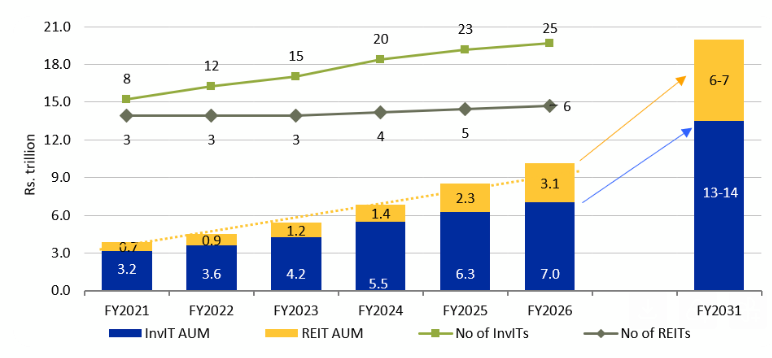
ICRA expects InvITs to account for around Rs 13.5 trillion of the projected AUM by 2030-31, while REITs could reach around Rs 6.5 trillion. (AI Image)
The combined assets under management (AUM) of infrastructure investment trusts (InvITs) and real estate investment trusts (REITs) could double to around Rs 20 trillion by 2030-31 from about Rs 10 trillion in 2025-26, according to ICRA.
The rating agency expects the sector to grow at a compound annual growth rate (CAGR) of around 15% over the next five years. Continued monetisation of road and transmission assets, expansion of renewable energy and fibre platforms, and wider use of REITs in commercial real estate are expected to drive growth. Warehousing and data centres could also emerge as important new areas for these investment vehicles.
The sector has already expanded sharply in recent years. Combined AUM of InvITs and REITs rose from around Rs 4 trillion in 2020-21 to about Rs 10 trillion in 2025-26.
ICRA expects InvITs to account for around Rs 13.5 trillion of the projected AUM by 2030-31, while REITs could reach around Rs 6.5 trillion.
“The InvIT and REIT ecosystem has reached a scale that can support meaningful growth across both traditional and emerging asset classes,” said Anupama Reddy, Vice President and Group Head, Corporate Ratings, ICRA.
She said continued monetisation of infrastructure assets and the emergence of new asset classes could create further growth opportunities. Greater participation from domestic institutional investors and recent regulatory changes could also give these vehicles more flexibility in raising funds.
Historical AUM of InvITs & REITs and potential future growth
Source: ICRA Research; Bharat InvIT Association, Indian REIT Association
InvITs see strong growth
InvITs have been a major contributor to the expansion of the sector. Their AUM increased to around Rs 7 trillion in March 2026 from Rs 3.2 trillion in March 2021, a CAGR of about 17%.
Road assets have emerged as the fastest-growing segment. Their share of InvIT AUM increased to 43% in March 2026 from 16% in March 2021. Telecom remained marginally ahead, accounting for around 44% of AUM.
REITs have grown even faster, although from a smaller base. Their AUM rose to around Rs 3.1 trillion in March 2026 from about Rs 0.7 trillion in March 2021, translating into a CAGR of roughly 33%.
Office properties continue to form the core of REIT portfolios, although retail and warehousing are gradually gaining a larger presence.
As of 2025-26, the sector comprised 25 InvITs and six publicly listed REITs.
Regulatory changes could widen funding options
A series of regulatory changes over the past decade has also helped the sector mature. Among the latest measures, REITs were reclassified as equity for mutual fund investment purposes in January 2026. From October 1, 2026, banks will also be allowed to lend directly at the REIT level.
According to ICRA, these changes could help attract more capital, broaden funding sources and make it easier for REITs to access longer-tenure debt.
The widening of the definition of a strategic investor to include all qualified institutional buyers has also increased the pool of domestic investors that can participate in the sector.
Domestic institutional participation is already increasing. Mutual funds’ exposure to InvITs and REITs rose 56% year-on-year to more than Rs 310 billion as of June 2026. Insurers, pension funds, sovereign funds and retail investors have also increased their participation.
Investor interest has been supported by returns from seasoned issuances. ICRA said these have recorded a median extended internal rate of return (XIRR) of around 14%. Borrowing spreads have also narrowed relative to government securities (G-Secs) and AAA-rated corporate bonds, according to the rating agency.
“Domestic capital is expected to play a progressively larger role in the next phase of growth,” Reddy said.
Fundraising gathers pace
Fundraising by InvITs and REITs has also picked up as the market has matured.
Since 2019-20, the two segments have collectively raised around Rs 200 billion through public issues, private placements, preferential allotments, institutional placements and rights issues. InvITs accounted for nearly 80% of the total amount raised.
Almost half of the cumulative capital raised since 2019-20 came in the last three years, indicating a sharp increase in fundraising activity.
One of the key attractions of InvITs and REITs is their ability to unlock capital from operational infrastructure and real estate assets and redeploy it into new projects. This recycling of capital is expected to remain important as the sector expands.
However, ICRA cautioned that rapid growth will need to be accompanied by disciplined borrowing and asset acquisition.
Refinancing requirements, restrictive covenants at underlying special purpose vehicles, property and asset valuations, concentration of cash flows and changes in taxation will remain important factors to watch.
Maintaining adequate liquidity, spreading out debt maturities and ensuring efficient cash-flow pooling will be critical for InvITs and REITs to maintain their credit strength as their combined AUM moves towards the projected Rs 20 trillion by 2030-31.