

Office segment dominates as PE investments reach $637 mn in Q1: Knight Frank
Office remains the anchor of institutional confidence, and domestic capital’s leadership reflects both the maturation of Indian alternative asset management and the relative friction still facing cross-border capital.

Office assets led investment activity with USD 529 mn, accounting for 83% of total inflows across four transactions. (AI Image)
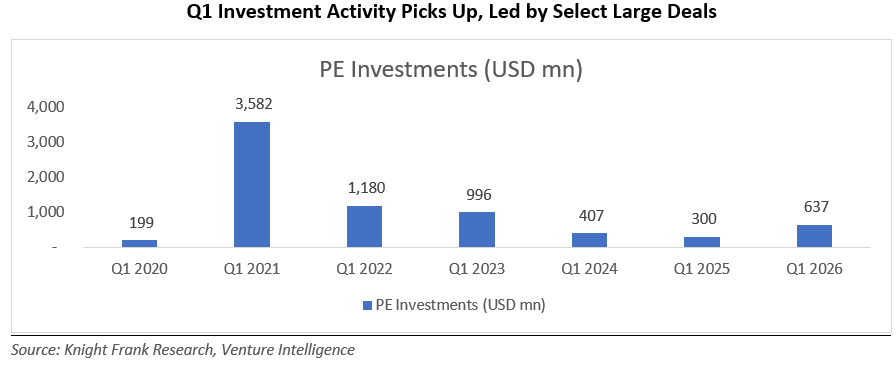
Private equity investment in Indian real estate recorded USD 637 million (mn) across 9 transactions in Q1 2026, marking a 2.1x increase over Q1 2025 (USD 300 mn across 3 deals), according to knight frank india. While the increase reflects improved transaction activity, investment momentum remains selective and is largely being driven by domestic capital, against a backdrop of continued global uncertainty.
Office remains the preferred asset for investment
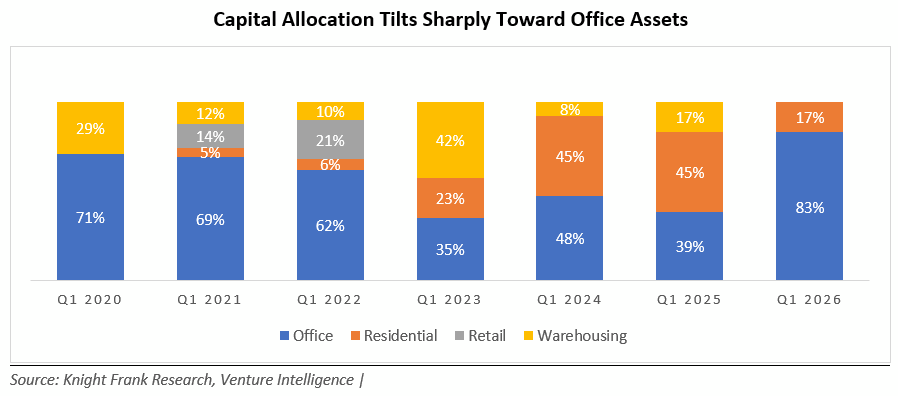
Office assets led investment activity with USD 529 mn, accounting for 83% of total inflows across four transactions. All deals involved stabilised, income-generating assets, indicating a clear investor preference for yield visibility and asset-level security over development exposure. Three of the four transactions were structured as equity, suggesting improving conviction on pricing for leased office assets.
Residential capital continues to favour structured credit
Residential investments totaled USD 108 mn over five deals (17% of activity). The quarter was still highly debt-led with four of five deals being debt financings. Capital was deployed into mid-income as well as luxury projects across different stages of development, showing that preserving downside remained a key focus for investors in a sector where exits can be less certain.
Warehousing and retail record no transactions in Q1 2026
There were no deals done within warehousing and retail sub-sectors in Q1 2026 compared to combined investment volume of USD 885 mn in 2025. Within warehousing, deals velocity continued to soften due to a more cautious underwriting environment from higher cost of financing and fewer stabilized, institutionally owned assets coming to market at attractive entry yields.
Retail’s inactivity is consistent with its historically episodic investment pattern. Capital deployment in this segment has been confined to select large-format, high-quality assets, and no such opportunity closed in the quarter. Both segments are expected to see renewed activity as the year progresses, with investor interest in income-producing assets remaining intact.
Capital deployment concentrated in select markets
Deal flows continued to be dominated with NCR attracting USD 411 mn (65%) and Pune USD 203 mn (32%) of total investments. Mumbai also did not see much investment activity at USD 23 mn. A deal reported between a Japanese investor and an Indian listed real estate player across multiple cities led by Bengaluru was undisclosed.
Deal concentration once again highlights the risk-adjusted deployment strategy with investments focussing on markets with better leasing depth, institutional caliber assets and exit clarity.
Domestic capital anchors activity amid global caution
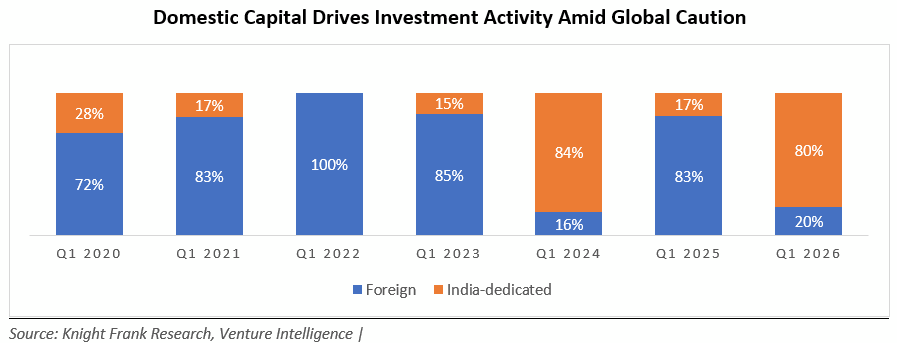
Indian funds invested USD 510 mn, accounting for 80% of total investments and effectively anchoring Q1 activity. This reflects both the availability of domestic dry powder and a more measured approach by foreign investors.
Foreign capital, at USD 128 mn (20%), remains selective, with deployment largely restricted to stabilised assets. Currency hedging costs, valuation gaps, and continued caution toward development risk continue to influence cross-border investment decisions. As a result, current investment momentum is being shaped more by domestic liquidity than by a broad-based return of global capital.
Shishir Baijal, International Partner, Chairman and Managing Director, knight frank india said,“The opening quarter of 2026 confirms a direction if not yet a velocity. The doubling of PE investment volumes relative to Q1 2025, combined with a decisive tilt toward ready office assets and structured residential credit, suggests that investors are increasingly comfortable with the risk-return profile in select segments. Office remains the anchor of institutional confidence, and domestic capital’s leadership reflects both the maturation of Indian alternative asset management and the relative friction still facing cross-border capital. The broader recovery in 2026, which we expect to build through the year, will depend on how quickly valuation alignment improves in the development pipeline and whether the macro environment remains supportive.”