

‘Dhurandhar’ Crafted the Narrative; ‘Revenge’ Cemented It
Dhurandhar 2 not only shattered box office records but also revitalized a stagnating Bollywood—one that many believed had fallen under the grip of an insular “Khan-Johar” nexus.
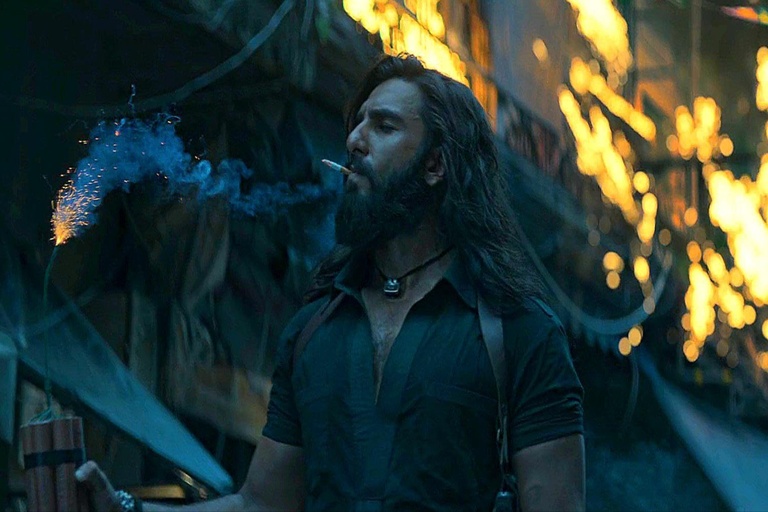
This film will be remembered for its spectacular action sequences. Such breathtaking action choreography had never before been witnessed in Hindi cinema.
By Madhurendra Sinha
By now, you must have realized why the movie Dhurandhar generated such immense buzz. It established a narrative with remarkable finesse. However, Dhurandhar 2 went ten steps further. It not only raked in colossal sums of money but also breathed new life into a moribund Bollywood – a Bollywood that had become a hostage to the “Khan-Johar gang,” but which has now broken its shackles and escaped. Bollywood had reached such a nadir that, within the country, only South Indian films – be it Pushpa, RRR, or Kantara – were genuinely succeeding at the box office. Films produced by the aforementioned “gang” were being propped up through aggressive publicity campaigns, by greasing the palms of social media influencers, and by colluding with multiplex owners. Cinema halls would often contain barely a dozen patrons, yet the marquee outside would boldly proclaim: “House Full.”
The films being produced were created solely to cater to the whims and fancies of this gang. In one such film, a ruthless and murderous ISI agent and a RAW agent are depicted joining forces to fight against extremists. The ISI agent even dances semi-nude and engages in a romantic liaison. Such an absurd film was nevertheless manufactured into a “super-duper hit.” This occurred despite the fact that everyone is well aware of how many of our agents the ISI has tortured to death. Yet, Bollywood – true to form – continues to harbor not just friendship, but even romantic affection for them. However, these two films have thoroughly exposed this blatant lie. Dhurandhar laid bare an uncomfortable truth – backed by irrefutable evidence – without a shred of exaggeration.
The film’s veracity was so compelling that even Pakistanis acknowledged it. Former Pakistani Army Major Adil Raja and his wife, Shamim, conceded that the film deserves a rating of eight or nine out of ten. Several other Pakistani journalists and critics share this view. However, our own homegrown “so-called secularists” and Pakistan-sympathizers do not appear to agree. Many prominent social media influencers – whose follower base consists of hundreds of thousands of Pakistanis and who constantly serve up content tailored to their audience’s tastes – are currently reeling in either rage or shock. Among them is the cunning Kaathi, who boasts millions of Pakistani followers. He had audaciously claimed that he could single-handedly ensure this film’s failure; yet, let alone in India, the movie has turned out to be a super-hit even in Pakistan – despite having been denied official clearance there – with people clandestinely downloading and watching it. Reports suggest that over 4 million pirated copies have been sold there, each priced at 50 Pakistani rupees. Furthermore, people are finding various other means to watch and enjoy the film. The movie’s songs, in particular, have become immensely popular. The machinations of frauds like Kaathi came to naught, and he ended up receiving a humiliating kick in the teeth. Arfa Khanum, too, suffered a similar rebuff. The poor woman spent four hours watching Dhurandhar 2 and heaped vitriol upon it, yet no one paid her the slightest heed.
But what accounts for the historic success of this film in India? There are numerous reasons. However, in my view, the most significant factor is a sense of vindication. By infiltrating thousands of terrorists into India, Pakistan not only unleashed widespread violence but also publicly humiliated us. While these terrorists were ostensibly religious zealots, the entity behind their deployment was none other than the ISI. From recruitment and radicalization to funding and providing weapons training – the ISI orchestrates it all. Every nation is aware of this reality, yet no Western power – nor the United States – ever stepped forward to assist India. We continued to take the blows; our people continued to be slaughtered. They reveled in their acts of violence, shedding blood and attacking our iconic landmarks.
Be it the Kandahar hijacking, the mumbai attacks, or the assault on Parliament – every single incident left us wounded and humiliated. We sat idly by, doing nothing, remaining completely passive and silent. But times changed, and with them, the people in power changed as well. Thus began an era of retribution. One by one, the terrorists began to fall. Unidentified gunmen across Pakistan began systematically eliminating those who had launched attacks against India. Even Zahoor Mistry, the mastermind behind the Indian Airlines hijacking, was killed. This film has exposed all those liberal elements who used to advocate for friendship with Pakistan.
It is not as if Aditya Dhar wrote the story out of thin air; he was assisted by a team of serious researchers. Another notable feature of this film is that it unmasked mumbai’s fugitive don, Dawood Ibrahim. He is currently lying ill in his opulent bungalow in Karachi – a fact that is indeed true. Renowned mumbai journalist and former editor Hussain Zaidi recently confirmed in an interview that Dawood is, in fact, ailing in Karachi. It is worth noting that his book, Dongri to Dubai, chronicles Dawood’s life and his escape from India in great detail.
The film features the character of Major Iqbal, an operative of the ISI. It was he who masterminded the mumbai attacks. However, his character appears to be an amalgamation of various figures, notably Ilyas Kashmiri – the man who beheaded a soldier of the Maratha Light Infantry at the border and presented the severed head to General Musharraf. Subsequently, Ilyas was eliminated by the Pakistani government itself, as his stature and influence had grown too formidable. At this juncture, it becomes pertinent to mention Chaudhry Aslam, who carried out numerous high-profile encounters in Karachi. Although the film depicts him being killed by Hamza, the reality is that he was blown up by the Taliban, who targeted him for killing their operatives in staged encounters.
This film will be remembered for its spectacular action sequences. Such breathtaking action choreography had never before been witnessed in Hindi cinema; these scenes rival – if not surpass – those found in Hollywood productions. Most significantly, the film relies on raw, practical action rather than technological crutches – even though these sequences could have easily been created using VFX. This stands as yet another testament to Aditya Dhar’s masterful direction.
In any case, one thing can be stated with certainty: this film is not directed against any specific community or group. If it targets anyone, it is solely the terrorists of Pakistan.
(The author is a senior business journalist of India and a former editor of Navbharat Times)