
Food, global commodity risks push CPI inflation higher in February: SBI Research
While all-India core inflation only increased by 5 bps to 3.40% in Feb’26, the state-wise trend is quite divergent.
Weather patterns along with ongoing geopolitical risks affecting the energy prices can adversely impact inflation in 2026. (Image: Freepik)
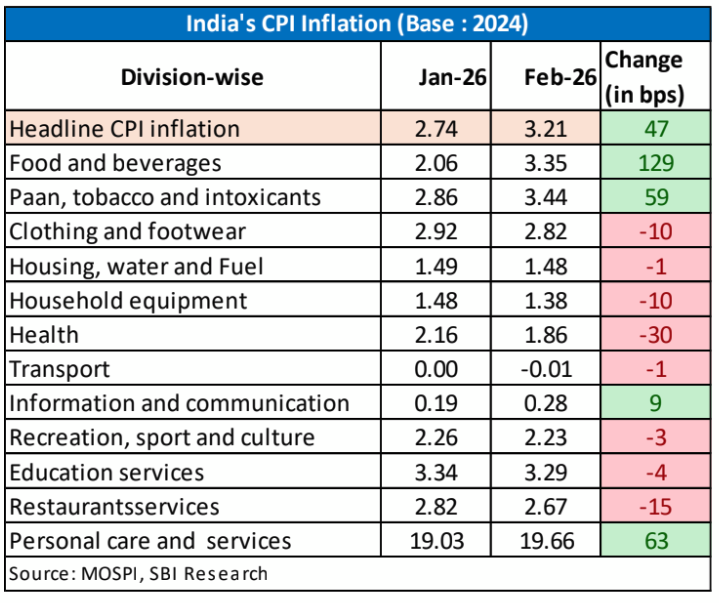
Headline inflation exhibited slight increase in February 2026 as compared to January 2026 and stood at 3.21%. The increase is primarily attributed to food inflation, which jumped by 129 bps to 3.55%. Rural and Urban CPI have witnessed a rising trend in Feb’26 compared to Jan’26 numbers. While Rural inflation is entirely driven by food prices, Urban inflation has mixed trend, according to SBI Research.
While all-India core inflation only increased by 5 bps to 3.40% in Feb’26, the state-wise trend is quite divergent. Telangana core CPI crossed 6% mark in Feb’26. Except a few states like Kerala, WB, Punjab, Maharashtra, etc. the state wise core CPI is greater than Overall CPI across states.
Due to exchange rate fluctuations (rupee dollar exchange rate already hovering between 91-93 per dollar with a negative bias) and external shocks like supply chain disruptions (brent crude flip flopping around $100), imported inflation (weight: 24.4%) is already at 5.7% (245 bps more than the headline) for Feb’26 and is expected to increase considerably further.
The recent forecast for global weather patterns indicate possible build up on El Nino in 2026. The recent trends in Nino 3.4 SST Index shows that ENSO is currently in neutral phase but may transition to positive either in 2026 or in latter part of 2026. As Indian monsoon is influenced with global weather pattern, this along with ongoing geopolitical crisis (price of fertilisers, natural gas and brent crude all imbibing volatilities) is likely to affect inflation in 2026.
Precious metals, that gained some grounds post a steep fall towards end January, are raring to breach the range bound trading, restrained largely by a stubborn Greenback leveraging its ‘safe heaven’ status. However, on an average price basis, Gold, a favourite for hedging amidst risk-on sentiments and a solid debasement component, traded at $5020 in February, against $4753 in January. Even Silver is hovering around $85, and could get a clue from demand revival from new age industries as and when the Middle East tension abates.
Against the claims from the US and allies, the war has lingered and has ensured a near shut down of maritime trade, as also production with no storage capacity to accommodate, or ‘oil on water’ floating around which presses the commodities markets with heightened speculation rubbing shoulders with genuine demands from multiple jurisdictions. “Clearly, the importance of communication, with alternative arrangements for energy security while ensuring a reasoned rationale in curtailing usage wherever possible would go a long way in checking the unwarranted consequences of a war that benefits and enriches a select few, while raising hardships for the world at large by multiple times, its wrath most evident on the fringe,” says Dr. Soumya Kanti Ghosh, Group Chief Economic Adviser, State Bank of India.
CPI INFLATION (BASE: 2024) INCREASED TO 3.21% IN FEB’2025
* India’s Consumer Price Index (CPI) inflation rose to 3.21% in February 2026, up from 2.75% in January 2026, driven by rising food prices. This marks the second consecutive month of increase under the revised 2024 base year series. Food inflation increased to 3.47% in February from 2.13% in January, reflecting heightened price pressures.
* Core CPI increased to 3.40% in Feb’2026, compared to 3.35% in Jan’2026, primarily driven by rising precious metal prices. Personal care inflation is at 19.64% in Feb’26, due to higher gold inflation of 48.16% and silver inflation at 160.84%.
“Although we believe that the current LPG crisis may be resolved going forward, yet if it prolonged, it will impact the states where weight of LPG/piped gas is more as compared to national weight (if prices of LPG are further increased from here!). In states like Mizoram, Manipur and Punjab the weight of LPG/piped gas is more than 2.5% from the overall weight,” says Ghosh.
STATE-WISE CORE INFLATION
* While all-India core inflation only increased by 5 bps to 3.40% in Feb’26, the state-wise trend is quite divergent. Telangana core CPI crossed 6% mark in Feb’26. Except a few states like Kerala, WB, Punjab, Maharashtra, etc. the state wise core CPI is greater than Overall CPI across states.
RURAL & URBAN CPI INFLATION
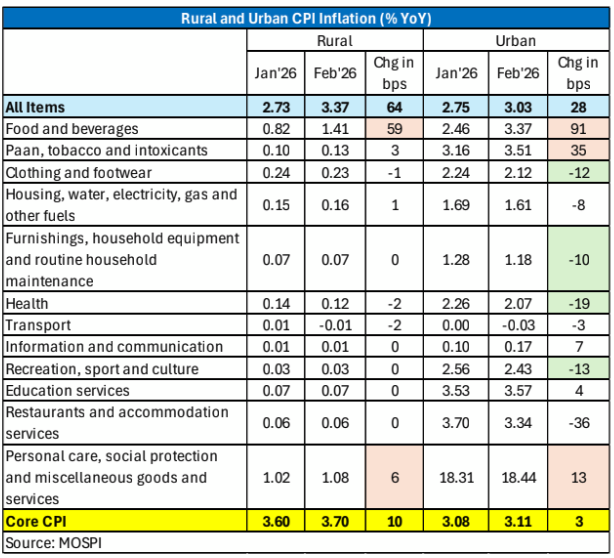
* Rural and urban CPI have witnessed a rising trend in Feb’26 compared to Jan’26 numbers. Rural inflation has risen from 2.73% in Jan’26 to 3.37% in Feb’26 majorly driven by Food and beverages which has witnessed a steep rise from 0.82% in Jan’26 to 1.41% in Feb’26. Further, personal care has witnessed a rise from 1.02% in Jan’26 to 1.08% in Feb’26.
* Urban inflation has risen from 2.75% in Jan’26 to 3.03% in Feb’26 primarily driven by Food and beverages which rose from 2.46% in Jan’26to 3.37% in Feb’26. Further, in the urban basket the rise is also driven by “Pan, tobacco and intoxicants” which rose from 3.16% in Jan’26 to 3.51% in Feb’26. “Clothing and footwear” has declined from 2.24% in jan’26 to 2.12% in Feb’26, Health from 2.26% to 2.07% and “Recreation, sports and culture” from 2.56% to 2.43%.
GLOBAL COMMODITY PRICES
* Global commodity prices as given by the World Bank pink shows higher price increase in case of metals and fertilisers in Jan’26 and Feb’26.
* While platinum and silver shows much higher inflation in yoy terms (above 100%) in both months compared to gold (around 75% yoy), in monthly terms the price of silver and platinum have declined in Feb’26 when compared to Jan’26 prices, gold continues to shine further with its price increasing from $4753 to $5020 per troy oz.
* With West Asia war continuing and strait of Hormuz virtually closed, price of fertilisers, natural gas and brent crude can spike which will translate into higher inflation in the domestic market.
EL NINO TRENDS AND ITS HISTORICAL INFLUENCE
* The recent forecast for global weather patterns indicate possible build up on El Nino in 2026. The recent trends in Nino 3.4 SST Index shows that ENSO is currently in neutral phase but may transition to positive either in 2026 or in latter part of 2026.
* Indian Monsoon are influenced by both ENSO and movements of Indian Ocean Dipole (IOD) and El Nino along with negative IOD typically leads to deficient monsoon (see orange bands). Currently IOD is negative and forecast for El Nino forming range from 40-60%.
* Weather patterns along with ongoing geopolitical risks affecting the energy prices can adversely impact inflation in 2026.




1 thought on “Food, global commodity risks push CPI inflation higher in February: SBI Research”