

India largely insulated from Middle East conflict: Ind-Ra
Ind-Ra suggests that the effect of the conflict between Iran and US allies on the Indian economy largely depends on its duration.
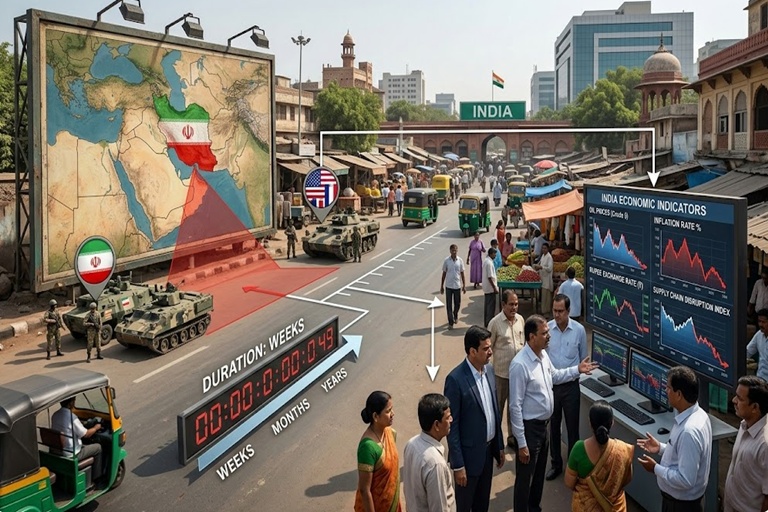
A prolonged conflict could lead to rising crude prices, a wider current account deficit (CAD), pressure on capital flows and the currency, and the transmission of risks to domestic debt and risk assets through the currency channel. (AI Image)
India Ratings and Research (Ind-Ra) believes that the overall economic impact of the conflict between Iran and the US allies on India is expected to be limited, unless the disruption is prolonged. In the short term, the effects are likely to be observed mainly through higher prices for crude oil and petroleum products. Ind-Ra does not foresee an immediate supply shock, as most corporations have adequate inventories. However, if the Strait of Hormuz were to close for an extended period, it could lead to increased costs for fuel, freight, and insurance, longer transit times, and affect the margins and working capital of Indian corporations involved in international trade. However, Ind-Ra notes that volumes are unlikely to be affected unless there is a significant downturn in global demand.
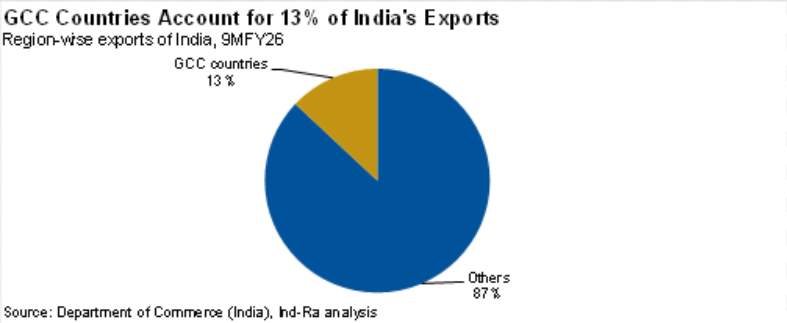
India’s export exposure to the Middle East is relatively modest, with the Gulf Cooperation Council (GCC) countries accounting for only 13% of exports. These exports are primarily concentrated in gems and jewellery, mineral fuels, electrical equipment, and industrial machinery. On the import side, goods from GCC countries make up just 16% of India’s total imports, mainly consisting of crude oil, natural gas, gold, and diamonds.
Limited Economic impact on India: Ind-Ra suggests that the effect of the conflict between Iran and US allies on the Indian economy largely depends on its duration. If the tensions and potential closure of the Strait of Hormuz are short-lived, the impact on India is expected to be minimal. The primary consequence of these tensions is an increase in crude oil and other petroleum product prices. Although petrol and diesel prices are deregulated, it is unlikely that oil marketing companies will immediately raise these prices, thereby insulating inflation from the rise in petrol and diesel costs. However, increases in gas prices could affect fertilizer prices and, consequently, the fertilizer subsidy.
“The Indian Rupee may weaken further as the proportion of GCC in India’s remittances is highest, and a prolonged period of conflict may impact remittance inflow into India. The short-term impact would be increase in commodity prices and some supply disruption. Overall, the impact depends on how long conflict will continue”, says Dr. Devendra Pant, Chief Economist, Ind-Ra.
No Near-Term Supply Shock but Logistics Costs To Increase: Ind-Ra assesses that there is minimal risk of immediate supply shocks due to adequate inventory levels across most sectors. However, if the conflict persists without a near-term resolution, companies could experience a higher cost structure as fuel, insurance, and ocean freight charges rise sharply, along with longer transit times that could strain margins and working capital. Should the conflict extend beyond two-to-three months, supply challenges may arise for companies and industries sourcing inputs from Middle Eastern countries or relying on affected trade routes in the region.
“The impact on account of closure of Strait of Hormuz is likely to be temporary. However, in the event of a long-term closure, it is likely that ships will have to take a longer route through the Cape of Good Hope. This could lead to input cost escalation through (a) a rise in the freight cost by 3%-5%, assuming around 10% increase in bunker fuel costs is fully passed on; (b) longer voyage time and the associated freight costs; (c) increased insurance premiums ranging from 0.1%-0.5%; and (d) additional costs such as war insurance premium, which have historically spiked during such supply chain disruptions. Overall, logistics costs of imports and exports are likely to increase, though volumes are unlikely to be affected based on past experiences”, says Prashant Tarwadi, Director, Corporates, Ind-Ra.
Ind-Ra also notes that regular supply-chain disruptions post COVID-19 and intermittent conflicts have led most companies engaged in global trade to build redundancies into their supply chains, partly through diversification and partly through increased inventories, providing a cushion in the short-to-medium term.
Oil Price Spike Key Near-Term Risk for Oil-Sensitive Sectors: With India’s significant import dependency on crude oil (approximately 88%-90%) and the strategic importance of the Strait of Hormuz, which accounts for 50% of India’s crude oil imports, the primary risk to corporations arises from a potential oil supply shock leading to a spike in crude oil prices. Following the attack on Iran, Brent crude prices surged to USD77-80 per barrel as on 2 February 2026. Ind-Ra highlights that rising commodity costs impacting corporate profit and loss statements could affect sectors such as paints, chemicals, aviation, and oil refineries. However, the impact on the chemical sector will depend on the specific spreads and demand-supply dynamics due to the diverse nature of chemicals. Conversely, sectors like defense may benefit from increased order flows.
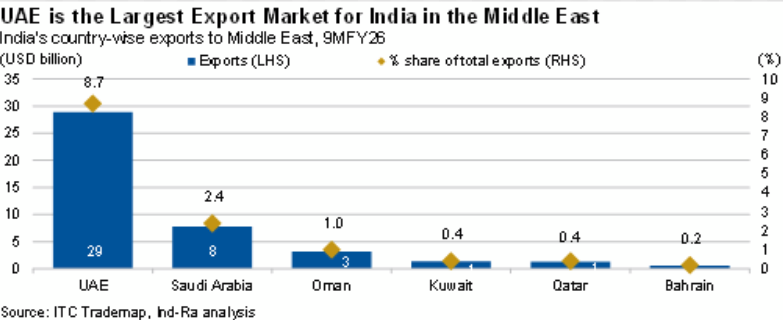
Limited Export Exposure to Middle East: India’s overall export exposure to the Middle East remains largely insulated, with GCC countries contributing only 13% to India’s total exports during the first nine months of fiscal year 2026. Risks are concentrated in a few countries and specific export items. The UAE is the second-largest export destination for India (and the largest among GCC countries), accounting for USD29 billion (8.7%) of total exports, followed by Saudi Arabia, which represented USD8 billion (2.4%) of total exports during the same period. Key export items to GCC countries include gems and jewellery, mineral fuels and oils, electrical equipment, and industrial machinery, which together account for 50% of exports to the region.
Liquidity Remains Supportive Amid Rising Geopolitical Risks: Despite ongoing tensions in the Middle East that continue to affect global sentiment, markets have largely absorbed the shock with minimal reaction, buoyed by expectations of stabilisation. Ind Ra observes increasing global geopolitical and trade risks, noting that while domestic resilience is supported, it is also constrained by limited fiscal space and weak monetary transmission. A brief and contained conflict remains the baseline expectation, with Reserve Bank of India (RBI) managed liquidity helping to maintain supportive financing conditions. Current government securities (G Sec) spreads already reflect moderate geopolitical risk, with limited potential for further widening unless tensions escalate. However, a prolonged conflict could lead to rising crude prices, a wider current account deficit (CAD), pressure on capital flows and the currency, and the transmission of risks to domestic debt and risk assets through the currency channel.