

India’s GDP growth may touch 8.1% in Q3 amid base year shift: SBI Research
India is updating its GDP base year from 2011-12 to 2022-23, with the new series scheduled for release on February 27, 2026.

High-frequency activity data indicates resilient economic activity in 3QFY26. (AI Image)
Despite global headwinds, the Indian economy has maintained strong growth momentum. As per the first advance estimate, GDP is estimated to growth at 7.4% in FY26, with growth largely driven by domestic demand. As per the latest economic Survey, India’s potential GDP is estimated to be around 7% and estimated to grow in the range of 6.8-7.2% during FY27, as per the Research Report from the State Bank of India’s economic Research Department.
The second advance estimates of GDP for FY26, incorporating additional data and revisions, are scheduled to be released on February 27, 2026. So, all the previous quarterly numbers of Q1 and Q2 are expected to change with the base revision to 2022-23.
High-frequency activity data indicates resilient economic activity in 3QFY26. Rural consumption remains strong, driven by positive signals from farm and non-farm activity. Supported by fiscal stimulus, urban consumption shows a consistent uptick since the last festive season.
“Overall, we expect Q3FY26 real GDP growth of closer to 8.1%. Given significant methodological changes, it is difficult to predict the direction of revision,” says Dr. Soumya Kanti Ghosh, Group Chief Economic Adviser, State Bank of India.
India’s New Base 2022-23 GDP is expected to provide better estimate
India is updating its GDP base year from 2011-12 to 2022-23, with the new series scheduled for release on February 27, 2026. This revision, along with an updated CPI base (2024), aims to better reflect the current economic structure, including increased digital commerce and service.
The overhaul includes better measurement of the informal sector and new data sources like GST, potentially placing India as the world’s fourth-largest economy.
The new methodology will incorporate more granular data, including GST records, e-Vahan (vehicle registrations), and information on natural gas consumption, as per The Economic Times.
The update promises improved measurement of the informal economy using quarterly QBUSE bulletins. The Second Advance Estimates of GDP for 2025-26 along with past 3 financial years’ GDP estimates as well as Quarterly GDP estimates as per the new base 2022-23 will be released on 27 Feb 2026.
Global uncertainty remains with New Tariff of 15%
The global economic environment is characterized by high uncertainty, with growth projected at 3.3% both in 2025 and 2026 but remain uneven elsewhere due to geopolitical tensions, high debt, and structural shifts like digitalization and decarbonization.
On February 20, 2026, the US Supreme Court issued a landmark decision that invalidated the POTUS/Administration’s use of imposing tariffs under the International Emergency Economic Powers Act (IEEPA), 1977. The act had never before been used by a President to impose tariffs and does not find much footing in peacetime.
However, the executive has quickly invoked Section 122 of the 1974 Trade Act to impose new 10% global tariff on all imports to US for 150 days (note: this will be the first time Section 122 authority has ever been used). This temporary measure will start from 24 Feb 2026 and ends in July should the Congress not ratify the imposition. Later, the President has further increased this to 15% (the maximum possible allowed).
Under the trade Act, President can impose temporary import surcharges (up to 15%) or quotas to fix US balance of payment issues. It lasts up to 150 days max, unless Congress extends via legislation.
The new 10% tariff has exemptions, including goods from Canada and Mexico that comply with the USMCA, as well as specific, already-in-place national security tariffs. It is expected that during this time, the Administration would complete investigations and levy tariffs using Section 301 and Section 232.
Aggregating Leading Indicators showing an upward Trend
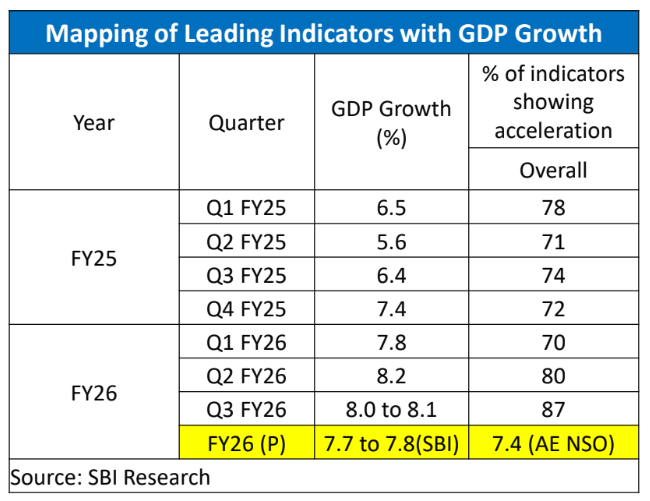
“We track 50 leading indicators in consumption and demand, Agri, Industry, service and other indicators, which indicate significant jump in Q3 FY26 growth (as compared to Q4 FY25). The % of indicators showing acceleration has increased to 87% in Q3, compared to 80% in Q2,” says Dr. Ghosh.
GDP growth as per SBI composite leading indicator (CLI) based on monthly data shows an upward momentum.





1 thought on “India’s GDP growth may touch 8.1% in Q3 amid base year shift: SBI Research”