
Budget 2026-27: Education Budget pivots to jobs, skills, and medical education
Higher education spending and policy measures in the Union Budget 2026 will support upskilling, employability and academic outcomes.
The school and higher education sector has received a higher budgetary allocation in FY27 than FY26 revised estimate. (AI Image)
India Ratings and Research (Ind-Ra) believes the increased budgetary allocation to the education sector combined with a slew of proposed measures in the FY27 union budget, which prioritise fostering creativity, technology adoption and research in higher education, would support upskilling, employability and achievement of higher overall academic standards in the near-to-medium term. The school and higher education sector has received a higher budgetary allocation in FY27 than FY26 revised estimate (RE), which will facilitate the expansion of infrastructure in educational institutions, improve the quality of schooling and enhance access to creative programs in designing and animation, visual effects, gaming and comics (AVGC) sector, and advanced and digital-based learning.
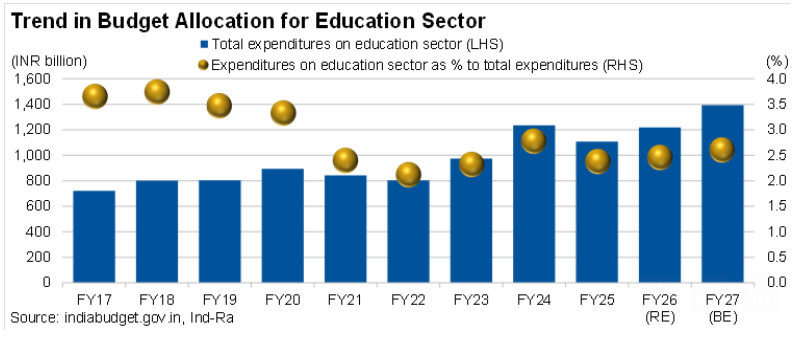
The union government has proposed an allocation of INR1,392.89 billion (14.22% yoy increase) towards the education sector in FY27 (INR1,219.49 billion as per FY26RE). The increased allocation is mainly towards the department of school education, which has been increased by INR129.95 billion (18.42% yoy) to INR835.62 billion as per FY27 budget estimate (BE). Furthermore, the higher allocation as per FY27BE is primarily on Pradhan Mantri Poshan Shakti Nirman (PM POSHAN) scheme (20.28% yoy), Samagra Shiksha Scheme (10.79% yoy) and Kendriya Vidyalaya Sangathan (6.58% yoy). This reinforces policy focus on inclusivity; enhancing school enrolment, attendance and retention; improving learning outcomes; and nutritional support to children from low‑ and middle‑income households.
The union government has increased the allocation towards higher education by INR43.46 billion to INR557.27 billion as per FY27BE, primarily on students’ financial aid under Prime Minister Uchchatar Shiksha Protsahan Yojana, Madhyamik evam Uchchatar Shiksha Kosh, PM Research Fellowship, followed by spending on statutory and regulatory bodies and grants to Indian Institutes of Technology. Commensurate with the emphasis on research and innovation, the union government has increased the fund allocation towards research and innovation in higher education by 208.37% yoy to INR4.18 billion in FY27BE. The union budget has also announced a reduction in the tax collection at source (TCS) to 2% from 5% for overseas education remittances of more than INR1 million. This reduction in TCS on foreign education expenses will provide financial relief to students seeking to pursue international education.
The union budget has focused on improving employability in the services industry through establishing high-powered standing committee, creative and skill-based curriculum embedding artificial intelligence (AI), university townships and five Regional Medical Hubs.
Ind-Ra views the union budget proposal to set up a high-powered ‘Education to Employment and Enterprise’ standing committee, aimed at recommending measures focused on the services sector as a core driver of Viksit Bharat, as directionally positive. The Union Budget has also emphasised creative career opportunities and youth upskilling, and has announced the establishment of a new National Institute of Design in eastern India to strengthen design education in India. The Union Budget proposes to encourage students to pursue creative subjects, which will support the youth in identifying new and emerging career paths. As a policy initiative, the union government will support the Indian Institute of Creative Technologies, Mumbai, in setting up AVGC content creator labs in 15,000 secondary schools and 500 colleges across the country.
The budget has proposed measures to support the biopharma-focused network through the establishment of three new National Institutes of Pharmaceutical Education and Research, and upgradation of seven existing ones. A budgetary allocation of INR100 billion has been announced towards biopharma initiatives for healthcare advancement through knowledge, technology and innovation (SHAKTI) over the next five years. Furthermore, Ind-Ra expects the government’s proposal to launch a scheme to support states in establishing five regional medical hubs, in partnership with the private sector, to strengthen India’s medical tourism sector.