
Leisure travel keeps India’s hotels on growth path as corporate demand faces headwinds

Leisure travel, weddings, and social events will continue to anchor demand, supported by a structural consumer shift towards experience-led spending. (AI Image)
India Ratings and Research (Ind-Ra) expects India’s hotel sector to sustain its structural upcycle in FY27, with revenue per available room (RevPAR) remaining resilient across its rated portfolio despite moderating growth and geopolitical headwinds. Occupancy for Ind-Ra’s peer set is expected to remain around FY26 levels (nearly 74%), supported by a strong leisure demand, social events and a shift in consumer spending towards experiences over goods, although corporate travel may soften due to oil-led cost pressures.
demand-supply growth of 10%–15% yoy is likely to support healthy cash flows across rated entities, even as average room rate (ARR) growth approaches its cyclical peak, signalling pricing stabalisation. Operating cash flows are expected to remain stable, supported by an improved revenue mix. Overall, Ind-Ra expects its rated portfolio to maintain strong credit profiles, with balance sheets adequately positioned to absorb near-term macroeconomic shocks.
“Our baseline estimates on the hotel sector demand and supply growth range from 10%-15% yoy in FY27, leading to sustained robust operating cashflows even as RevPAR growth normalises. Key industry players have focused on brownfield investments and leasing models to swiftly add capacity and capitalise on strong spending trends. We further expect major hotel operators to continue outperforming the industry in FY27, on back of continued industry consolidation. Within segments, leisure and luxury are likely to remain more resilient than the premium and business. Despite strong supply additions, the balance sheet leverage is likely to remain low, with the capacity to absorb the risk of a near-term oil shock,” says Mahaveer Shankarlal, Director-Corporates, Ind-Ra.
Leisure-led demand to Sustain Portfolio Performance; Corporate Travel Faces Oil-Led Risks: Ind-Ra expects continued robust demand momentum across its rated portfolio in FY27, with both demand and supply growing 10%–15% yoy, sustaining occupancy at around FY26 levels (nearly 74%) for its peer set of 13 listed hotel companies. Leisure travel, weddings, and social events will continue to anchor demand, supported by a structural consumer shift towards experience-led spending, although wedding days are marginally lower yoy. However, geopolitical tensions, particularly the Middle East conflict and the resulting oil shock, could weigh on corporate travel demand across rated entities due to rising cost pressures, leading to a divergence between strong leisure demand and relatively softer business segment performance.
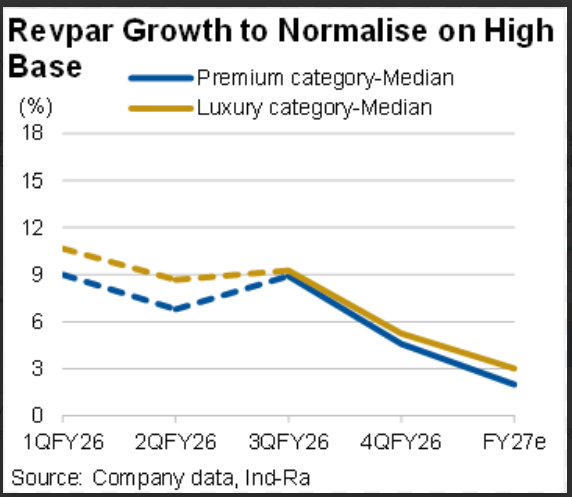
Peak Pricing Cycle; RevPAR to Normalise, But Cash Flows to Remain Healthy: ARR growth across Ind-Ra rated portfolio is expected to peak out in FY27, after growing between 5%–8% in FY26 and wider 2%–13% across the entire peer set. As a result, RevPAR growth is likely to normalise over FY27 but will remain at healthy absolute levels. While Ind- Ra continues to assume through-the-cycle ARR lower than the current elevated levels in its rating case, suggesting muted pricing upside ahead, healthy underlying demand and increasing scale advantages will continue to drive strong operating cash flows across rated companies even as RevPAR growth moderates.
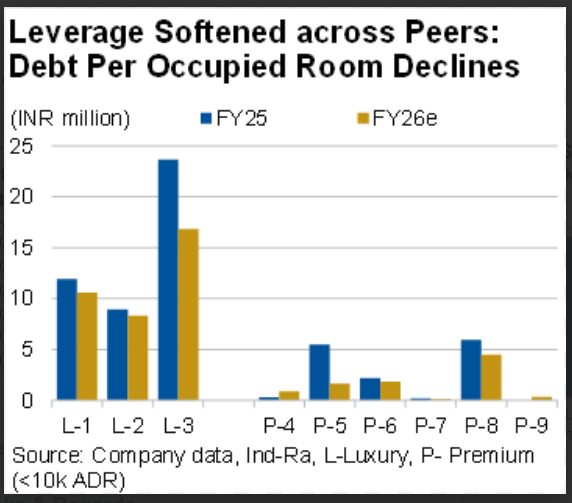
Stable profitability; Expansion & Consolidation Could Lead to Marginal Increase in Leverage: EBITDA margins across Ind- Ra rated portfolio are expected to remain stable to marginally lower at 39%–40% in FY27 (39% in FY25), benefitting from strong revenue mix (banquet, F&B and management contract revenue). Capacity addition has been witnessing strong traction across rated companies on account of brownfield expansions, asset upgrades, adoption of leasing models and few international expansions in gateway cities. This upcycle has also witnessed rising M&A activity in the sector and increase in institutional ownership leading to consolidation with bigger players likely to outperform the market in the long run. Expansion could lead to marginal increase in leverage in coming years but balance sheets across rated portfolio are comfortable and provide enough cushion to absorb near term macros including oil price volatility.





1 thought on “Leisure travel keeps India’s hotels on growth path as corporate demand faces headwinds”