

Indian buyers look overseas for property returns; 61% eye rental income, capital gains
Overseas property is gaining ground in Indians’ investment plans, with rental income, capital appreciation and residency options driving interest across markets.

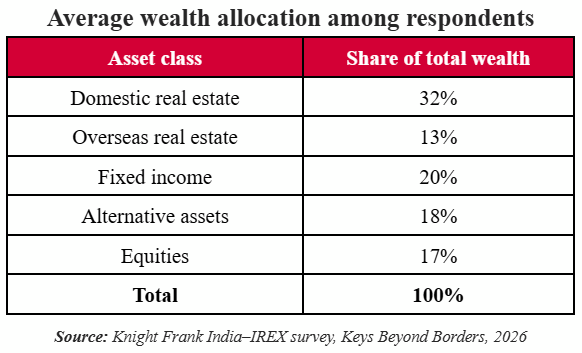
Real estate accounts for an average of 45% of total wealth allocation of the respondents, comprising 32% in domestic property and 13% in overseas property. (AI Image)
A joint survey by Knight Frank India and IREX finds that 61% of respondents want to buy property overseas to earn rental income and benefit from a rise in property values. The UAE, Greece, Thailand, Portugal, Australia, the US, the UK, Bali in Indonesia, Canada and Malaysia are among the destinations they are considering.
The report, Keys Beyond Borders, suggests that Indians are looking at property abroad for reasons that go beyond owning a second home. For many, the aim is to earn rent and make gains over time. Others may be weighing the benefits of residency options, diversifying their investments or meeting lifestyle and long-term financial needs.
The findings relate to the core investible market and do not cover trophy or ultra-prime assets. The survey reflects stated purchase intentions, and not all high-intent responses will translate into completed purchases. All funding discussed assumes full statutory compliance with the Reserve Bank of India’s Liberalised Remittance Scheme (LRS), FEMA and applicable tax rules in India and the destination country. Respondents include buyers and intermediaries answering on their behalf; the sample is not designed to represent all resident Indian buyers.
Shishir Baijal, International Partner, Chairman and Managing Director, Knight Frank India, said, “Overseas residential property is increasingly being considered as part of a broader wealth and investment strategy by Indian buyers. While rental income and capital appreciation remain important considerations, destination choices are also shaped by residency opportunities, lifestyle preferences and the need to diversify assets across markets. It is important to note that this report captures the intent of resident Indian individuals considering overseas residential purchases, viewed in the context of the Liberalised Remittance Scheme (LRS) and the permitted annual remittance limit of US$250,000 per individual. It therefore maps the destinations buyers may consider within this funding framework, rather than representing the entirety of overseas property investment by Indians. The findings highlight the importance of evaluating each market against individual investment objectives, budgets and regulatory considerations.”
Overseas property gains a larger share of wealth portfolios
Real estate accounts for an average of 45% of total wealth allocation of the respondents, comprising 32% in domestic property and 13% in overseas property. The allocation to overseas real estate has increased from approximately 5% a decade ago, indicating its growing share in respondents’ investment portfolios.
The survey finds that 84% of respondents already own property overseas, while 16% are prospective first-time buyers in international markets.
Residency and Golden Visa opportunities rank first among the five key factors influencing overseas property purchase decisions. Other factors include portfolio diversification and currency hedging, business expansion and tax benefits, children’s education and lifestyle improvement. These findings indicate that overseas property purchases are driven by broader personal and investment objectives, in additions to potential financial returns.
Lavanya Anand, Event Director, IREX said, “The growing interest among Indian buyers in overseas real estate reflects a more considered approach to global property ownership, where investment potential, residency options and lifestyle aspirations intersect. Buyers are increasingly evaluating international markets not just for rental income and capital appreciation, but also for the long-term value they can offer in terms of portfolio diversification and global mobility. The findings highlight the importance of understanding market-specific opportunities, regulatory frameworks and ownership considerations before making an overseas property investment.”
“Since 2015, IREX has been connecting Indian investors with international real estate and investment migration opportunities. Over the years, we have seen a significant change in how Indians approach overseas property investments, whether for wealth creation, global mobility or securing their families’ future. Our collaboration with Knight Frank India on ‘Keys Beyond Borders’ builds on our earlier research in 2017 and examines how investment preferences, motivations and trends have evolved over the years. The report offers fresh insights into the changing landscape of overseas real estate investment among Indians,” continued Lavanya Anand, Event Director, IREX.
A broader buyer profile is exploring overseas markets
Business owners, traders and industrialists account for 53% of respondents, making them the largest group considering overseas property acquisitions. Corporate executives and working professionals represent 30%, while first-generation entrepreneurs account for 11%. The share of corporate executives and working professionals has increased from 7% a decade ago, indicating that interest in international property markets now extends to a wider range of buyer’s profiles.
The survey finds that 76% of respondents are between 35 and 50 years old. This suggests that overseas property is drawing interest from people in their prime earning years, who may be looking to build wealth, spread their investments across asset classes or plan for the future.
Buyers favour apartments and mid-range investment budgets
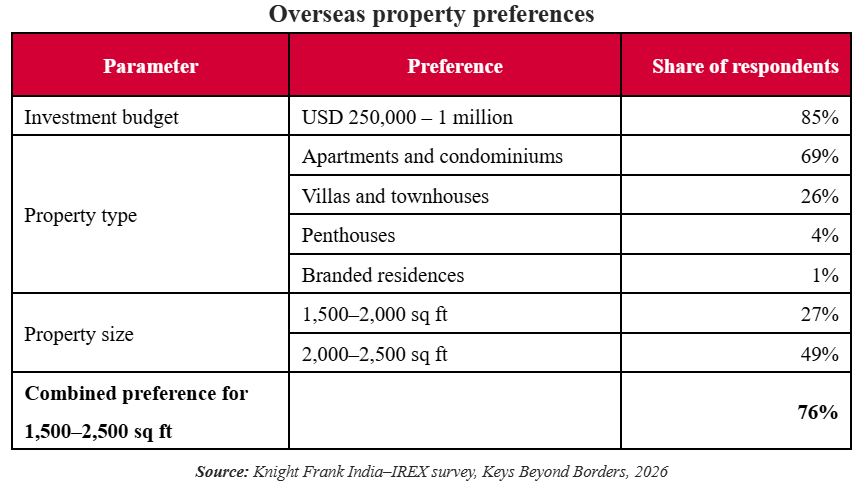
Most respondents are looking at properties priced between USD 250,000 and USD 1 million, with 85% putting their budgets in this range. Apartments and condominiums are the clear favourites, accounting for 69% of preferences. Villas and townhouses follow at 26%. Penthouses and branded residences find few takers, at 4% and 1%, respectively.
The preferred size is also fairly clear. About 76% of respondents are considering homes measuring 1,500–2,500 sq ft. Nearly half (49%) want a property in the 2,000–2,500 sq ft range, while 27% are looking at homes of 1,500–2,000 sq ft.
For those considering a property abroad, the decision will go beyond the price and size of the home. The location, the intended use of the property and the purpose of the investment will also matter.
Overseas property remittances rise 64% in FY2025–26
Indians sent USD 528.70 million abroad to buy immovable property in FY2025–26, up 64% from USD 322.82 million in the previous financial year. The rise is notable because overall outward remittances under the Liberalised Remittance Scheme (LRS) fell by around 2% during the same period.
In other words, while total remittances edged down, the amount sent specifically for overseas property purchases went up sharply.
Property-related remittances accounted for around 1.8% of total LRS outflows. Although overseas property purchases remain a relatively small component of overall outward remittances, the annual increase provides additional context for the survey findings on interest in international real estate.
Other markets such as Georgia, Cyprus, Malta and Latvia are also attracting interest from buyers exploring overseas property opportunities. Residency programmes may influence interest in some of these markets, alongside investment potential, lifestyle preferences and other market-specific considerations.