

Indian stocks get cheaper, but earnings must deliver: Bajaj AMC
Indian equity valuations have fallen from their September 2024 highs, while earnings and credit growth are gaining ground. However, high crude oil prices and global uncertainties could keep markets volatile.

Q1FY27 earnings growth strengthened across market-cap segments. Large-cap earnings growth rose to 23% from 10% in Q4FY26, while mid-cap earnings grew 23%. (AI Image)
The Indian stock market is less expensive than it was two years ago, but that does not necessarily mean the worst of the volatility is over. Bajaj Asset Management Limited’s latest analysis shows that valuations have fallen since September 2024. Earnings and credit growth, meanwhile, are picking up. Much will depend on how companies perform in the coming quarters, especially if high crude oil prices and global uncertainties continue to weigh on markets.
Valuations have come down, but the earnings test remains
Investors were willing to pay a much higher price for Indian stocks in September 2024 than they are today. The Nifty 50’s 12-month forward price-to-earnings (P/E) ratio has fallen from 24.8 times to 17.2 times in September 2026, a decline of 31%.
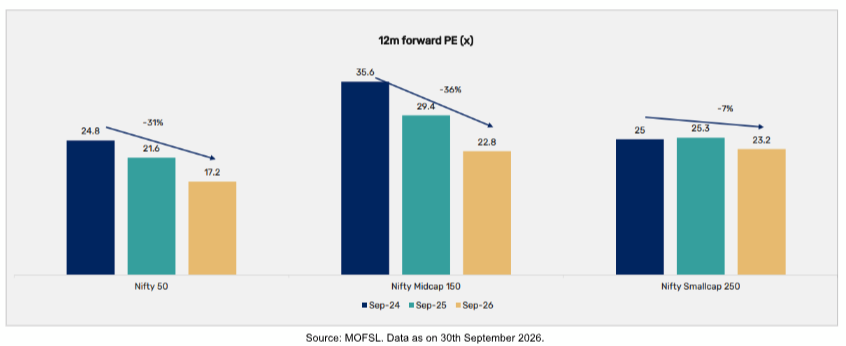
Midcap stocks have seen a bigger correction in valuations. The Nifty Midcap 150’s P/E ratio is down 36%, from 35.6 times to 22.8 times. The decline has been smaller for smallcaps: the Nifty Smallcap 250’s multiple has slipped from 25 times to 23.2 times, a fall of 7%.
The change is also visible in the market’s value relative to the size of the economy. India’s market capitalisation-to-GDP ratio is estimated at 122% for FY27, below its September 2024 high of 150%. Yet earnings delivery remains crucial for market performance.
“Valuation multiples have eased from recent highs, but the market capitalisation-to-GDP ratio remains elevated. Sustained earnings growth will be important for market performance ahead,” said Sorbh Gupta, Head – Equity, Bajaj AMC.
The gap between prices and earnings expectations is also notable: the Nifty 50 was down 8.09% year-on-year in September 2026, even as its forward 12-month earnings per share (EPS) estimate rose 9.62%.
Corporate earnings gain momentum
Q1FY27 earnings growth strengthened across market-cap segments. Large-cap earnings growth rose to 23% from 10% in Q4FY26, while mid-cap earnings grew 23%. Nifty 50 profits increased 19% year-on-year, with commodity and telecom companies contributing around 60% of incremental profits.
Bajaj AMC’s estimates point to BSE 500 earnings growth of 17% in FY27 and 16% in FY28. For FY27, growth is estimated at 16% for large caps, 19% for mid-caps and 28% for small caps. These are forecasts, not assured outcomes.
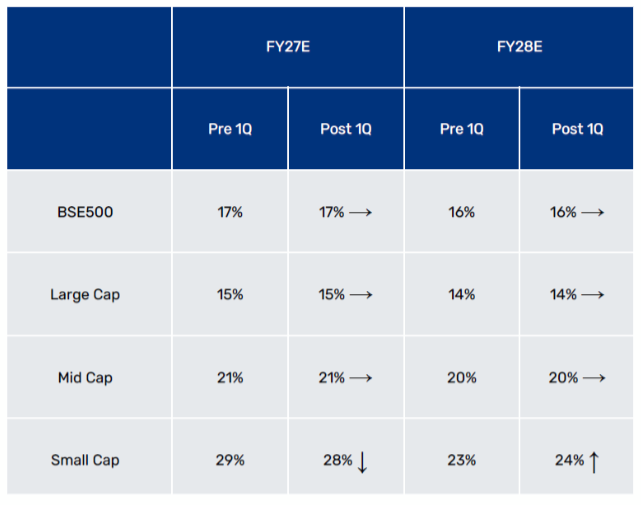
Source: Avendus Spark. Data pertaining to Q1FY27 released in August 2026 as per the latest available. E stands for Estimates.
Credit growth picks up pace
Credit growth is broadening, led by corporate and SME lending. Infrastructure financing is supporting demand from large industries. Banks have reported improving loan growth and stable asset quality, while non-banking finance companies have benefited from lower funding costs and healthy lending activity.
Life insurers also recorded growth in the value of new business, particularly in traditional products.
“Improving credit growth and valuations support the banking outlook. Banks where loans reprice faster than deposits may be better positioned,” said Gupta.
Sector outlook: Selectivity remains key
Bajaj AMC identifies sector-specific drivers and risks rather than a uniform market opportunity:
* Banking and financial services: Credit growth and asset quality remain supportive; margins need monitoring.
* Healthcare: Hospitals, diagnostics, wellness and contract research and manufacturing services benefit from long-term demand trends.
* Power and power equipment: Government capex, grid expansion, and sustainable-energy investment support demand.
* Automobiles: Volumes and affordability have improved, while raw material and currency costs may pressure margins.
* Consumer staples: Volume growth has improved, but pricing power and cost control remain important.
* Information technology: Subdued demand visibility, global policy uncertainty, and potential AI-led disruption warrant caution.
* Pharmaceuticals: Domestic formulations and contract manufacturing remain supportive; US generics face tariff-related risks.
* Metals, oil and gas, and utilities: Commodity prices, crude-related margin pressure and electricity demand are key earnings drivers.
Outlook: Earnings delivery in focus
Geopolitical tensions, crude oil prices, US interest rates, rupee movements and foreign portfolio flows may keep near-term volatility elevated. Bajaj AMC remains focused on earnings visibility and valuations when assessing sector opportunities.
“Easing valuations and improving earnings offer a more supportive market backdrop, but global risks remain. Our focus is on selective opportunities, disciplined valuations and sustainable earnings growth,” concluded Gupta.