

India’s tourism story moves beyond leisure to spiritual, MICE, wellness and wildlife
India’s improving connectivity is bringing more destinations into travel circuits, while rising demand for spiritual, MICE, wellness, cruise, rural and wildlife tourism is creating new opportunities for hotels, resorts and tourism-linked infrastructure.
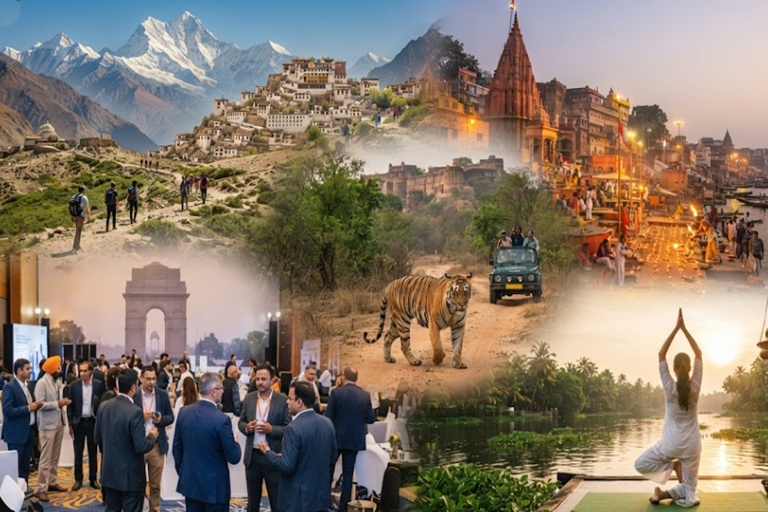
Beyond Leisure: New Tourism Segments Create Fresh Demand For Hotels, Resorts And Travel Infrastructure. (AI Image)
India’s tourism sector is being influenced by two simultaneous shifts: a connectivity build-out that is bringing destinations into wider travel circuits, and a broadening of demand beyond leisure and heritage travel, according to CBRE South Asia Pvt Ltd’s latest report titled “Reimagining Indian Tourism: Unlocking the Next Wave of Growth”, released at the ASSOCHAM National Tourism Conclave in New Delhi on Wednesday. CBRE South Asia Pvt. Ltd. was the Knowledge Partner at the conclave.
The report was released by Gajendra Singh Shekhawat, Minister for Tourism and Culture, Government of India, in the presence of Dr Arvind Kumar Sharma, Hon’ble Minister for Co-operation, Jails, Elections, Heritage & Tourism, Government of Haryana; Shri Saurabh Sanyal, Secretary General, ASSOCHAM; Shri Anshuman Magazine, Chairman & CEO, India, South-East Asia, Middle East & Africa, CBRE; and Shri Nirmal Kumar Minda, President, ASSOCHAM.
The report notes that India’s expressway network has begun functioning as a set of tourism corridors. The Delhi-Mumbai Expressway now connects Jaipur, Ranthambore, Sariska and Ahmedabad along a single heritage and wildlife corridor; the Samruddhi Mahamarg links Shirdi, Nashik, Trimbakeshwar and the Ajanta and Ellora caves; the Bundelkhand Expressway brings Khajuraho, Orchha, Chitrakoot and Jhansi into one circuit.
Upcoming corridors, including the Char Dham Mahamarg, Shaktipeeth Expressway and Somnath-Dwarka Expressway, are set to create further multi-destination itineraries.
Rail and alternative transport are extending this shift. Dedicated tourism circuits, luxury heritage journeys and panoramic coaches have added a distinct tourism dimension to rail travel, while the strongest growth in high-speed rail has been concentrated along pilgrimage corridors. Improved access to Kashmir and the Northeast is opening up leisure and cultural markets previously constrained by travel time.
Ropeways and river cruise circuits are emerging as mobility options in hill, riverine and island destinations where conventional infrastructure is limited.
The report further notes that demand has broadened into segments with materially different real estate requirements. The tourism story is no longer just about people visiting a place and staying in a hotel. Around pilgrimage centres, for instance, the increase in visitors is creating business for hotels, transport operators, shops and restaurants. At the same time, travellers are increasingly willing to pay for a better experience, giving premium hotels and experiential stays more room to grow.
The same is happening in other segments. MICE events and destination weddings are creating demand for convention centres, hotels and event venues in cities that were not traditionally major tourism markets. Wellness and medical travel are opening up another set of opportunities, from resorts and retreats to hotels located close to large hospitals.
Cruise tourism is likely to have a similar spillover effect. As more passengers pass through ports, there is scope for hotels, restaurants and shops to come up around these terminals. Rural tourism is taking a different route. Much of the demand is being met through existing homes and small accommodation providers rather than large hotel projects. This keeps the initial investment relatively low, but also makes the segment more scattered and less organised.
Wildlife tourism remains a smaller market, but the limited availability of land and restrictions around protected areas can work in favour of operators that are already present. Branded hotel companies are increasingly looking at destinations such as Ranthambore and Satpura, where demand for quality stays is rising but supply cannot expand freely.
There are signs that this wider spread of tourism demand is already showing up in hotel numbers. Occupancy in India’s organised hotel market rose to 64.1% in 2025, from 42% in 2021. Room rates have also gone up, helping RevPAR move above pre-pandemic levels.
Importantly, the recovery is not limited to the big business centres. Leisure destinations such as Goa and Jaipur continue to see healthy occupancy, at 75-80% and 62-67%, respectively. Bengaluru, meanwhile, recorded RevPAR growth of 20-25% year-on-year.
India’s hotel market is also becoming broader at the other end of the price spectrum. Economy, upper-midscale and midscale properties together account for nearly 60% of branded hotel rooms. That reflects the fact that India’s tourism growth is not being driven only by luxury travellers.
Uttar Pradesh offers a good example of this change. The state’s branded hotel inventory has grown 18% since 2021, while the share of midscale hotels has risen from 15% to 19%. As tourism spreads to more destinations, this middle segment could become increasingly important in meeting demand.
Gajendra Singh Shekhawat, Minister for Tourism and Culture, Government of India, said, “Tourism is emerging as an important driver of economic growth and employment, with the potential to play a much larger role in India’s journey towards Viksit Bharat 2047. As the economy grows and connectivity improves through highways, airports, railways and new transport corridors, the demand for tourism and travel experiences will also expand significantly. This will require greater investment and stronger participation from the private sector. The next phase of tourism growth will require us to look beyond increasing tourist numbers and focus on building new destinations, creating new experiences and improving destination management. The quality of the visitor experience is critical, and this requires investment in infrastructure, hospitality and human resource development across the tourism ecosystem. Technology will also be central to improving the tourism experience, from destination discovery and parking to feedback and visitor services. The government has been working with technology companies, airlines and other platforms to strengthen this ecosystem, but greater private-sector participation and partnerships will be important. With the right combination of policy support, technology and investment, tourism can create significant opportunities for businesses, communities and the wider economy.”
Anshuman Magazine, Chairman and CEO, India, South-East Asia, Middle East and Africa, CBRE, said, “Connectivity has done a lot of the heavy lifting. Expressways, new rail routes and regional airports have put destinations within reach that weren’t five years ago. The harder part sits at the destination itself — rooms, trained people, and the kind of assets each type of traveller actually needs. But we expect the sector to continue growing with new segments becoming increasingly important.”
Nirmal K. Minda, President, ASSOCHAM, said, “India’s tourism sector is at a defining juncture, evolving beyond leisure into a powerful engine of economic growth, employment, investment and regional development. As we move towards Viksit Bharat 2047, we must build a tourism ecosystem that is globally competitive, inclusive and sustainable. The ASSOCHAM-CBRE report highlights how improved connectivity and emerging segments such as spiritual, MICE, wellness, cruise, rural and wildlife tourism are opening new avenues for growth and investment. To unlock this potential, we must focus on five pillars – Make in India, Ease of Doing Business, MSME growth, the Digital Economy and Sustainability. Through this Conclave, ASSOCHAM seeks to bring government and industry together to translate these opportunities into actionable policy and investment roadmaps, strengthening India’s journey towards a $1 trillion tourism economy.”