

India’s next 100 million investors could come from smaller cities, young households: EY Report
India could add more than 100 million long-term investors by 2035, with a large part of this growth coming from smaller cities, women, young professionals and digitally connected households.

EY estimates that individual mutual fund AUM could exceed $3 trillion by 2035, while individual direct equity holdings could reach $2.5 trillion-$3 trillion. (AI Image)
For years, the typical Indian household’s financial strategy was relatively straightforward: earn, save and keep a large part of the money in bank deposits, insurance and other traditional instruments. That approach is gradually changing as rising incomes, digital access and greater familiarity with markets give households more room to think about long-term wealth creation.
India could add more than 100 million long-term investors by 2035, with a large part of this growth coming from smaller cities, women, young professionals and digitally connected households, according to EY India’s latest report, Wealth Inclusion in India: Expanding Investor Participation Beyond Metros.
The shift is already visible in household finances. Investable household assets rose to nearly $5.2 trillion in FY25, with their share of total household assets increasing to around 34-35% from 28% in FY15. At the same time, individual investors now account for 18.7% of the Indian equity market through direct equity holdings and mutual fund investments — the highest level in more than two decades, according to EY.
From access to actual investing
India has already built much of the digital infrastructure needed to bring people into the formal financial system. But having a bank account or using digital payments does not necessarily mean that a household is investing for the long term.
EY estimates that India has more than 550 million active UPI users, compared with around 62 million people investing in mutual funds and about 50 million actively participating in equity markets. The gap suggests that a large pool of financially connected consumers has yet to become regular investors.
The next phase, therefore, may be less about opening investment accounts and more about helping people stay invested and make appropriate choices.
“The next one will be about connecting households to wealth creation,” says Pratik Shah, National Financial Services Leader, EY India. He says the next wave is likely to come from smaller cities, women investors, young professionals and emerging affluent households, many of whom need guidance along with access.
Five trends driving India to a wealth inclusion inflection point
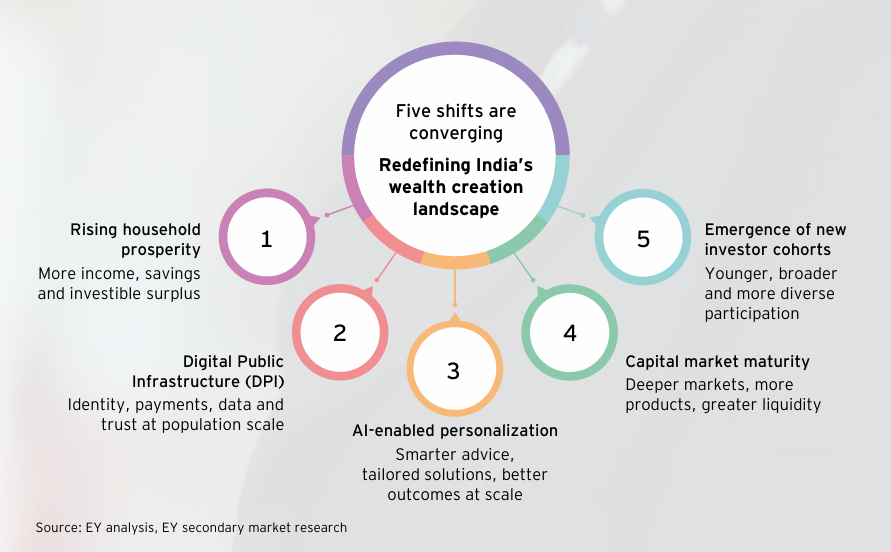
Smaller cities are already making a difference
The investment map is gradually moving beyond the metros. EY says cities beyond the top 110 now contribute 12% of mutual fund assets under management, while districts outside the top 10 account for 70% of NSE-registered investors who traded in FY25.
Age is another important part of the shift. Investors below 30 accounted for 38% of the investor base in June 2026, compared with 23% in FY19. In B30 cities, women accounted for 25% of investors in FY24, up from 20% in FY19.
Systematic investment plans (SIPs) are also helping make market participation more accessible. SIPs now account for 35% of individual mutual fund AUM, compared with 19% in FY19. EY also points to micro-SIPs of around $2.6 and distribution networks covering more than 250,000 rural touchpoints as ways of bringing first-time and underserved investors into the market.
The challenge is no longer just access
For a first-time investor, however, the problem can begin after the account is opened. There are hundreds of funds, stocks and investment products to choose from, while questions about risk, asset allocation and market volatility can make investing intimidating.
This is where EY sees a need for what it calls a “Wealth Stack” — an ecosystem combining digital access, consent-based financial data, AI-enabled intelligence, advice and investor-protection mechanisms.
The idea is to move away from simply selling financial products towards helping households make decisions based on their goals, risk appetite and time horizon. Technology could make such guidance cheaper and more scalable, while human advice would continue to play a role where financial decisions are more complicated.
Vishal Madia, Partner – Wealth and Asset Management, EY India, says the next opportunity is to build the infrastructure for wealth creation by combining digital public infrastructure, consent-based data sharing, AI and scalable advice.
A much bigger investment pool ahead
EY estimates that individual mutual fund AUM could exceed $3 trillion by 2035, while individual direct equity holdings could reach $2.5 trillion-$3 trillion. The report also sees more than 100 million additional long-term investors potentially entering the market over the next decade.
But the success of this transition may not be measured simply by the number of demat accounts or the amount of money flowing into mutual funds. For households, the more meaningful outcome would be whether they remain invested through market cycles, diversify appropriately and build enough financial resilience to meet long-term goals.
India has already made significant progress in making financial services accessible. The next challenge is making long-term investing simple enough, understandable enough and trusted enough for that access to translate into lasting household wealth.